


Pair Art Deco Bookends
Pair art deco bookends bring sculptural form to a shelf, balancing heavy volumes with bronze, marble and carved wood.
Pair Art Deco Bookends
Pair art deco bookends combine functional shelf weights with the distinct modernist and geometric aesthetics of the interwar decades. Most examples on this page date from the 1920s and 1930s, emerging from French and British workshops during the height of the movement.
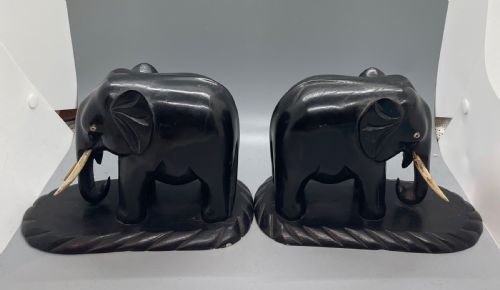
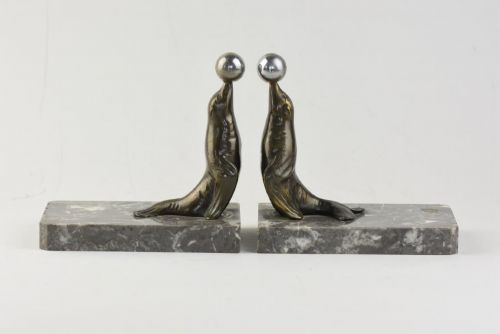
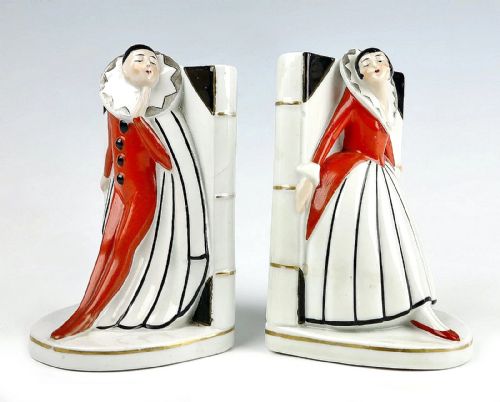
The subjects range from abstract architectural blocks to naturalistic animals and human figures. Sculptural motifs frequently depict dogs such as Scottish terriers and greyhounds, alongside elephants, birds and dancers mounted on stone bases.
How they were made
Foundry workers cast metals like bronze, brass, chrome and spelter, often finishing surfaces with silvering, gilding or cold painting. These metal figures were then mounted onto heavy foundational bases of marble, alabaster or onyx to provide the necessary weight.
Woodworkers utilised hardwoods such as oak, ebony and bamboo, shaping them into sports themes or animal forms. Ceramicists and glassmakers employed moulded kiln techniques to produce figural pairs from potteries and glassworks.
Dogs dominate the menagerie, with Scottish terriers, greyhounds and bulldogs holding up the library.
What varies in quality
Substantial stone bases with polished edges and well-integrated fixings separate standard utility pieces from high sculptural examples. The fidelity of the modelling in animal and human figures dictates the overall presence of the object.
C Omin·V Ramirez·Compton Potters Art Guild·Karl Hagenauer·Bagley and Co·Dan Karner·H Moreau·Gual·Lorenzl·Max Le Verrier·Salvado
The Pair Art Deco Bookends Glossary
- Spelter
- A zinc alloy commonly utilised as a less costly alternative to bronze for decorative figures. It takes patination and paint well, though it remains softer than true bronze.
- Cold painted
- A method where enamel or oil paint is applied to a bronze or metal object without subsequent kiln firing. This technique provides vibrant colour to animal and figural details.
- Alabaster
- A fine-grained, translucent stone often used for the heavy bases of bookends. Its natural veining offers a softer appearance than harder marbles.
- Patina
- The surface sheen or coloration developed through age or chemical treatment on metals and wood. It reveals the handling history and oxidation of the material.
- Cire perdue
- The lost wax casting method used for bronze sculptures. It allows for intricate detail and complex undercut forms in figural subjects.
Pair Art Deco Bookends: Frequently Asked Questions
Are these heavy enough for large books?
The combination of metal sculptures and dense stone bases provides substantial weight for holding standard library volumes upright. Pieces featuring solid marble or bronze components offer the greatest resistance against sliding.
Lighter wooden or ceramic versions suit smaller collections of novels and paperbacks. Check the overall mass if supporting heavy art monographs.
How do I identify the period?
Examine the materials, casting signatures and stylistic traits typical of the interwar decades. The presence of chrome, spelter, stylized animal forms and marble bases generally points towards production between the wars.
Signatures cast into the metal or incised into the stone often link the piece to specific European foundries or designers active in the period.
Can I separate a matched pair?
Splitting a matched pair compromises their decorative function and aesthetic balance on a shelf. These objects are designed as symmetrical counterparts to frame a collection of volumes.
Keeping them together preserves their historical integrity as a matched set. Individual bookends lose their visual interplay when separated from their counterpart.