

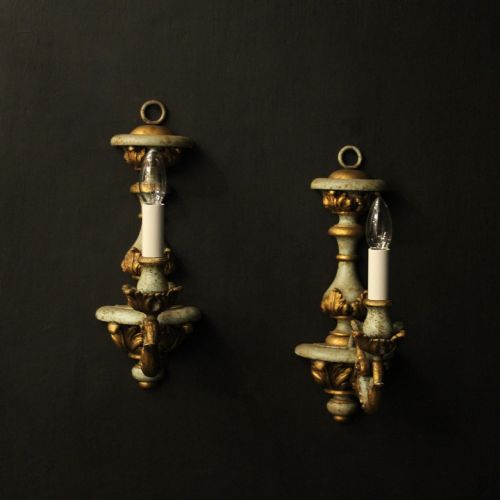


Painted Wood Brackets
These painted wood brackets bring architectural presence to a room, offering sturdy support for display while adding period character to your walls.
Painted Wood Brackets
When you search for painted wood brackets, you encounter items designed to support shelves, lights, or decorative objects upon walls. These pieces emerge from various eras, including the eighteenth and nineteenth centuries, spanning distinct aesthetic movements.
The selections on this page encompass Italian polychrome wall lights, French wall consoles, and architectural elements from Indian roof decorations. Such diversity means buyers find both functional shelf supports and purely decorative architectural fragments.
Origin styles range from Georgian and Neoclassical to Italian Baroque, Victorian Italianate, and traditional Indian. This variety allows collectors to match specific interior design schemes with authentic period hardware.
How they were made
Carved wood forms the structural base of these pieces, shaped by hand into intricate scrolls, brackets, and architectural motifs. Artisans applied gesso over the wooden foundation to create smooth surfaces suitable for fine detail work.
Decoration relied heavily on paint, giltwood, and polychrome finishes to enhance visual depth. Some examples feature faux tortoiseshell treatments or green Chinoiserie details, reflecting the decorative tastes of their respective periods.
Painted Wood Brackets Retail Price Guide 2026
Typical asking prices for painted wood brackets among the pieces listed under this phrase on Sellingantiques today, from the lower quarter to the upper quarter. They describe what is for sale here now, not the wider market.
Listings span the eighteenth century to 1930, featuring materials such as carved wood, gesso, paint, and giltwood.
What varies in quality
Quality rests in the precision of the carving and the depth of the painted surface. Superior examples display crisp architectural moulding and harmonious polychrome schemes rather than flat, uniform colour.
The integrity of the underlying carved wood and the preservation of original paint layers determine the standing of a piece. Finer items retain their early gilding and gesso work with minimal later interference.
The Painted Wood Brackets Glossary
- Polychrome
- Decorated in multiple colours. This technique appears frequently on Italian wall lights and brackets from the nineteenth and early twentieth centuries.
- Giltwood
- Wood carved and then covered with gold leaf or a gold-coloured finish. It adds reflective warmth to architectural wall fixtures.
- Gesso
- A plaster mixture applied to wood as a base for paint and gilding. It allows artisans to carve fine details before adding colour.
- Console
- A table or bracket supported by wall-fixed brackets rather than independent legs. French examples often showcase elaborate scrollwork.
- Chinoiserie
- European artistic style reflecting Chinese motifs. This aesthetic influences the painted decoration on specific mantel clocks and associated items.
Painted Wood Brackets: Frequently Asked Questions
How do I mount a wall bracket?
Wall brackets require secure fixing into solid masonry or wall studs to bear weight safely. Proper hardware chosen for the weight of the wood ensures stability.
Positioning depends on whether the bracket supports an object like a clock or serves as a standalone architectural feature.
What periods do these brackets come from?
The listings include pieces spanning from the eighteenth century through the nineteenth century and into the early twentieth century. Each era brings distinct carving depths and paint styles.
Georgian and Neoclassical designs differ noticeably from Victorian Italianate or later twentieth-century interpretations.
Can these brackets hold heavy items?
Capacity depends entirely on the size, construction, and structural integrity of the individual wooden bracket. Solid carved timber offers robust support for lighter display objects.
Heavier items require careful assessment of both the bracket's mounting points and the wall substrate.
How should I clean painted wood?
Dusting gently with a dry, soft cloth preserves delicate painted and gilt surfaces. Moisture and chemical cleaners damage historic gesso and paint layers.
Maintenance focuses on protecting the original finish from abrasion and direct sunlight.