
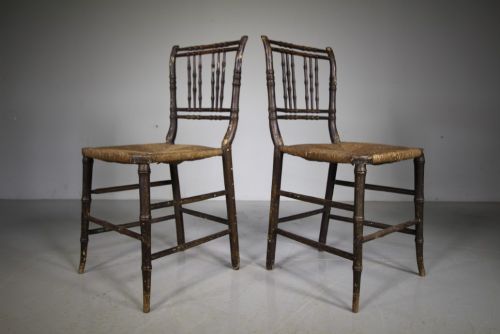
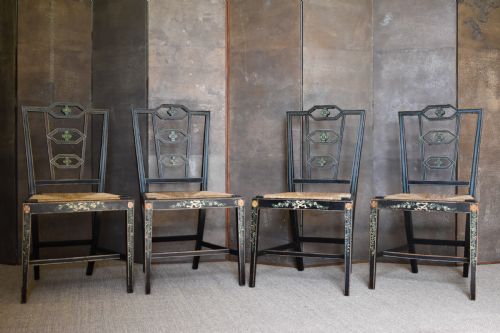


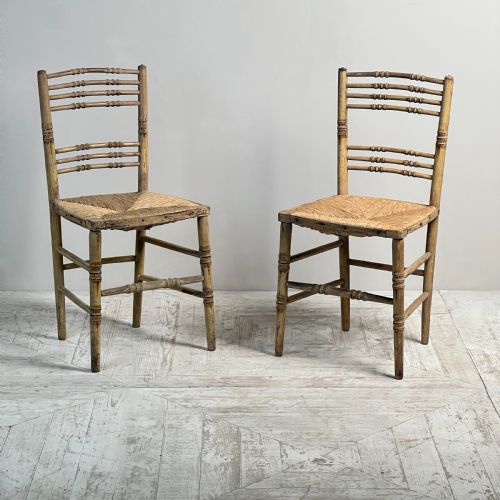
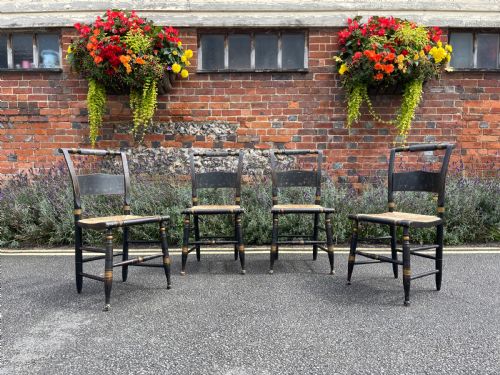


Painted Rush Seated Chair
These painted rush seated chair examples offer practical seating with traditional woven seats and decorative painted finishes, prized for their regional character and historic charm.
Painted Rush Seated Chair
A painted rush seated chair combines a sturdy wooden frame finished with paint or pigment and a woven rush or plaited straw seat. Buyers search for these pieces to add texture and historic character to rustic interiors or country house dining spaces.
Makers ranged from local rural workshops producing Cheshire ladder backs and Irish country variants to larger firms like Morris and Co producing Sussex chairs. Surviving pieces demonstrate how ordinary domestic seating was elevated through decorative paint and turned wooden components.
Materials and construction methods
Frames are constructed from native timbers including pine, ash, beech, and birch, selected for strength and turned on lathes to form spindles and legs. Some models emulate exotic materials through detailed decorative painting, such as faux bamboo finishes applied to wood.
Seats are tightly woven from natural rush or plaited straw, known locally as súgán in Irish examples, wrapped around internal wooden rails to provide a resilient and flexible surface. Original painted surfaces often survive beneath later overpainting, preserving early decorative schemes.
Listings feature ash, pine, beech, and bamboo frames finished with paint, paired with traditional rush or plaited straw seats across multiple historical periods.
Distinguishing quality across periods
Quality rests in the survival of original painted surfaces and the tightness of the rush weaving across the seat. Finer examples retain their early pigment and decorative detailing rather than stripped or heavily restored wooden frames.
Structural integrity of the turned spindles and the neatness of the rush plaiting separate standard vernacular work from more refined Regency or Arts and Crafts production. The presence of documented workshop origins adds distinction to an individual chair.
Morris and Co
The Painted Rush Seated Chair Glossary
- Rush seat
- A woven seating surface made from dried marsh rushes twisted into cords. This traditional method provides a flexible and durable pad for domestic chairs.
- Faux bamboo
- A decorative treatment where wood is carved, turned, and painted to imitate real bamboo stems. This style gained popularity during the Regency period.
- Ladder back
- A chair back featuring multiple horizontal wooden rails between the upright posts. This traditional vernacular form appears frequently in regional country seating.
- Súgán
- An Irish term for a twisted straw rope used to form traditional woven chair seats. These seats offer a distinct texture compared to standard marsh rush.
Painted Rush Seated Chair: Frequently Asked Questions
Are these chairs suitable for daily use?
Most antique examples remain sturdy enough for normal sitting when placed on even floors and handled with reasonable care.
Lighter frames like faux bamboo side chairs function best as occasional seating rather than heavy dining room use.
How can I identify original paint?
Original painted surfaces show natural wear patterns, craquelure, and microscopic traces of early pigment layers beneath any later decorative touch-ups.
Modern repainting often feels uniform and lacks the subtle depth accumulated through decades of domestic use.
What is the difference between rush and súgán?
Rush seats are woven from marsh rushes twisted into fine cords, yielding a smooth and tight surface common in English vernacular chairs.
Súgán refers specifically to plaited straw or hay ropes used in Irish country chairs, creating a coarser and more robust texture.