
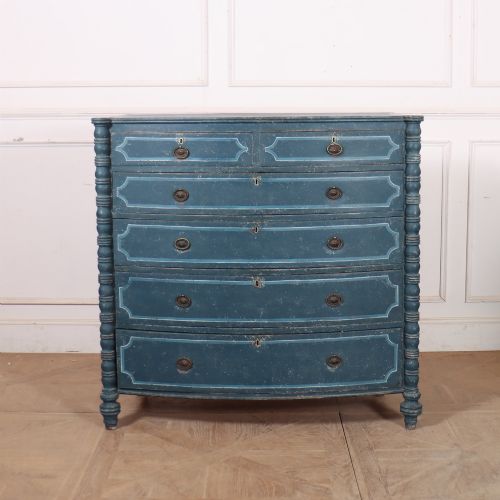
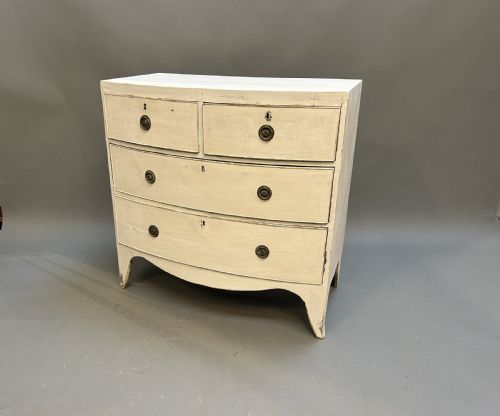


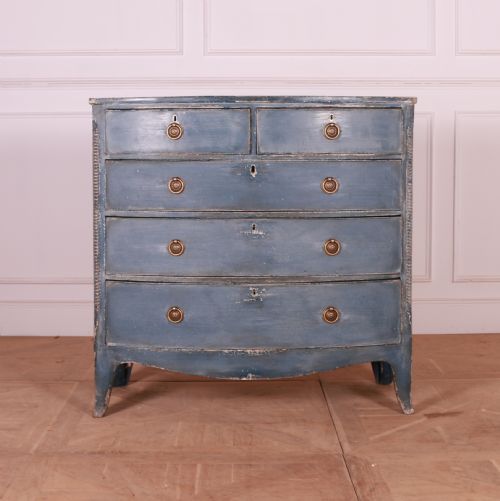
Painted Bowfront Chest
A painted bowfront chest brings curving form and colourful surface together, offering practical storage with a softened silhouette.
Painted Bowfront Chest
A painted bowfront chest provides substantial drawer storage behind a convex curved front that breaks the rigid geometry of standard bedroom furniture. These items appear across the Georgian, Regency, and nineteenth-century periods, alongside later revival pieces.
The most common examples encountered on this page date from the nineteenth century and the Georgian era, constructed as English pieces with distinct painted finishes. Regional interpretations include English country variants and French chateau styles alongside polished or ebonised wood surfaces.
Forms remain consistent to the chest of drawers typology, featuring stacked horizontal drawers housed within a carcase that swells outward at the centre. Smaller variants, including burr walnut examples from the nineteen-thirties, sit alongside larger antique prototypes.
How they were made
Makers constructed these carcases using timber such as walnut, incorporating burr walnut veneers on select surfaces to create natural patterning. Applied paint finishes then altered the visual character of the wood, ranging from plain coats to decorated schemes.
Hardware details relied on brass fittings for drawer pulls and key escutcheons, fixed securely to the curved drawer fronts. The joinery accommodated the convex sweep of the bowfront, requiring careful shaping of both the drawer frames and the external boards.
The listings span pieces from the eighteenth century through to nineteen-thirty, uniting Georgian, Regency, and English country styles under painted wood and burr walnut materials.
What varies in quality
Quality rests upon the refinement of the curved drawer fronts and the precision with which the timber meets the carcase. Superior examples display harmonious proportions where the sweep of the bow remains balanced against the height and depth of the piece.
The application of the paint finish dictates the visual hierarchy, distinguishing simpler utilitarian pieces from high-quality decorated variants. Original or early surfaces carry greater depth and integration with the underlying wood than later interventions.
The Painted Bowfront Chest Glossary
- Bowfront
- A furniture front that curves outward in a convex arc, softening the corners and adding visual volume. This shape distinguishes these chests from flat-fronted equivalents.
- Regency
- A stylistic period spanning the early nineteenth century, known for classical restraint and clean lines. Pieces from this era often incorporate ebonised details.
- Burr walnut
- A wood veneer taken from the wart-like growths of a walnut tree, prized for its swirling grain patterns. It appears on select decorative panels.
- Escutcheon
- A protective plate surrounding a keyhole, commonly cast in brass on these pieces. It serves both a functional and an ornamental purpose on the drawer fronts.
Painted Bowfront Chest: Frequently Asked Questions
Where do I put a bowfront chest?
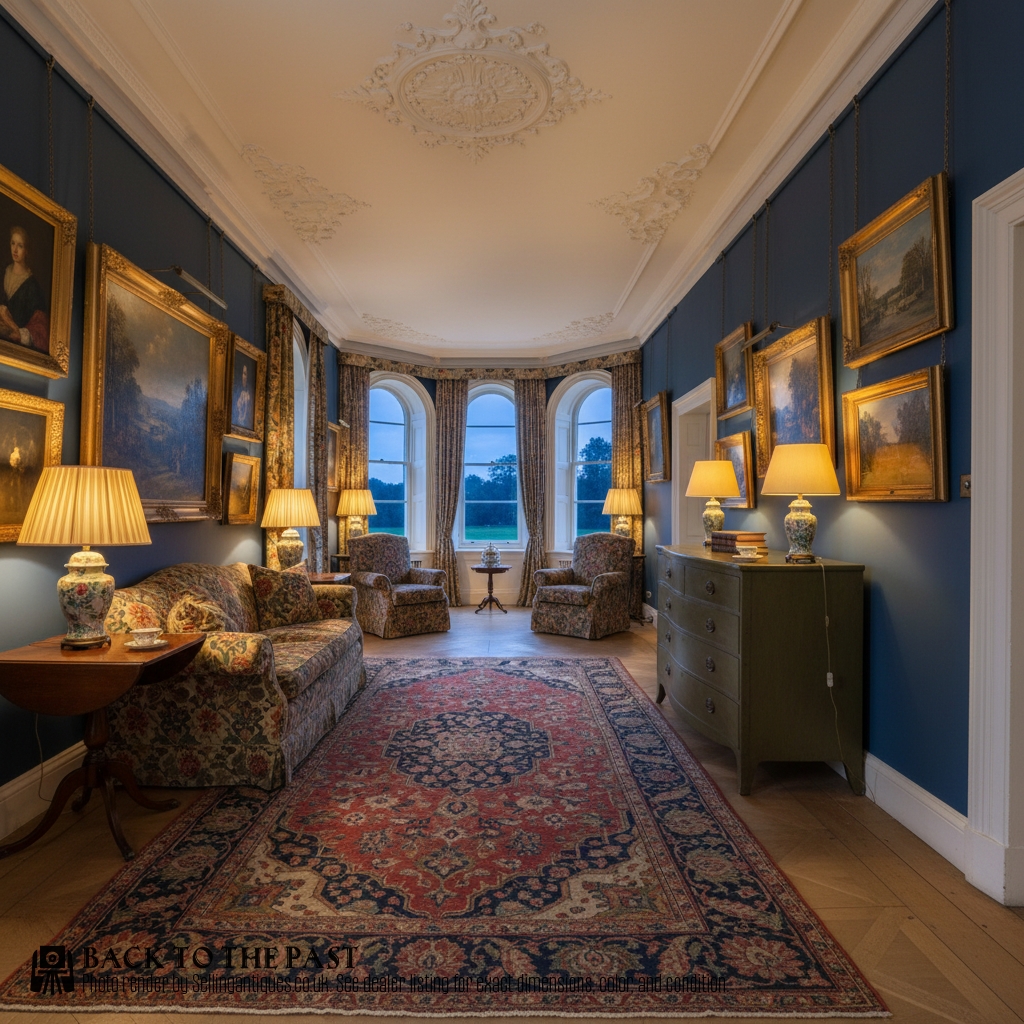
These chests suit bedrooms, hallways, or living spaces where the curved front softens room layouts and provides accessible drawer storage. Their compact footprint allows them to sit against flat walls while offering more internal volume than a straight-fronted cabinet of similar width.
Ensure adequate clearance around the protruding centre curve so the piece sits comfortably within the circulation space of the room.
How do I date a painted chest?
Dating relies on construction methods, timber selection, and stylistic markers such as Georgian proportions or Regency ebonised details. The integration of the paint layer with the underlying wood provides clues regarding the age of the surface finishing.
Comparing the hardware fixings and internal drawer construction against known period examples helps narrow down the decade of manufacture.
Are painted chests difficult to maintain?
Routine care involves dusting with a soft, dry cloth and avoiding excessive moisture or direct sunlight that might compromise the painted surface. Maintaining stable indoor humidity prevents timber movement beneath the paint layer.
Harsh chemical cleaners should be avoided to preserve the integrity of the original or historic decorative finish.
What is the difference between Georgian and Regency styles?
Georgian pieces often display heavier proportions and traditional timber framing, whilst Regency designs favour classical restraint and darker ebonised contrasts. Both periods utilise the curved bowfront shape but interpret decorative detailing differently.
Examining the feet, handle styles, and edge mouldings reveals which design vocabulary the maker followed.