
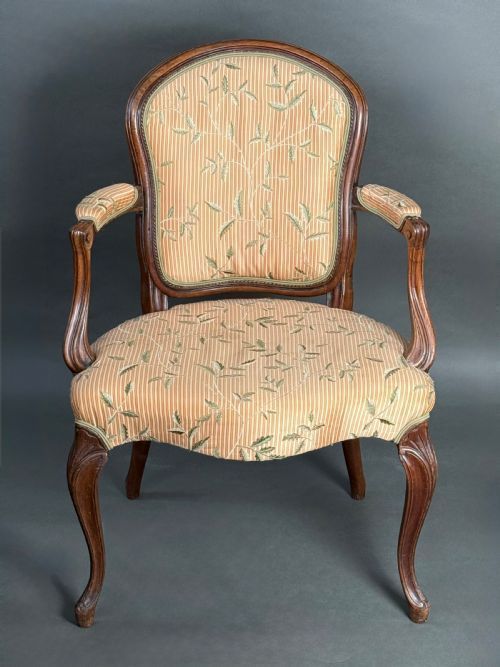
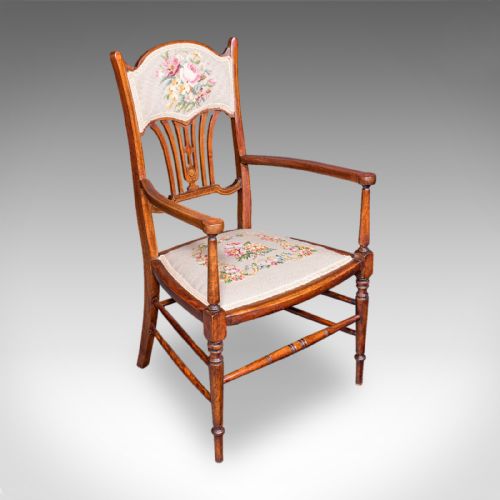


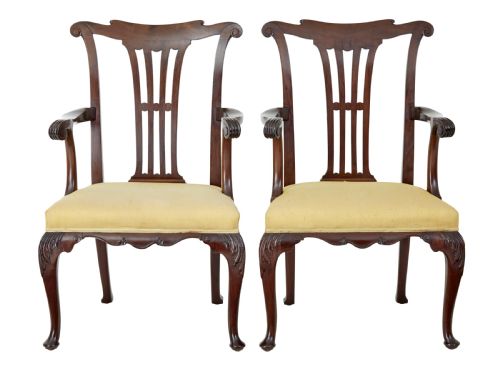


Padded Seat Elbow Chair
A padded seat elbow chair brings both supportive arms and cushioned comfort to a study, drawing room or library.
Padded Seat Elbow Chair
A padded seat elbow chair combines the sturdy support of armrests with upholstered seating, appearing across the seventeenth, eighteenth, nineteenth and early twentieth centuries in forms ranging from study chairs to library armchairs. These pieces emerge in a variety of traditional aesthetics, including Georgian Neoclassical, Queen Anne revival, William IV and French Rococo styles.
Buyers encounter versions shaped from mahogany, walnut and beech, with surfaces finished in leather, silk, velvet, fabric or brass accents. The selection spans formal drawing room seats and study chairs designed for domestic comfort over past centuries.
Materials and construction
Timbers such as mahogany, walnut and beech form the structural frames of these armchairs, providing durable skeletons for both carved and painted surfaces. Cabinetmakers shaped these hardwoods into supportive armrests and upright backs.
Upholstery materials including leather, velvet, silk and standard fabric cover the padded seats, often secured alongside brass details. Frames reflect specific historical periods, from early seventeenth-century construction methods to later revival movements.
Some early study chairs secretly hoped their owners would spend less time sleeping and more time reading.
Assessing quality and craftsmanship
Quality rests in the precision of the timber frame and the integrity of the carving or painted decoration upon the splat back and arms. Finer examples display meticulous attention to historical proportion, whether built during the Georgian period or executed in later revival styles.
The choice of covering material, from plain fabric to silk and leather, influences the character of the piece. Superior construction shows in the seamless integration of the upholstered pad with the structural armrests and legs.
Howard & Sons
The Padded Seat Elbow Chair Glossary
- Elbow chair
- An armchair featuring supportive rests for the arms. These seats offer additional comfort compared to standard dining chairs.
- Splatted back
- A central vertical slat within the backrest of a chair. This element often receives decorative painting or carving.
- Mahogany
- A durable hardwood commonly utilised in cabinetmaking. Its stability makes it suitable for fine frame construction.
- Revival
- A design style that imitates historical aesthetics from earlier centuries. Examples include Sheraton revival and Queen Anne revival forms.
Padded Seat Elbow Chair: Frequently Asked Questions
What is a padded seat elbow chair?
A padded seat elbow chair is an armchair featuring cushioned seating and structural armrests designed for rooms like studies and libraries.
These pieces span multiple historical eras and incorporate various timbers and upholstery materials.
How do I date a wooden armchair?
Dating relies on identifying the prevailing timber species, construction methods and stylistic details associated with periods like the Georgian or Victorian eras.
Revival pieces often replicate earlier centuries, requiring careful observation of decorative motifs and materials.
Where should I place an elbow chair?
These armchairs suit studies, libraries and morning rooms where cushioned armrests provide functional comfort.
Their varied designs allow them to complement both traditional and eclectic interior schemes.
What woods were used for these chairs?
Cabinetmakers frequently utilised mahogany, walnut and beech to construct the frames of these armchairs.
These hardwoods provided the necessary strength for supporting upholstered seats and carved components.