

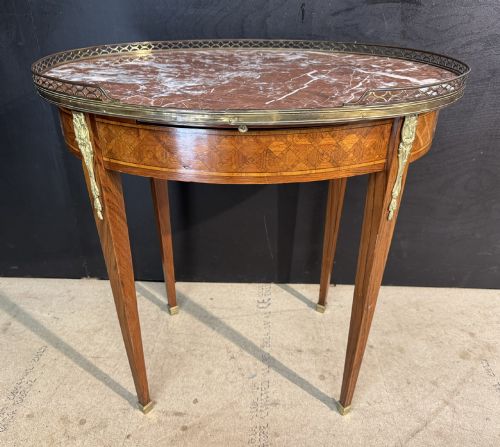
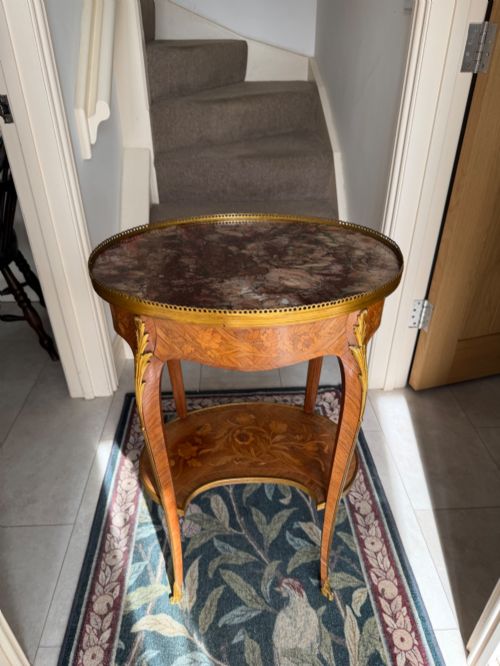
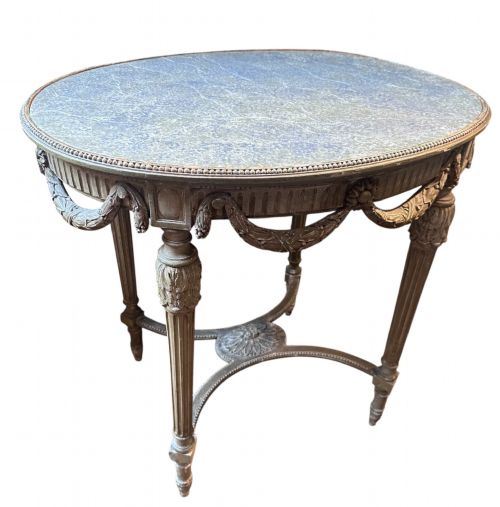


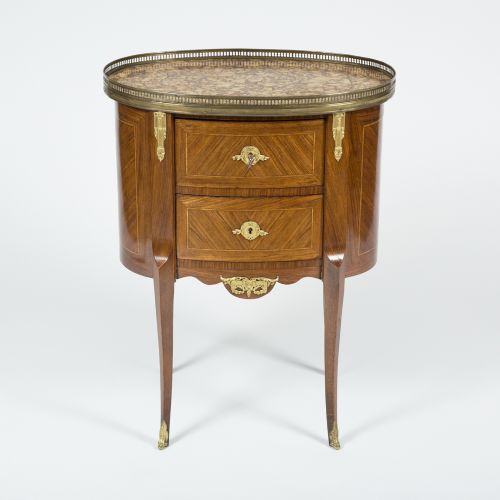


Oval Marble Side Table
An oval marble side table brings a polished continental surface to a corner, most often seen in French nineteenth-century and early twentieth-century designs.
Oval Marble Side Table
An oval marble side table combines a smooth stone top with a supportive wooden or gilt framework, designed primarily for placement beside a bed, chair or in a hallway. When you search for an oval marble side table, you encounter pieces that span from the Victorian era into the early twentieth century, with nineteenth-century French examples appearing most frequently.
These tables take various forms beyond the standard occasional table, including bedside cabinets, commodes, and boudoir cabinets. They often incorporate cabinetry with drawers or cupboards beneath the marble slab, serving both display and storage functions in domestic interiors.
The aesthetic leans heavily towards French provincial and classical revival movements, particularly Louis XVI style. Makers utilised walnut, mahogany, kingwood, and painted finishes to complement the veined stone surfaces inset into the timber frames.
Materials and Construction
Cabinetmakers constructed the main carcase and legs using timbers such as mahogany, kingwood, walnut, and amboyna, frequently employing marquetry or painted wood finishes to enrich the exterior. Ormolu, gilt bronze mounts, and brass detailing are applied to corners, feet, and drawer pulls to accentuate the classical forms.
The defining feature is the inset stone surface, which includes specific varieties like breche d'alep marble, shaped to fit the curved wooden borders precisely. Structural support often relies on tapered legs, sometimes joined by stretchers, to bear the considerable weight of the stone top.
Oval Marble Side Table Retail Price Guide 2026
Typical asking prices for oval marble side table among the pieces listed under this phrase on Sellingantiques today, from the lower quarter to the upper quarter. They describe what is for sale here now, not the wider market.
One recorded pair of bedside tables managed to cram in kingwood, satinwood, tulipwood, and gilt bronze all at once.
Distinctions in Quality
The refinement of the bronze or ormolu mounts separates standard production from exceptional pieces, where chased detailing and fire-gilding display superior craftsmanship. Subtle differences in the timber veneers, such as finely matched kingwood or satinwood grain patterns, indicate the maker's investment of time and material.
The quality of the marble slab itself, including the depth of its natural breciation and the precision of its edge moulding, dictates the overall architectural presence of the table. Stamped signatures from workshops and cabinetmakers further elevate the standing of a piece by confirming its documented origin.
François Linke·P Chorier
The Oval Marble Side Table Glossary
- Ormolu
- Gilded bronze mounts applied to furniture for decorative effect. This technique was widely utilised by French cabinetmakers in the eighteenth and nineteenth centuries.
- Kingwood
- A dense, richly grained tropical timber used extensively for decorative veneers. It appears frequently on nineteenth-century French occasional and bedside furniture.
- Breche d'alep
- A specific multi-coloured quarried marble featuring brecciated patterns of various tones. It provides a robust and decorative surface for tabletops and commodes.
- Louis XVI Style
- A neoclassical design movement characterised by straight lines, symmetry, and classical motifs like fluted legs. It heavily influences many nineteenth-century French tables.
Oval Marble Side Table: Frequently Asked Questions
What rooms suit an oval marble side table?
These tables find a natural home beside a bed or sofa where the stone surface offers resistance to moisture and wear. Their compact footprint also allows them to function as lamp tables in hallways or auxiliary surfaces in sitting rooms.
The curved oval profile prevents sharp corners from jutting into narrow walkways, making them practical for tighter spaces. Their decorative woodwork ensures they integrate easily into period and eclectic interiors alike.
How do I identify a nineteenth-century French example?
Look for construction traits such as oak secondary woods inside drawers, hand-cut dovetails, and the specific use of kingwood or mahogany veneers. The presence of classical motifs like tapered fluted legs points directly to the Louis XVI revival taste popular during that era.
Hardware offers another clue, as cast brass and ormolu mounts from the period display hand-chased finishing rather than modern machine tooling. The marble top is typically thick and sits within a rebated wooden frame designed specifically for the stone.
How should I care for the marble top?
Marble is a porous stone that reacts to acidic substances like wine, citrus, and vinegar, which can etch the polished surface. Wipe spills promptly with a damp cloth and mild soap to preserve the finish.
Avoid using harsh abrasive cleaners or scouring pads that scratch the stone. Periodic application of a specialised stone wax helps maintain the sheen without damaging the material.