


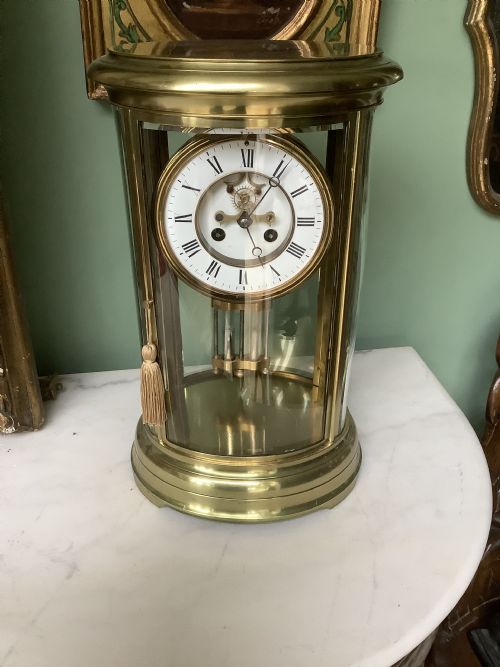
Oval Glass Mantel Clock
An oval glass mantel clock brings weight and precise mechanical movement to a room, catching the light through bevelled panels.
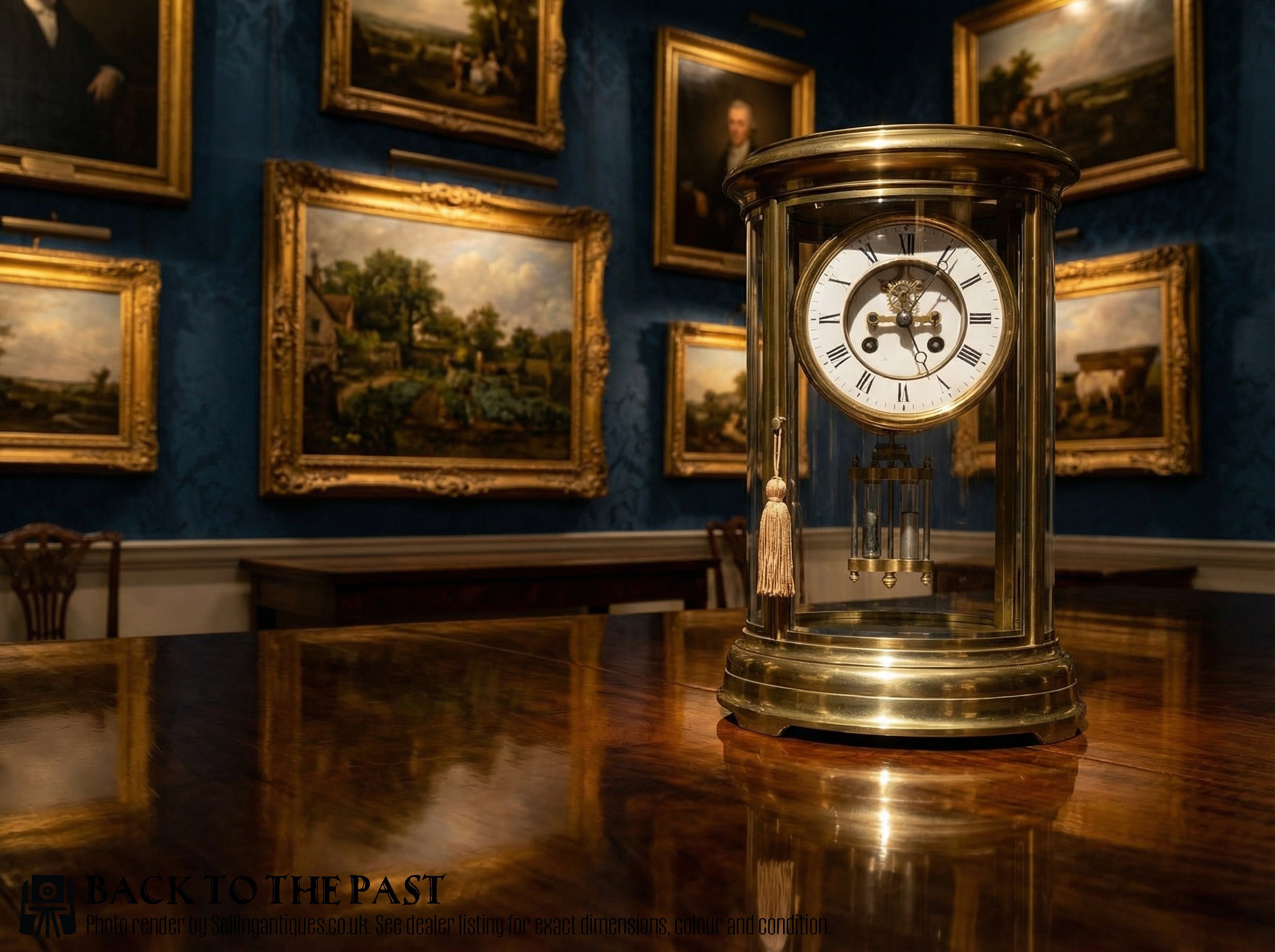
Oval Glass Mantel Clock
An oval glass mantel clock is a heavy domestic timepiece designed to stand on a shelf or mantelpiece, enclosed primarily by transparent panes that reveal the interior mechanism. The pieces seen here span the Victorian, Edwardian, and nineteenth-century periods, capturing an era of domestic refinement and mechanical ambition.
The version most commonly met on this page is the four-glass mantel clock, often French in origin, housing a striking movement visible from all angles. Alongside these stand miniature and standard carriage clocks, offering a more compact interpretation of the same polished brass and glass form.
Materials and construction
These clocks rely on heavy brass and gilt brass frames that support thick glass panels, creating a rigid housing for intricate brass gear trains. Enamel dials, sometimes decorated with additional details like diamontes or cloisonne enamel, provide a clear surface for painted numerals.
French workshops shaped these metals through casting and gilding, while glass was cut and bevelled to fit precise corner pillars. The construction prioritises visibility, allowing the pendulum or escapement to remain in constant view.
Oval Glass Mantel Clock Retail Price Guide 2026
Typical asking prices for oval glass mantel clock among the pieces listed under this phrase on Sellingantiques today, from the lower quarter to the upper quarter. They describe what is for sale here now, not the wider market.
Listings feature French Belle Epoque and Beaux-Arts styles alongside traditional Victorian and Edwardian domestic designs.
Distinctions in quality
Quality in an oval glass mantel clock rests on the crispness of the brass casting and the weight of the frame. Finer examples display heavier gilding, cleanly bevelled glass without distortion, and intricate dial decoration that remains sharp and even.
The distinction also lies in the movement itself, where signed mechanisms by established makers and robust striking trains indicate higher standards of production. Simpler cased pieces with plain dials occupy a more utilitarian tier of the same tradition.
AD MOUGIN
The Oval Glass Mantel Clock Glossary
- Four glass
- A mantel clock design enclosed by glass panels on the front, back, and both sides. This arrangement offers an unobstructed view of the movement from every direction.
- Carriage clock
- A portable spring-driven timepiece originally designed for travel. These typically feature a rectangular or oval brass case with a carrying handle on top.
- Cloisonne enamel
- A decorative technique where metal wire is soldered to a metal base to create compartments, which are then filled with coloured enamel paste and fired.
- Dial
- The face of the clock where the hours and minutes are displayed. On these pieces, dials are frequently made of white enamel with painted Roman or Arabic numerals.
- Striking movement
- A mechanical system within the clock that sounds the hours or half-hours on a bell or gong. It distinguishes active timepieces from simple time-only models.
Oval Glass Mantel Clock: Frequently Asked Questions
How do I wind an oval glass mantel clock?
Most of these mechanical timepieces require a key inserted into the dial to tension the mainsprings. Care must be taken not to over-wind the movement.
Moving the hands should be done strictly according to the specific instructions for the escapement type to avoid damaging the gear train.
Where should I place a four glass clock?
These heavy brass and glass pieces suit stable surfaces like mantelpieces, sideboards, or heavy desks where vibrations are minimal. Placing them away from direct sunlight and dampness protects the delicate enamel and gilding.
Because the movement is visible from all sides, positioning them where light can pass through the glass enhances their visual impact.
How do I tell a Victorian piece from an Edwardian one?
Victorian examples often display heavier brass castings, ornate cloisonne decoration, or larger proportions. They frequently date from the late nineteenth century when four-glass mantel clocks reached peak popularity.
Edwardian pieces tend toward slightly more restrained forms or smaller carriage clock formats, reflecting changing interior tastes around the turn of the twentieth century.
Are these clocks suitable for daily timekeeping?
While these mechanisms were built to keep accurate time in a nineteenth-century home, mechanical antiques benefit from gentle handling and regular professional servicing. They function reliably when properly set up on a level surface.
Daily use is entirely feasible, provided the owner respects the vintage nature of the brass gears and mainsprings.