
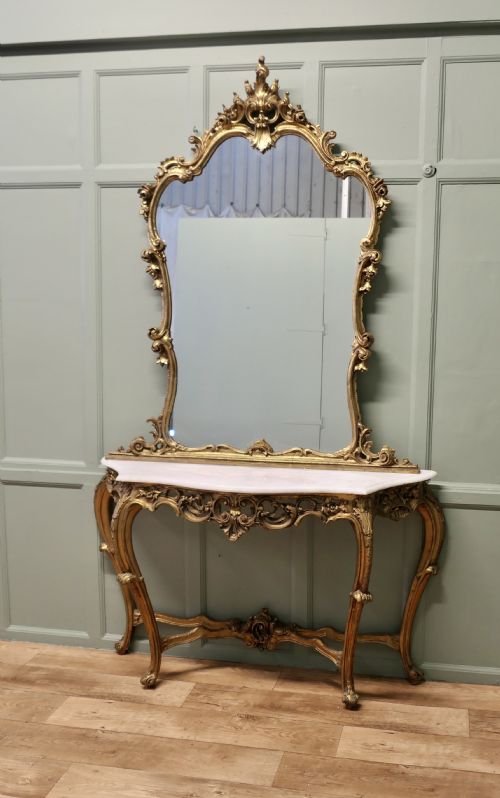
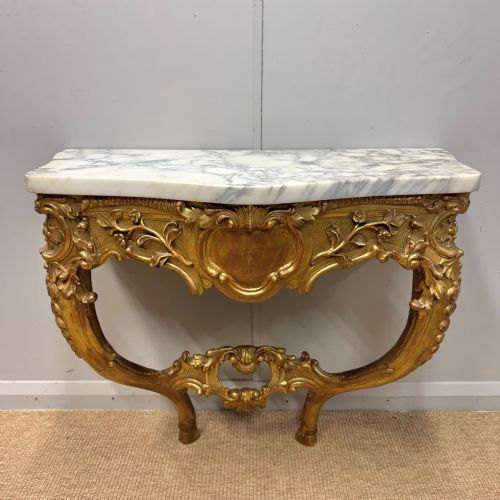
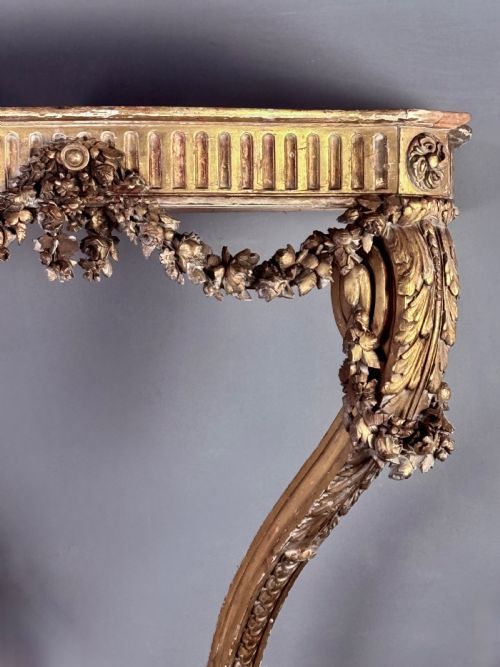
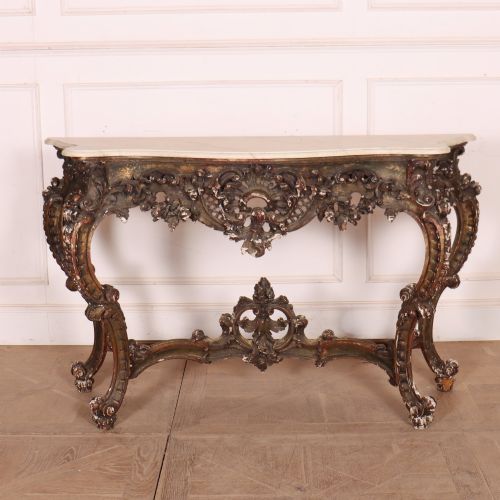
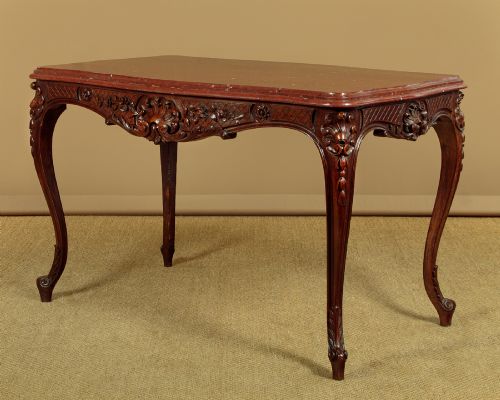
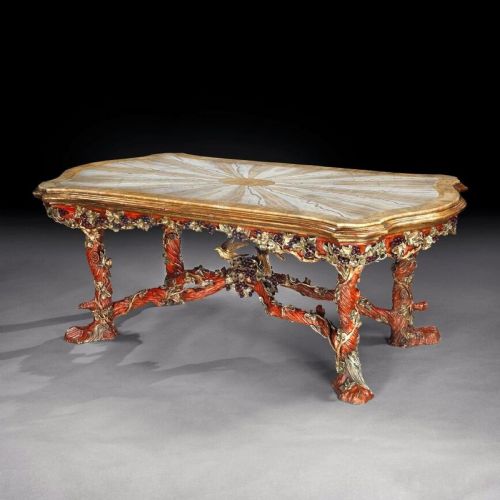
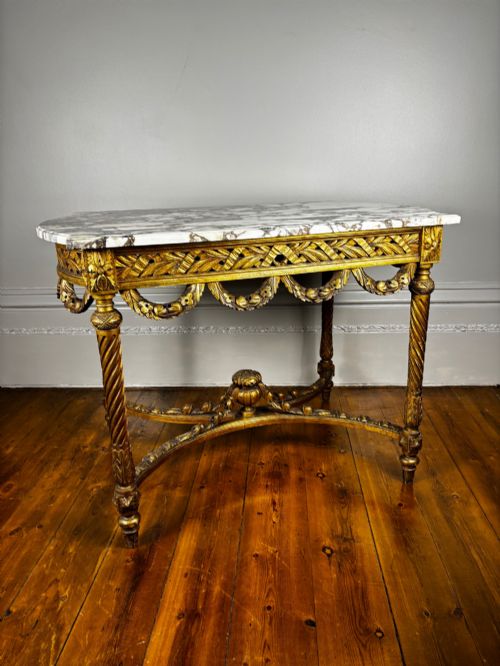
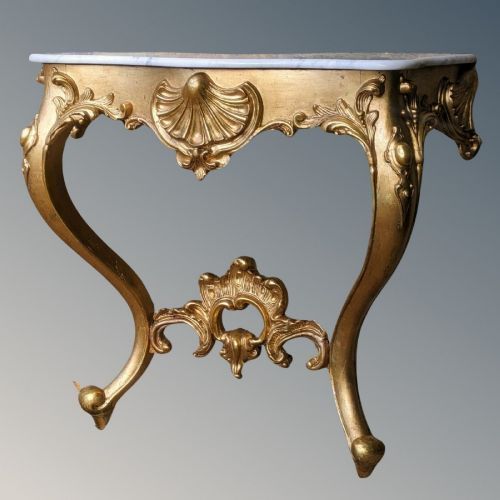
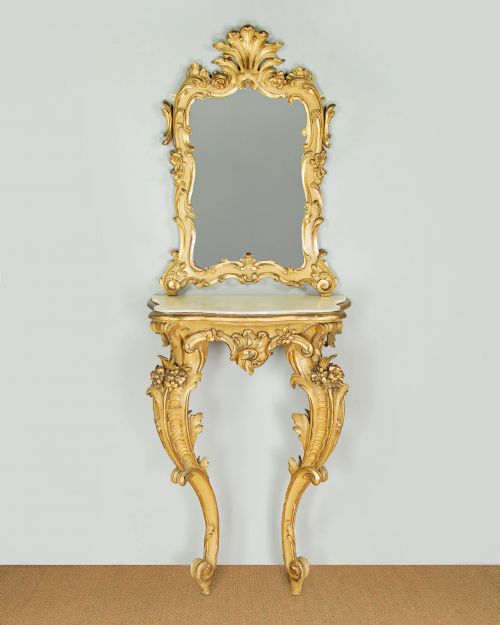


Ornate Marble Console Table
An ornate marble console table brings classical weight and sculptural gilding to a hall, uniting stone and carved wood.
Ornate Marble Console Table
When you search for an ornate marble console table, you encounter heavy stone slabs set upon elaborately carved and gilded frames designed to stand against a wall. These pieces frequently emerge from nineteenth-century French and Italian workshops channeling earlier Rococo and Louis styles. The forms range from serpentine fronts and pier tables to matching console and mirror sets.
Makers of these tables adopted exuberant scrolling, asymmetrical cartouches, and mythological figures to frame substantial marble tops. You will frequently meet giltwood and gesso surfaces paired with white Carrara, rouge, or onyx marble slabs. They serve as grand architectural anchors in reception rooms and entrance halls.
Materials and Craft
Carved wood forms the structural core of these pieces, utilising walnut, oak, and softer timbers shaped into elaborate scrolls and floral motifs. Artisans applied layers of gesso to the carved wooden frames to create a smooth, receptive base for gilding with gold leaf or applying paint.
Heavy marble tops, including Carrara and rouge varieties, were quarried, shaped, and polished to sit flush upon the wooden framework. Metal elements and cast iron appear in specific Victorian and garden variants, while parcel-gilt details highlight individual carved reliefs.
Listings feature marble console tables spanning the eighteenth, nineteenth, and early twentieth centuries, predominantly showcasing French and Italian stylistic revivals.
Assessing Quality
Quality rests upon the depth and crispness of the wood carving, distinguishing hand-chiselled organic detail from soft, moulded gesso ornaments. The articulation of scrolling foliage, putti, and structural supports reveals the hand of a skilled artisan rather than a standard factory output.
The integration between the stone top and its wooden base dictates structural integrity, with superior examples featuring custom-fitted marble slabs that match the exact contours of the frame. The application of gold leaf and the preservation of original polychrome or parcel-gilt surfaces further separate standard decorative items from masterworks.
Felix-Alfred Ternisien·Amleto Bertoni
The Ornate Marble Console Table Glossary
- Giltwood
- Wood that has been coated with a thin layer of gold leaf. This finish creates a brilliant metallic sheen that catches interior candlelight or daylight.
- Gesso
- A plaster-like mixture applied to wood surfaces to prepare them for gilding or painting. It allows artisans to carve intricate relief details before applying gold leaf.
- Console Table
- A table designed to stand against a wall, traditionally supported by wall brackets or decorative legs. These tables often anchor large mirrors in formal interiors.
- Carrara Marble
- A type of white or blue-grey marble quarried in Italy. It provides a durable, cool surface prized for its smooth texture and subtle veining.
- Parcel-Gilt
- A decorating technique where only specific portions of an object are gilded with gold leaf. This highlights particular carved details against a painted or stained wood background.
Ornate Marble Console Table: Frequently Asked Questions
Where should I place this table?
These tables suit entrance halls, narrow corridors, or principal reception rooms where wall space allows for a statement piece. Because their backs are often unfinished or designed to abut a wall, they anchor an entryway effectively.
Pairing a console with a matching mirror creates a cohesive focal point. Ensure the floor is level to support the substantial weight of the stone top.
How do I clean the marble top?
Use a soft, damp cloth with mild, pH-neutral soap to wipe down the stone surface. Avoid acidic cleaners, vinegar, or harsh chemicals that can etch or dull the marble polish.
Dry the surface thoroughly after cleaning to prevent water spots. Coasters should be used beneath glasses to protect the historical stone from rings.
Are these tables freestanding?
Traditional console tables were designed to stand against a wall, sometimes securing to the masonry for additional stability due to the heavy stone tops. Some centre tables share similar decorative carvings but feature finished legs on all sides for open-room placement.
Check the base construction to determine if the piece requires wall anchoring. Most pier tables rely on the wall for balance.
How do I identify the period?
Examine the joinery, tool marks on the wood, and the specific stylistic revival movement influencing the design. Nineteenth-century interpretations often revive eighteenth-century Rococo or Louis XV motifs with heavier proportions and distinct surface patination.
Reference materials like walnut timbers, gesso preparation, and specific carving techniques help narrow the date of manufacture. Signed pieces or attribution to makers provide definitive historical context.