






Ornate Gilt Carriage Clock
An ornate gilt carriage clock brings portable timekeeping with heavy brass and glass cases into a room, offering mechanical interest and polished metal reflection.

Ornate Gilt Carriage Clock
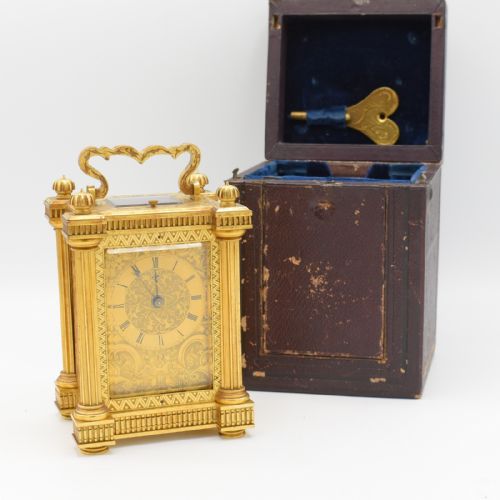
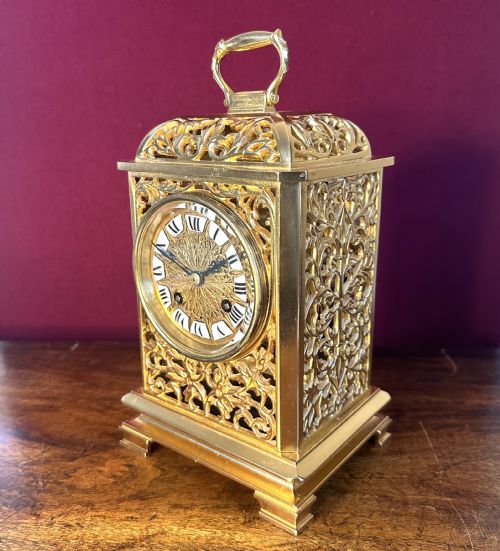
An ornate gilt carriage clock is a portable timepiece housed in a glazed metal frame, designed originally for travel by coach but settled later on desks, mantels, and tables. These pieces draw attention through decorative surface work and visible internal movements.
The versions most common here are French carriage clocks dating from the nineteenth century, particularly from the 1850s through to 1900, alongside Victorian and Edwardian examples. They take the form of carriage clocks, mantel clocks, and desk clocks, often featuring elaborate outer casings.
Makers and retailers from London and Paris produced these pieces in styles ranging from Rococo Revival and Victorian Gothic Revival to Second Empire. Collectors encounter variants with repeating mechanisms, grand sonnerie striking, and intricate engraved or enameled panels.
How they were made
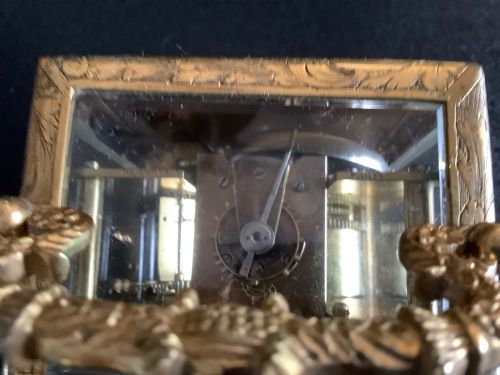
Makers constructed the primary structural cases of these pieces using brass, gilt brass, gilded brass, or gilt bronze, sometimes mounting them on marble or incorporating leather travel outer boxes. Bevelled glass panels fitted into the top and sides to protect the dial while allowing light to pass through to the escapement.
Surface ornamentation involved profuse hand engraving, champlevé enamel, Limoges enamel, or cast filigree masks applied across the metal work. Movements utilised platforms, fusee mechanisms, and striking trains requiring precise hand assembly by skilled horologists in workshops across France, Switzerland, and Britain.
One miniature clock was specially produced for the Chinese market around 1890.
What varies in quality
The distinction between standard production and top-tier work rests on the depth of the metal ornamentation and the complexity of the movement. Profuse, hand-engraved cases and signed movements by known makers separate ordinary timepieces from exceptional ones.
Quality also appears in the inclusion of specialised complications such as repeater mechanisms, grand sonnerie striking on bells, inset enamel panels, and platform escapements. The crispness of the cast gilt bronze or brass work dictates the overall visual impact.
Howell & James London·Brunelot·Gontard & Bolviller Paris·Thomas Cole and James Cole·Hunt And Roskell·James Moore·Luxor
The Ornate Gilt Carriage Clock Glossary
- Carriage clock
- A small, spring-driven clock originally designed for travellers, featuring a handle on top and glass panels on all sides.
- Repeater
- A mechanism that chimes the hours and quarters on demand when a button or pendant is pushed, useful in the dark before electric lighting.
- Platform escapement
- The small horizontal platform holding the balance wheel and escapement assembly visible through the glass top of a carriage clock.
- Champlevé
- An enamelling technique where troughs are dug into a metal surface, filled with enamel powder, and fired.
- Fusee
- A conical pulley used in mechanical clocks to maintain even power delivery to the gear train as the mainspring unwinds.
Ornate Gilt Carriage Clock: Frequently Asked Questions
What is an ornate gilt carriage clock?
It is a portable mechanical timepiece housed in a glass and metal case with decorative gilded surfaces. These pieces were built for travel or domestic table placement.
They combine heavy brass frames with glazed panels, often featuring engraved bronze decoration and visible clockwork movements through the top and sides.
How do you wind a carriage clock?
Winding typically involves inserting a small key into arbors located on the back plate of the movement. Turning the key clockwise tensions the mainspring.
Care must be taken not to overwind the mechanism, and striking trains require independent winding through separate arbors where present.
What is a repeating carriage clock?
A repeating carriage clock includes an extra mechanism that sounds the last hour and quarters upon pressing a button or lever on top of the case. This allowed owners to check the time at night without lighting a candle.
Such movements rely on additional gear trains and gongs or bells housed inside the heavy metal frame.
Where were carriage clocks made?
The majority of nineteenth-century carriage clocks originated in French workshops and factories, particularly in Paris. Significant numbers were also retailed by high-end London jewellers and houses.
Swiss workshops also produced miniature examples for export markets such as China during the late Victorian era.
How do you date a carriage clock?
Dating relies on stylistic clues such as case shape, engraving styles, dial design, and signature marks on the back plate or movement. Pieces from the 1850s to the 1890s exhibit distinct Victorian and French Second Empire decorative motifs.
Makers' signatures, patent numbers, and registration marks stamped onto the brass plates also help narrow down the period of manufacture.