






French Brass Officer Clock
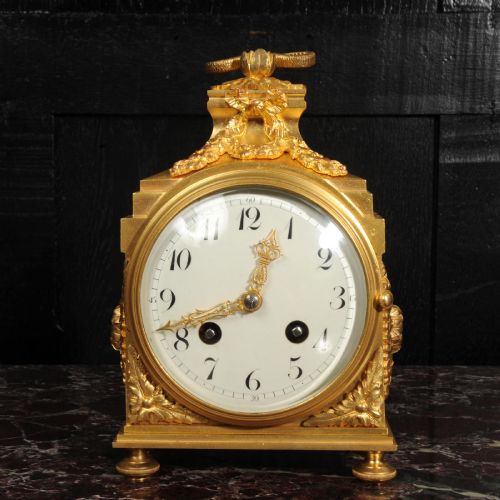
A french brass officer clock brings robust mechanics and polished metalwork together in a portable form made for travel or campaign use.

French Brass Officer Clock
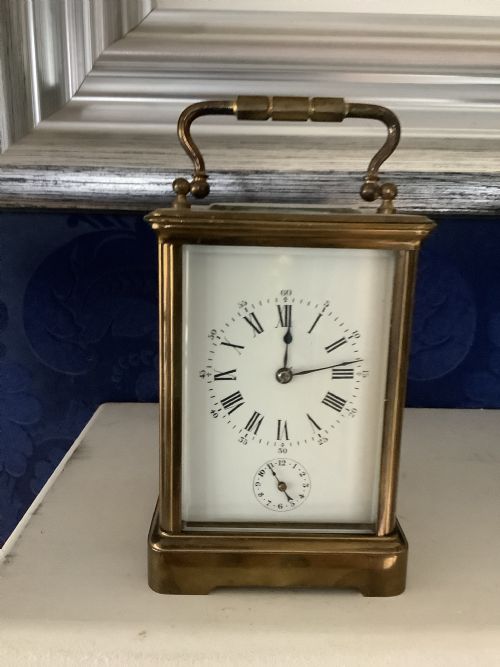
A french brass officer clock is a mechanical timepiece designed for portability, often featuring a heavy carrying handle and bevelled glass panels that reveal the internal movement. These pieces originate predominantly from the nineteenth century, spanning periods from eighteen hundred through to nineteen hundred, with Victorian influences appearing across many examples.
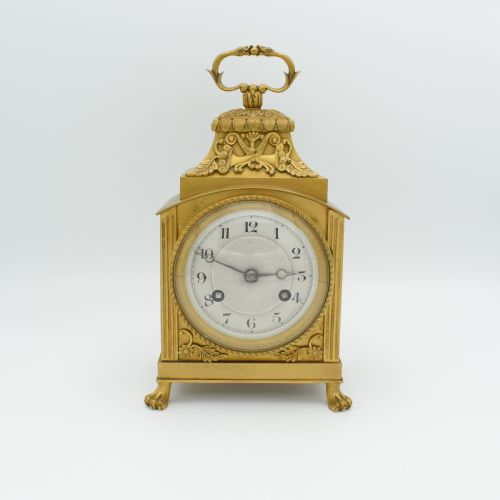
Buyers will encounter various forms on this page, including standard carriage clocks, mantel clocks, and specialised pendule d'officier models. Makers such as Henri Jacot, Drocourt, and Paul Garnier shaped these varying styles, housing intricate gear trains inside robust metal housings.
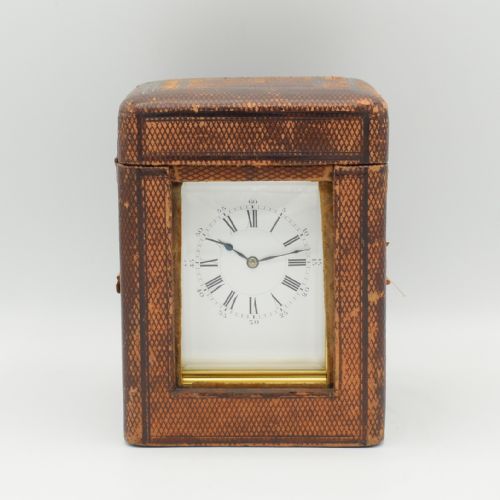
The casing typically takes a rectangular architectural shape, sometimes accompanied by a leather travel case or protective wooden box. These items reflect the demands of nineteenth-century life, where precise timekeeping was required on the move.
Markers of quality
The weight and thickness of the brass case, the clarity and bevelling of the glass panels, and the presence of original travel boxes or leather cases further separate standard pieces from finer examples.
Henri Jacot·C. Detouche Paris·J. F. Bautte Et Cie·Le Roy et Fils·Bourdin Paris·Drocourt·E.J.Dent·Paul Garnier·J.W.Benson·Joseph Soldano
The French Brass Officer Clock Glossary
- Grande sonnerie
- A striking mechanism that sounds both the hours and the quarters automatically on every quarter hour. It represents a high level of horological complexity.
- Gorge case
- A stepped, architectural brass case style commonly found on nineteenth-century carriage clocks. The design uses tiered mouldings to frame the glass panels.
- Escapement
- The internal mechanism that controls the release of power to maintain the motion of the clock. It regulates how the gear train turns.
- Ormolu
- Finely ground high-carat gold applied to a bronze or brass base object through a mercury amalgamation process. This technique produces a rich, durable golden surface.
French Brass Officer Clock: Frequently Asked Questions
What is the difference between a carriage clock and a mantel clock?
Carriage clocks are specifically built for travel, featuring a sturdy top handle and protective glass panels encased in brass. They are compact enough to be packed into leather or wooden cases.
Mantel clocks are generally larger and intended to remain stationary on a fireplace mantel or shelf. Some officer styles bridge this gap by adopting military portability while functioning as desk pieces.
How do striking mechanisms work?
Striking trains use internal racks and snails to count the hours and sometimes quarters, releasing a hammer to strike a bell or gong. Simple models strike only on the hour, while repeating examples allow the user to trigger the last struck hour on demand.
Complicated movements like grande sonnerie sound the time automatically at every quarter hour. These require careful adjustment by a horologist to maintain synchronization.
Why do some clocks have travel cases?
Nineteenth-century officers and travellers required robust protection for delicate brass and glass instruments during rough carriage or rail journeys. Fitted leather or rosewood outer cases absorbed impacts and kept dust away from the escapement.
Finding a clock with its original case adds significantly to its historical completeness. These boxes often feature velvet or silk linings tailored to the exact dimensions of the brass frame.