
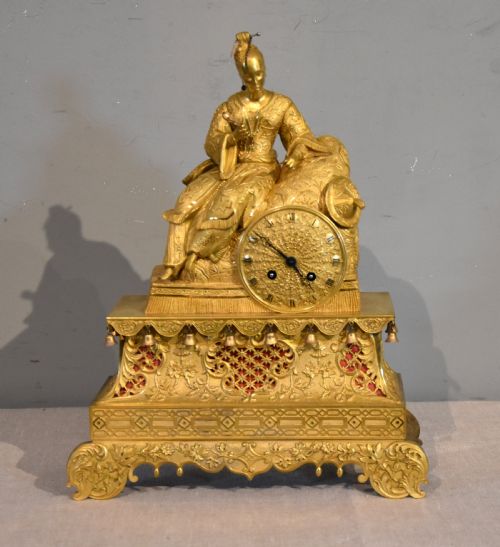


Ornate Bronze Timepiece
An ornate bronze timepiece brings heavy nineteenth-century French metalwork, enamel dials, and elaborate rococo or classical styling directly onto the mantelpiece.
Ornate Bronze Timepiece
An ornate bronze timepiece is primarily a nineteenth-century French domestic clock, taking the form of mantel clocks, carriage clocks, and portico clocks. The version most commonly met on this page is the gilt bronze or ormolu mantel clock, frequently styled in French Rococo or Louis XVI revival designs from the Victorian era.
Makers and workshops of the period produced these pieces using bronze, brass, and marble, often incorporating enamel dials and porcelain panels. Forms range from large architectural portico models down to miniature boudoir and bedside clocks enclosed in glass crystal regulators.
The regional origin remains predominantly French, spanning decades from the mid-nineteenth century through to nineteen hundred. Buyers encounter varying decorative schemes, from cherub motifs and lion masks to Chinoiserie and profusely engraved carriage cases.
Materials and construction
The primary structural material is cast bronze or brass, heavily gilded to create the characteristic ormolu finish seen across nineteenth-century French pieces. Metal casting combines with marble bases in red or white, alabaster, and glass panels for crystal regulator housings.
Listings feature items dated across the Victorian period and the late nineteenth century, predominantly originating from French workshops.
Assessing quality
Quality reveals itself in the depth and crispness of the bronze casting and chasing, where sharper relief work separates superior examples from softer production. The weight of the ormolu and the precision of the engraving across all sides of the case indicate the skill of the workshop.
The integration of materials such as Sevres porcelain panels, hand-painted enamel dials, and matching marble plinths elevates an ordinary mantel clock into a distinguished piece. Signed movements by notable makers add further distinction to the overall execution.
Samuel Marti·Japy Freres·Henri Jacot·FB Adams London·Farcot
The Ornate Bronze Timepiece Glossary
- Ormolu
- Gilded bronze produced by applying a mercury-gilding technique to cast bronze objects during the eighteenth and nineteenth centuries. This finish provides a warm, deep gold lustre that withstands the passage of time.
- Crystal Regulator
- A mantel clock enclosed entirely in glass panels within a brass or gilt metal frame. This design allows light to pass through the movement from multiple angles.
- Portico Clock
- An architectural clock design supported by four columns resembling a classical portico. These pieces often feature a suspended pendulum swinging freely within the central opening.
- Champlevé
- An enamelling technique where troughs are dug into the bronze surface and filled with coloured vitreous enamel before firing. It creates decorative geometric or floral patterns across the metal body.
- Chain Fusee
- A mechanical device using a conical pulley and chain to maintain even power delivery as the mainspring unwinds. It represents a higher standard of clockwork horology.
Ornate Bronze Timepiece: Frequently Asked Questions
How do I identify a French rococo mantel clock?
Look for asymmetrical scrollwork, C-scrolls, floral motifs, and naturalistic shell forms cast in gilt bronze. The overall silhouette avoids straight lines in favour of flowing, organic curves.
Check the dial and movement, as nineteenth-century French examples frequently bear maker stamps on the backplate matching the exterior stylistic period.
What is a crystal regulator clock?
A crystal regulator is a mantel clock housed in a brass or gilt frame with bevelled glass panels on all sides. This allows an unobstructed view of the mechanical movement and pendulum from any angle.
These pieces typically date to the late nineteenth century and often feature distinctive mercury-filled pendulum bobs designed to compensate for temperature changes.
How should I care for an ormolu clock?
Keep gilt bronze away from direct sunlight and sources of heat to protect the underlying metal and original mercury gilding. Dust gently with a soft, dry brush without applying liquid cleaners or commercial polishes.
Professional servicing of the mechanical movement every few years ensures the gears operate smoothly without excessive wear on the brass components.
Where were carriage clocks used?
Carriage clocks were originally designed as portable timepieces for travellers during the nineteenth century, fitted into protective leather cases for transit. They subsequently became popular for domestic use on tables and desks.
Examples range from simple brass-framed timepieces to profusely engraved models with repeating mechanisms that chimed the hours and quarters on demand.