





Ornate Brass Mantelpiece Clock
An ornate brass mantelpiece clock brings nineteenth-century weight and French Revival styling straight to the hearth.
Ornate Brass Mantelpiece Clock
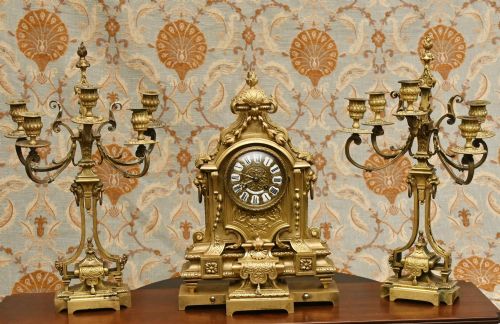
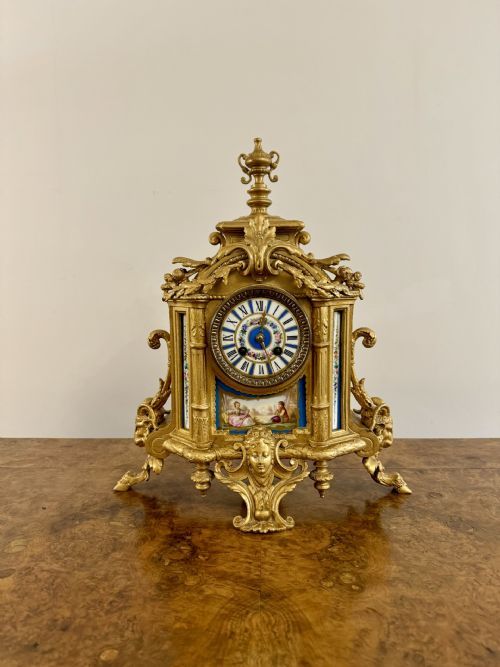
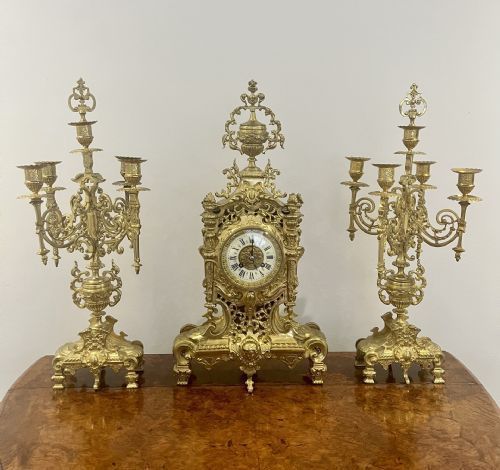
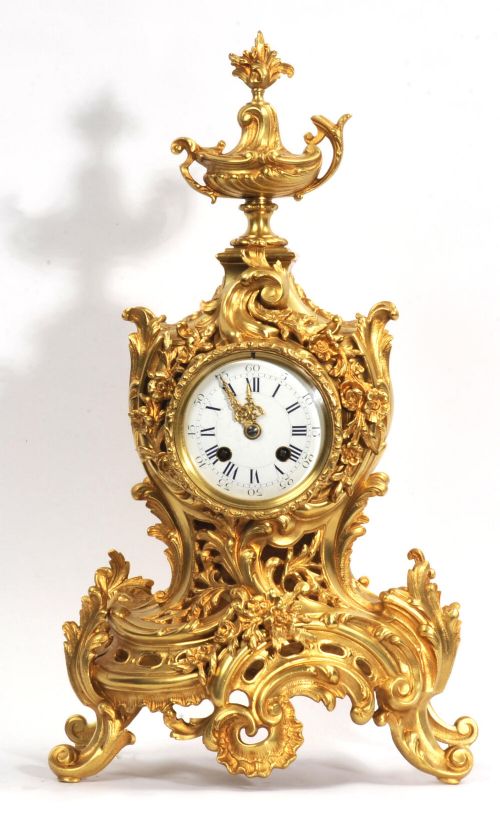
An ornate brass mantelpiece clock sits firmly in the nineteenth century, drawing heavily on French Rococo Revival, Louis XVI Revival, and Victorian aesthetics. These pieces include standalone mantel clocks, clock garnitures with side pieces, carriage clocks, and desk clocks.
The version most commonly met on this page is the French-influenced Victorian mantel clock or clock garniture, featuring detailed brass, gilt bronze, or ormolu work alongside enamel or porcelain dials.
Makers and houses such as Japy Freres, Howell, James & Co., and Hay London appear within the period evidence, alongside pieces decorated with Sevres style porcelain panels, green onyx, and champleve enamel.
Assessing Quality and Execution
The highest tier displays deeply chased and heavily cast metalwork where every surface of the brass, gilt bronze, or ormolu receives profuse hand engraving, as opposed to simpler, lightly stamped or plain brass cases.
Quality reveals itself in the integration of materials, such as undamaged hand-painted porcelain panels, flawless champleve enamel, and robust marble or onyx plinths that anchor the heavy metal superstructure.
The distinction between standard production and top-range workshop output rests on the crispness of the Rococo scrolls and Neo-Classical swags, alongside signed movements from established makers.
Ornate Brass Mantelpiece Clock Retail Price Guide 2026
Typical asking prices for ornate brass mantelpiece clock among the pieces listed under this phrase on Sellingantiques today, from the lower quarter to the upper quarter. They describe what is for sale here now, not the wider market.
Listings feature periods spanning from 1800 to 1900, with Victorian and nineteenth-century dates predominating.
Japy Freres·Howell, James & Co.·Hay London
The Ornate Brass Mantelpiece Clock Glossary
- Ormolu
- Gilded bronze produced by applying a mercury and gold amalgam to a bronze base and firing it. This technique creates a rich, durable surface finish found on many nineteenth-century French pieces.
- Clock Garniture
- A central clock accompanied by matching side pieces, such as urns or candelabra. These sets were designed to create a symmetrical display on a mantelpiece.
- Champleve
- An enamelling technique where troughs or cells are hollowed out of the metal surface and filled with vitreous enamel before firing. It produces vibrant coloured patterns across brass and bronze cases.
- Fusee
- A conical pulley used in clock movements to maintain an even pull as the mainspring unwinds. This mechanism improves timekeeping accuracy over the duration of the spring's power.
- Carriage Clock
- A small, portable spring-driven clock with a carrying handle, originally designed for travelling. Many Victorian examples feature brass cases with bevelled glass panels allowing the movement to be seen.
Ornate Brass Mantelpiece Clock: Frequently Asked Questions
What is a clock garniture?
A clock garniture is a matching set consisting of a central mantel clock accompanied by two side ornaments, such as urns or vases. These sets were designed to create a balanced, decorative arrangement on a fireplace mantel.
On this page, garnitures typically combine brass, gilt bronze, porcelain, or green onyx within Victorian and French Revival styles.
How do I wind an eight day clock?
An eight day clock requires winding approximately once a week using a matching key inserted into the dial holes. Care must be taken not to overwind the mainspring.
Most nineteenth-century brass mantel clocks utilise this striking mechanism, which sounds the hours and half hours on a bell or gong.
Are these clocks French or English?
Many ornate brass mantelpiece clocks on this page originate from France, reflecting popular nineteenth-century French Rococo and Louis XVI Revival tastes. Others are English productions or bear influences from London makers.
French pieces frequently feature gilt bronze, ormolu, and Sevres style porcelain panels, while English pieces often utilise fusee movements.
Where should I place a heavy brass clock?
A heavy brass or marble mantel clock requires a sturdy, level surface capable of supporting considerable weight. Mantelpieces and heavy sideboards provide traditional placement.
Ensuring the surface is level helps the pendulum swing evenly and keeps the striking movement running accurately.