


Ormolu Urn Clock
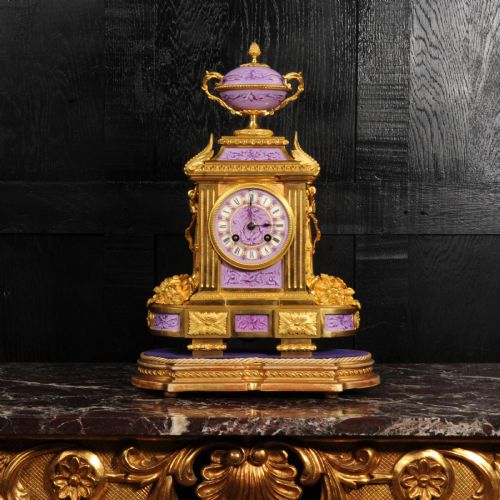
An ormolu urn clock brings together mercury-gilded bronze and classical proportions, offering a striking centrepiece for a mantelpiece.
Ormolu Urn Clock
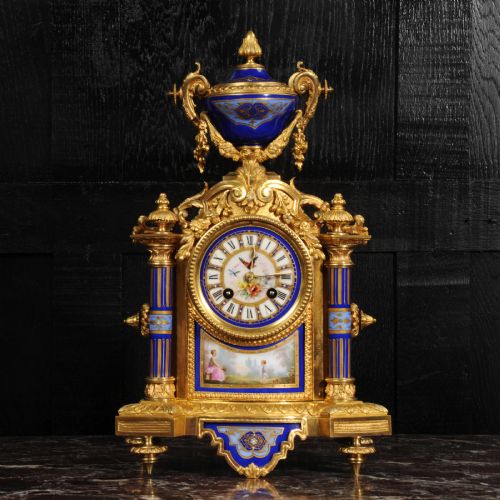
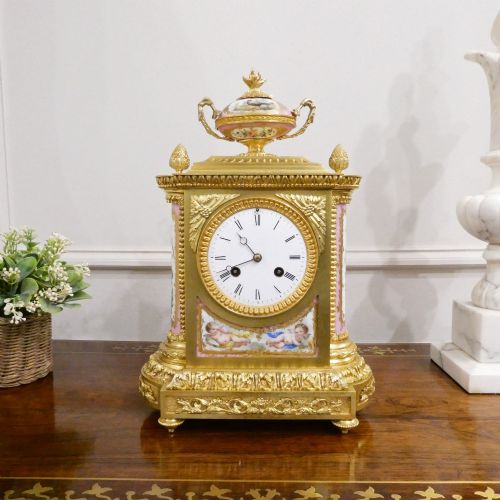
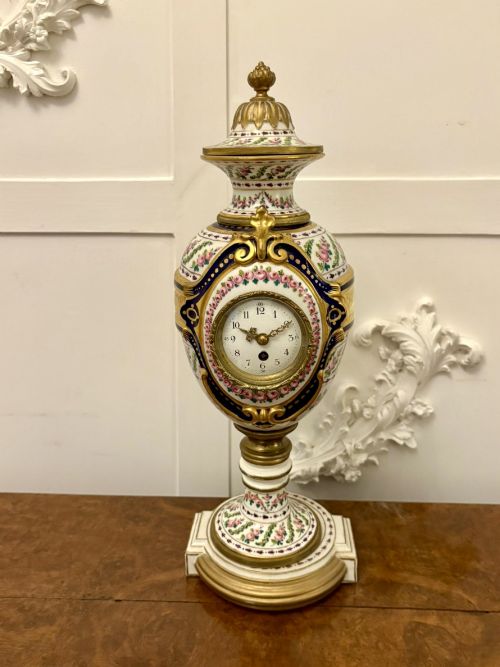
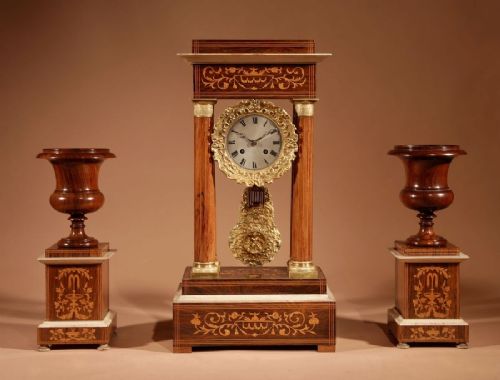
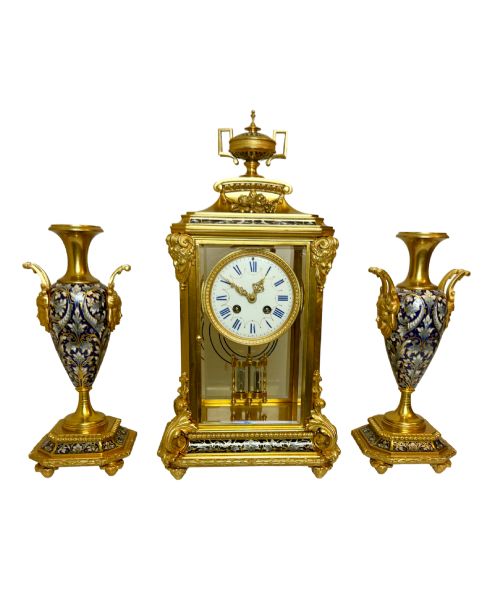
When you search for an ormolu urn clock, you find French mantel timepieces taking the form of classical vases mounted with gilt bronze. Most examples on this page hail from the nineteenth century, spanning Victorian decades and the Louis XVI revival. Makers incorporated porcelain urns, often hand-painted, directly into the clock housing or as part of a three-piece garniture set.
The layout typically places the dial inside the urn body or upon a marble plinth beneath it. Sets frequently include matching side vases or candelabra that balance the central timepiece on a mantel. These items reflect French horological output from workshops operating in Paris during the eighteen-fifties through to nineteen-hundred.
How they were made
Craftsmen cast the bronze mounts using traditional lost-wax or sand methods before applying an amalgamed gold finish known as ormolu. This surface treatment was paired with fired ceramic components, specifically Sèvres or Paris porcelain panels and urns decorated with enamel and hand-painted scenes.
Structural elements incorporated white marble, rouge marble, slate, and onyx bases that supported the heavy metal and ceramic weight. Movements were supplied by specialised French clockmakers, incorporating brass wheel trains, anchor escapements, and bell or gong strikes housed behind glass bezels.
Several clocks include secret calendar dials and striking mechanisms loud enough to surprise guests who admire the hand-painted porcelain urns.
What varies in quality
The distinction between ordinary and superior pieces rests upon the crispness of the bronze chasing and the depth of the gilding. Better examples display sharp relief in the acanthus leaves, swags, and classical figures, whereas lesser items suffer from softened cast details and dull plating.
Porcelain quality also dictates standing, with hand-painted reserves showing finer brushwork and richer cobalt grounds commanding greater attention. The inclusion of matching garniture urns under original glass domes elevates the integrity of the ensemble.
Japy Freres·Jean-Baptiste Delettrez·Achille Brocot·Louis Goret·A.D Mougin·Vincenti of Paris·James Ritchie and Son
The Ormolu Urn Clock Glossary
- Ormolu
- Gilt bronze produced by applying a mercury and gold amalgam to a bronze base and heating it to vaporise the mercury. This technique yields a warm, durable golden finish characteristic of nineteenth-century French decorative arts.
- Garniture
- A set of matching ornamental objects designed to be displayed together on a mantelpiece or sideboard. Typically comprises a central clock flanked by two matching vases, urns, or candelabra.
- Champlevé
- An enamelling technique where troughs or cells are hollowed out of the metal surface and filled with vitreous enamel paste before firing. The resulting design shows metallic dividing lines between coloured enamel areas.
- Portico clock
- A timepiece suspended within a architectural frame supported by four or more columns. This neoclassical form often incorporates marble and gilt bronze mounts.
- Sèvres
- A type of French soft-paste or hard-paste porcelain associated with the royal manufactory near Paris. Pieces often feature characteristic rich blue grounds and hand-painted gilt decoration.
Ormolu Urn Clock: Frequently Asked Questions
How do I wind an ormolu urn clock?
Use the appropriate winding key on the dial arbor, turning gently until you feel resistance. Avoid over-winding to protect the tension spring inside the brass movement.
Ensure you do not force the hands backward past the hour, as this can damage the striking train mechanism.
What periods do these clocks represent?
The pieces span the eighteenth, nineteenth, and early twentieth centuries. Most inventory originates from the Victorian era and the various Louis XVI revival periods.
Stylistic cues draw heavily from French neoclassical design, French Empire motifs, and Rococo revival ornamentation.
Are these clocks suitable for daily timekeeping?
Many restored examples keep accurate time, though mechanical clocks require professional servicing every few years to maintain proper lubrication. They function well as daily timekeepers if handled with care and kept away from drafts.
Placement should be level on a sturdy mantelpiece to ensure the pendulum swings evenly.
What is a clock garniture set?
A garniture set consists of a central clock accompanied by two matching decorative objects, such as urns, vases, or candelabra. These items were designed to create a balanced visual arrangement on a fireplace mantel.
Matched sets share identical materials, including ormolu mounts, porcelain bodies, and marble bases.