
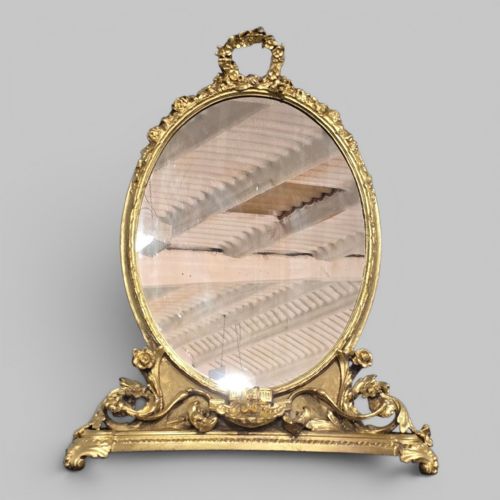


Ormolu Table Mirror
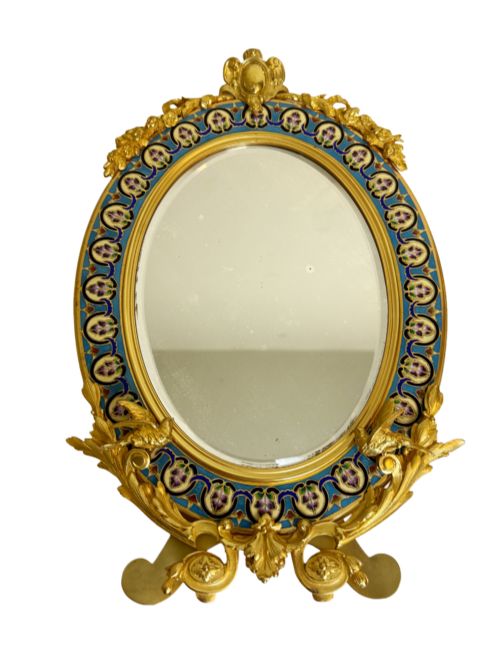
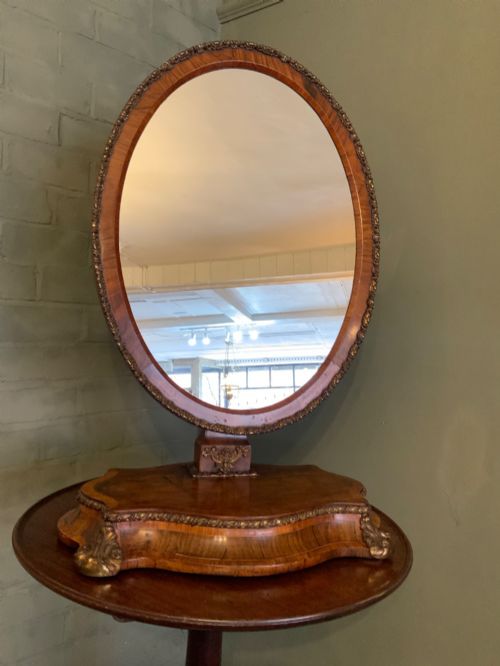
An ormolu table mirror sits upon a dressing surface, catching the light with gilt bronze and glass.
Ormolu Table Mirror
An ormolu table mirror brings decorative gilt work and polished glass to a bedroom or boudoir surface. These pieces sit on dressing tables, commodes and credenzas to aid with grooming and to reflect light around a room.
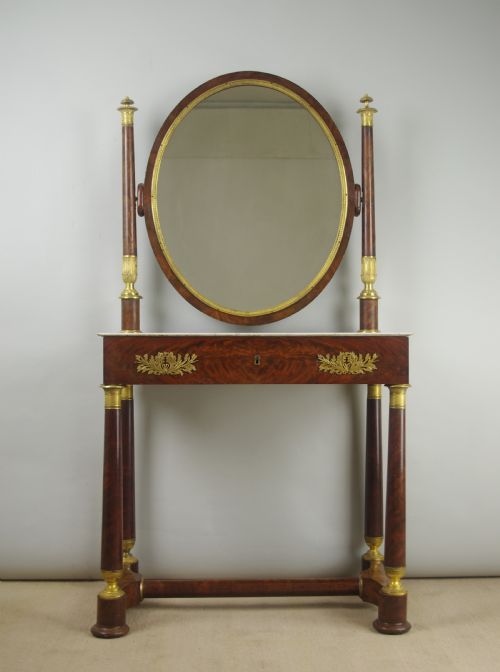
The versions most common on this page date from the nineteenth century, with strong representation from Victorian and French Empire periods. They take the form of small toilet mirrors, oval dressing table mirrors and vanity glasses.
Makers often combined the reflective glass with mounts of cast gilt bronze, supported by mahogany, burr walnut or marble bases. Some examples incorporate champleve enamel, Sevres porcelain or Limoges plaques alongside the metalwork.
How they were made
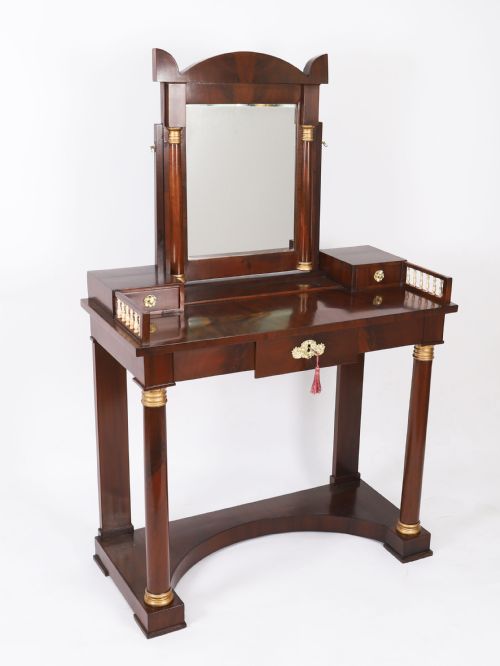
Craftsmen built the frames using timbers such as mahogany and walnut, frequently incorporating burr veneers or marble tops. These wooden and stone structures provided stable foundations for the swinging or fixed mirror plates.
The distinctive golden finish comes from ormolu, which involves applying finely ground gold to bronze through mercury amalgamation or chemical gilding. Skilled metalworkers cast intricate floral, scroll or architectural motifs to frame the mirror glass.
Details such as champleve enamel, Limoges painted panels and porcelain plaques were integrated into the frames. Each component was assembled by hand to ensure the pivoting glass remained balanced within its decorative mount.
The selection includes pieces incorporating Sevres porcelain and Limoges enamel, pointing to the crossover between ceramics and metalwork in nineteenth-century decorative arts.
What varies in quality
Quality shows in the crispness of the bronze casting and the depth of the fire gilding. Finer pieces display sharply defined ornamentation without the soft edges found in later or lesser castings.
The choice of secondary materials marks out superior examples, such as figured mahogany, substantial marble slabs and hand-painted porcelain plaques rather than plain timber or simple brass. Original mirror glass with clear bevels and minimal foxing also indicates a higher grade of manufacture.
Thiebaut Freres·Joseph Meissonnier·F.Bienvue
The Ormolu Table Mirror Glossary
- Ormolu
- Gilt bronze ornamentation created by applying a gold and mercury mixture to cast bronze before heating. This technique produced a durable golden surface seen on nineteenth-century furniture and frames.
- Champleve
- An enamelling technique where troughs or cells are hollowed out of a metal surface and filled with vitreous enamel before firing. It frequently appears alongside gilt bronze mounts on Victorian and French pieces.
- Empire
- A neoclassical design style spanning the late eighteenth and nineteenth centuries, characterised by mahogany veneers, symmetrical lines and classical bronze mounts. It draws inspiration from ancient Roman and Greek forms.
- Console table
- A wall-mounted or freestanding table designed to stand against a flat surface, often topped with marble. Examples frequently share stylistic motifs with matching table mirrors.
- Burr walnut
- Timber taken from the abnormal growth of a walnut tree, yielding a swirling, highly figured grain pattern. It was widely utilised for luxury Victorian dressing furniture.
Ormolu Table Mirror: Frequently Asked Questions
Where should I place an ormolu table mirror?
These mirrors work best on sturdy dressing tables, side cabinets or chests of drawers where their weight and decorative mounts can be seen. They require a stable surface because many designs feature pivoting frames that balance on upright supports.
Position them away from damp areas to protect the gilt bronze and the silvering on the glass. Natural daylight from a side window helps the ormolu catch the light without causing glare on the mirror plate.
How can I tell a nineteenth-century mirror from a later copy?
Examine the construction of the frame and the fixings holding the glass in place. Nineteenth-century examples often use hand-cut screws, pegged joints and heavy cast bronze rather than lightweight stamped brass.
The mirror glass itself may show minor foxing, tiny dark spots or hand-beveled edges typical of older manufacturing methods. The wood beneath the mounts should match the expected density and grain of period mahogany or walnut.
What is the difference between a toilet mirror and a table mirror?
A toilet mirror typically refers to a small dressing glass set into a dedicated wooden stand or mini chest with small drawers. These were designed for the dressing table during the Victorian and Empire periods.
A table mirror is a broader term encompassing any glass intended to stand freely on a horizontal surface, including pieces framed purely in ormolu or mounted with porcelain and enamel.