

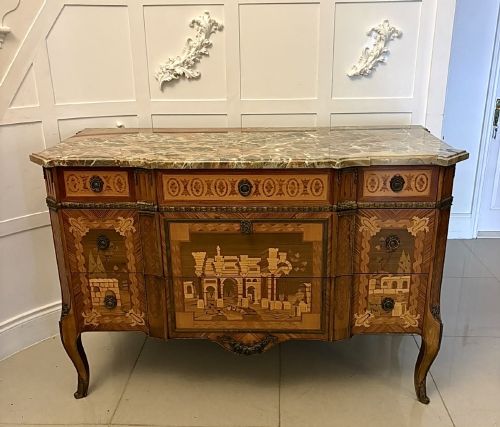
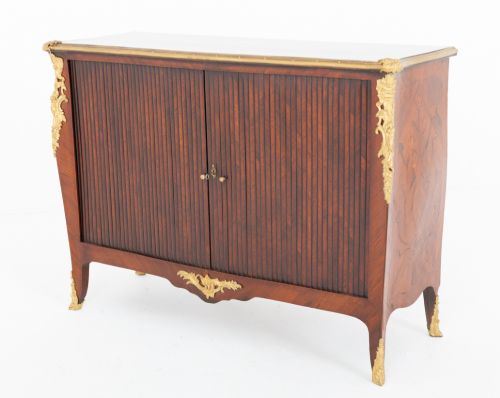
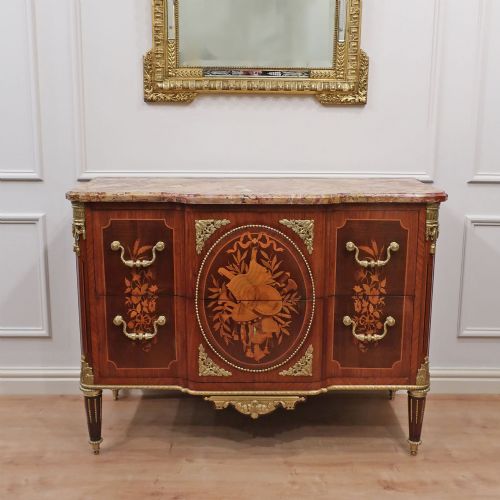
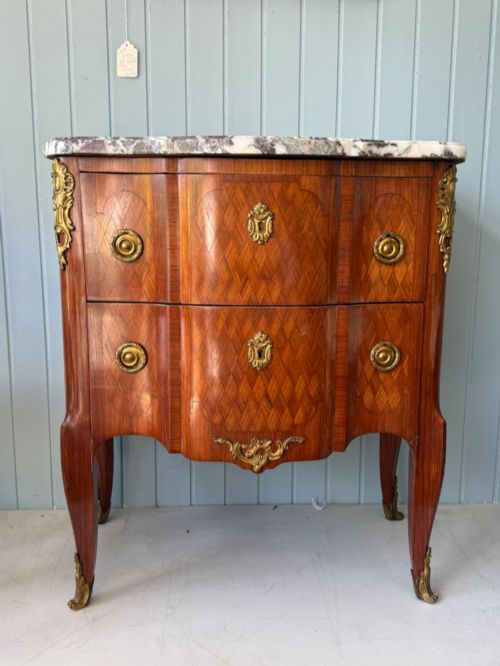




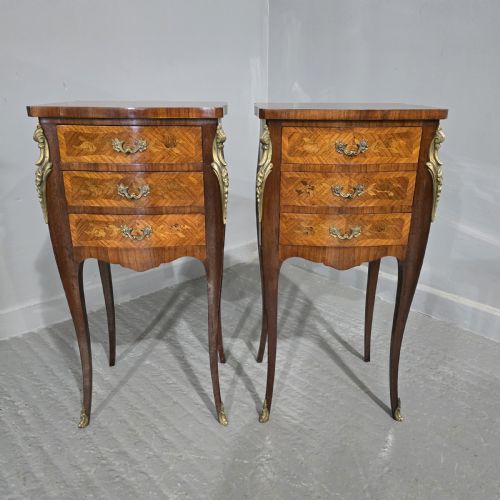


Ormolu Mounted Wooden Commode
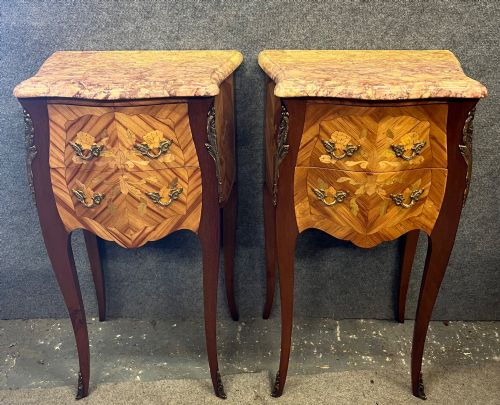
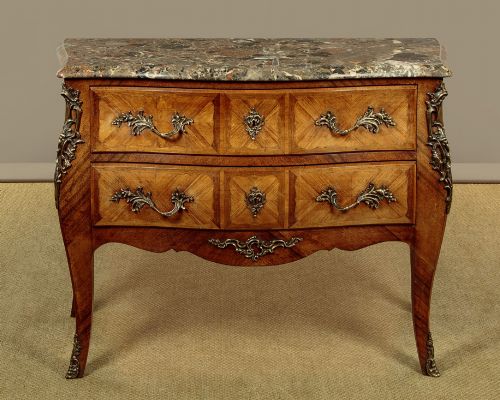
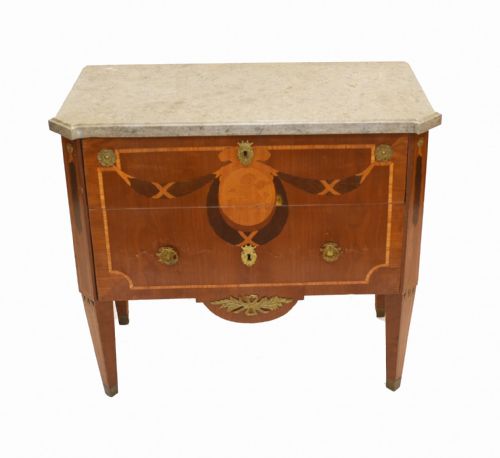
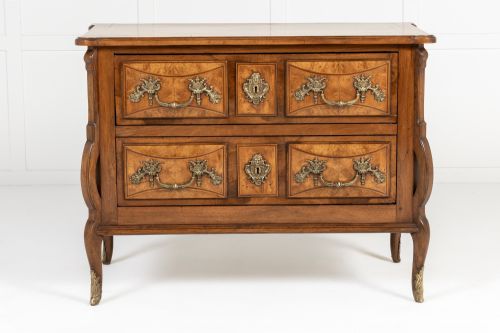
These ormolu mounted wooden commode pieces bring French revival elegance into a room with rich marquetry and polished marble tops.
Ormolu Mounted Wooden Commode
An ormolu mounted wooden commode functions as a grand chest of drawers, bedside table, or side cabinet rooted in French decorative traditions. When searching for an ormolu mounted wooden commode, buyers encounter nineteenth-century revival pieces alongside eighteenth-century originals.
The forms range from serpentine shapes to bombe silhouettes and bedside lamp chests. Walnut, kingwood, rosewood, and burr walnut form the timber carcases, topped with marble slabs.
How they were made
Cabinetmakers constructed these carcases using dense hardwoods like kingwood, walnut, and rosewood, often applying intricate marquetry inlay across the surfaces. Marble slabs were then shaped to fit precisely onto the tops of the chests and cabinets.
Gilt bronze or brass mounts, known as ormolu, were cast and chased by hand before being affixed to the corners, handles, and aprons of the furniture to accentuate the curved outlines.
Ormolu Mounted Wooden Commode Retail Price Guide 2026
Typical asking prices for ormolu mounted wooden commode among the pieces listed under this phrase on Sellingantiques today, from the lower quarter to the upper quarter. They describe what is for sale here now, not the wider market.
Some nineteenth-century makers signed their work in unexpected places, hiding signatures beneath heavy marble slabs where only a curious restorer would find them.
What varies in quality
The crispness and depth of the ormolu chasing separate standard mounts from finer examples, as hand-chiselling after casting defines the highlights on the bronze. The precision of the marquetry cutting and the choice of veneers also determine the standard of the piece.
Subtlety in the curve of a bombe silhouette and the selection of figured timber grades distinguish higher workshops from simpler production.
Germain Landrin·Gonçalo Alvest
The Ormolu Mounted Wooden Commode Glossary
- Ormolu
- Gilded bronze applied as decorative mounts to furniture. The technique involves coating metal in a gold amalgam.
- Marquetry
- Inlaid wood veneers arranged in geometric or pictorial patterns across a carcase. Craftsmen cut contrasting timbers together to ensure tight joints.
- Bombe
- A swelling, outward-curving chest profile popular in eighteenth-century French cabinet making. This shape requires advanced timber bending and shaping skills.
- Serpentine
- A front contour curving inward centrally and outward at the sides. It creates a fluid movement across the face of a commode.
- Kingwood
- A dense, heavily figured Brazilian timber prized for its contrasting dark and golden streaks. It frequently appears in French revival marquetry.
Ormolu Mounted Wooden Commode: Frequently Asked Questions
Where should I place an ormolu mounted wooden commode?
These chests suit living rooms, hallways, or bedrooms where their marble tops and decorative mounts can catch the light. They function well as statement sideboards or bedside tables.
Ensure the dimensions match the scale of the wall space, as serpentine and bombe shapes project further into a room than flat-fronted cabinets.
How do I tell an 18th century commode from a 19th century revival piece?
Eighteenth-century originals show period construction methods, timber ageing, and hand-forged joinery specific to their era. Revival pieces from the nineteenth century often adopt Louis XV or Louis XVI styles with later industrial hardware or machine-cut veneers.
Examining the underside, drawer linings, and the backboards provides clear indicators of the manufacturing period.
How do I care for the marble top?
Wipe the marble surface regularly with a soft, damp cloth and dry it immediately to prevent water marks. Avoid acidic cleaners, citrus, and vinegar, which etch polished stone.
Use protective mats under objects placed on the top to guard against scratches.
What is the difference between ormolu and brass?
Ormolu consists of a bronze base metal treated with a gold wash or mercury gilding technique, resulting in a warm, deep yellow metallic lustre. Brass is an alloy of copper and zinc that typically appears brighter and lacks the same historical gilding depth.
On finer furniture, mounts are described as gilt bronze or ormolu rather than plain brass.