



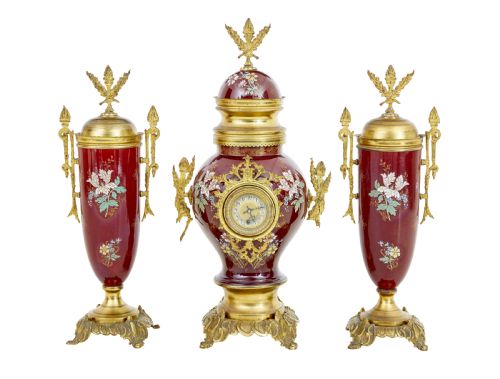

Ormolu Mounted Mantle Clock
These ormolu mounted mantle clock pieces bring together gilded metalwork and domestic timekeeping from the nineteenth century for any interior.
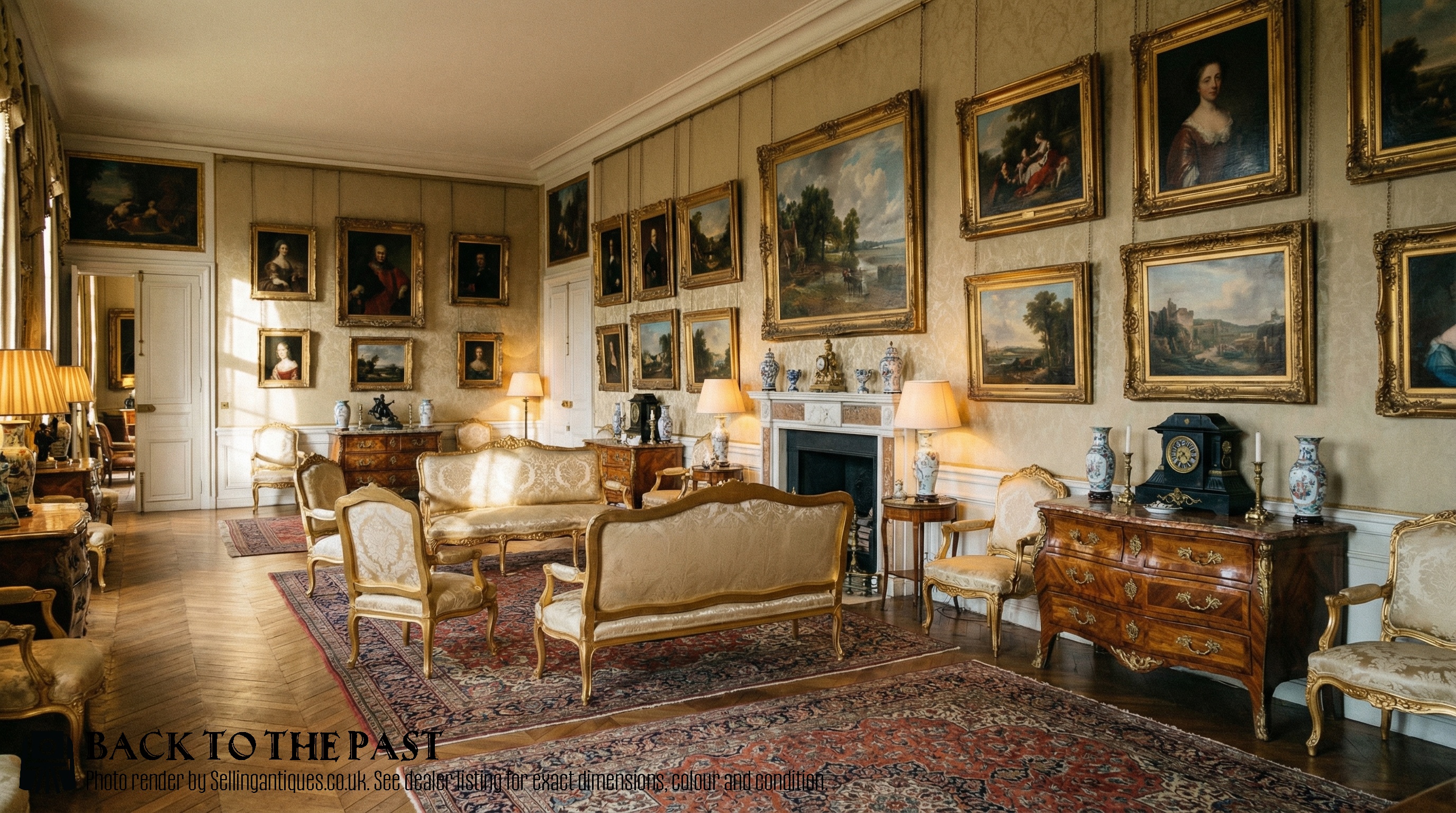
Ormolu Mounted Mantle Clock
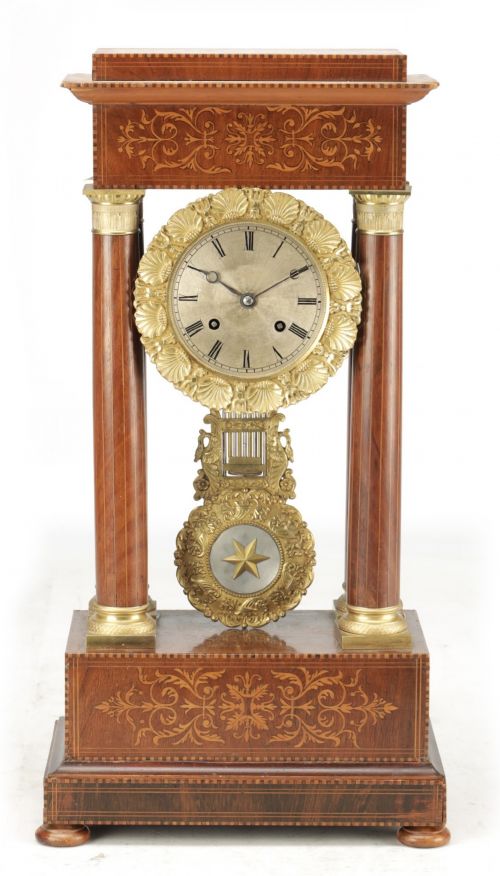
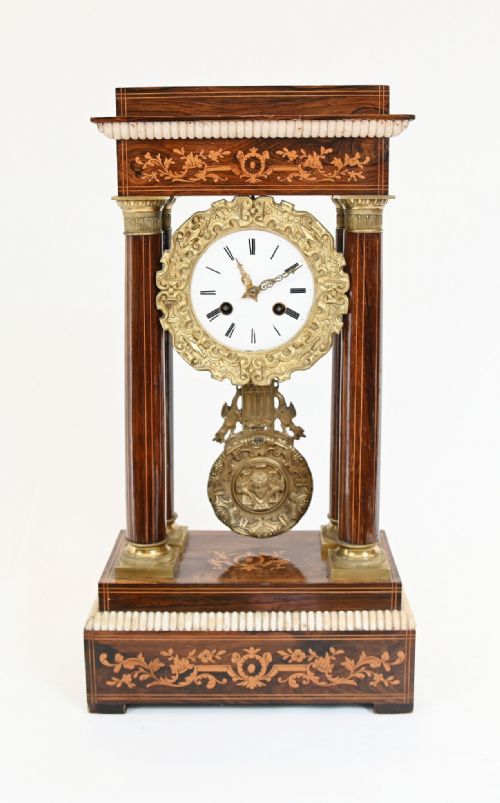
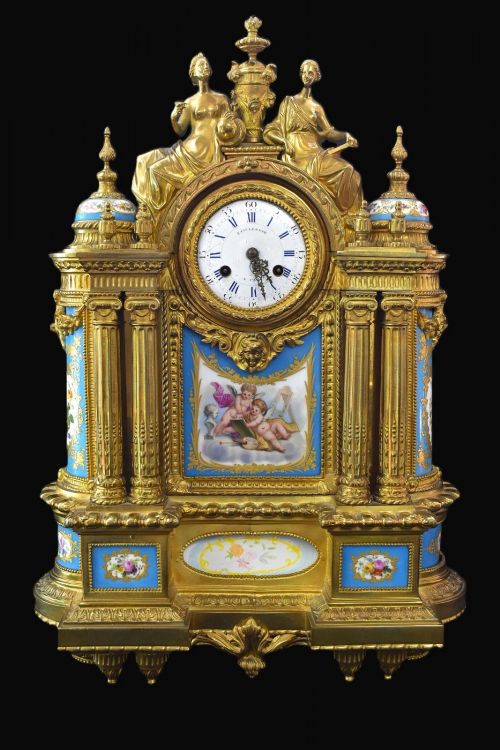
An ormolu mounted mantle clock is a decorative timepiece designed for display on a shelf or fireplace surround, incorporating gilt bronze mounts alongside materials such as marble, porcelain, and wood. The selection here leans heavily towards French production from the nineteenth century, spanning periods from the Charles X era through to the Victorian decades and the turn of the twentieth century.
Buyers will encounter various forms ranging from portico clocks and lyre mystery clocks to elaborate garniture sets accompanied by candelabras. Styles draw heavily on French Rococo Revival, Louis XV and XVI designs, Louis XV Revival, and Napoleon III aesthetics, alongside occasional Boulle work and Egyptian Revival motifs.
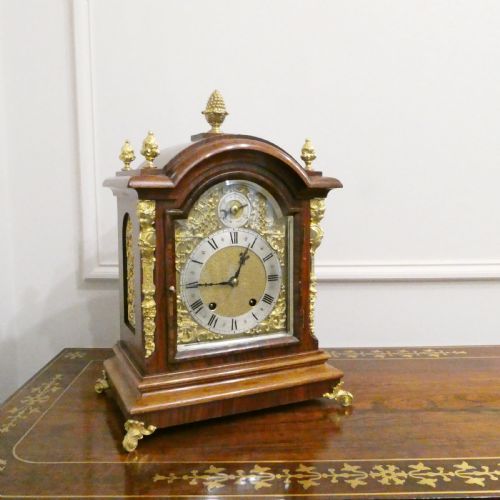
The objects frequently combine functional timepieces with sculptural elements like porcelain panels, enamel dials, and animal figures. Most examples originate from French workshops, though German bracket clocks also appear within the wider selection.
What varies in quality
The standard of an ormolu mounted mantle clock rests on the crispness of the bronze chasing and the depth of the gilding across the mounts. Pieces with hand-painted porcelain panels and substantial marble or slate bodies command attention through the integration of their materials.
The presence of named makers or complex movements, such as lyre mystery suspensions or ting tang striking systems, elevates specific examples above standard production. The harmony between the clock case and its matching candelabras in a garniture set also defines the tier of the piece.
The listings show nineteenth-century French production dominated by marble, slate, and porcelain cases adorned with ormolu mounts.
Etienne Lenoir·Schneckenburger·Achille Brocot·Adams of Lombard Street·Lenzkirch·JAMES MCCABE
The Ormolu Mounted Mantle Clock Glossary
- Ormolu
- Gilded bronze, where a layer of gold is applied to a base of copper and zinc alloy. This technique gives the metal mounts their characteristic bright golden surface.
- Garniture set
- A decorative matching group consisting of a central clock flanked by side pieces such as candelabras or vases. These sets were designed to sit symmetrically on a mantelpiece.
- Boulle
- A form of marquetry using brass and tortoiseshell inlaid into wood, named after the cabinetmaker André-Charles Boulle. It appears frequently on nineteenth-century French clock cases.
- Portico clock
- A clock housed within a architectural frame supported by columns. The style was popular during the Charles X and early nineteenth-century periods.
- Bracket clock
- A portable clock originally designed to sit on a wall bracket or table. These timepieces often feature wooden cases and specialised striking movements.
Ormolu Mounted Mantle Clock: Frequently Asked Questions
What is an ormolu mounted mantle clock?
An ormolu mounted mantle clock is a decorative timekeeper featuring gilded bronze mounts attached to a case of marble, wood, porcelain, or slate. These pieces were produced primarily in France during the nineteenth century.
They combine mechanical clock movements with sculptural metalwork, often reflecting revival styles such as Louis XV, Louis XVI, and Napoleon III.
How do I wind an antique clock?
Antique clocks usually require a key inserted into the dial holes to tension the mainsprings for the time and striking trains. Care must be taken not to overwind the movement.
Most pieces listed feature eight-day movements, meaning they need winding roughly once a week to maintain accurate timekeeping.
What is a clock garniture set?
A clock garniture set is a matching ensemble comprising a central mantle clock and two side ornaments, such as candelabras or urns. These sets were manufactured to create a symmetrical display on a fireplace.
The materials and ormolu mounts on the side pieces match those found on the main clock case.
How can I tell the period?
Dating relies on the stylistic clues of the case, such as the architectural columns of a portico clock or the ornate curves of a Rococo Revival design. Materials like Sevres porcelain and tortoiseshell Boulle work also point to specific nineteenth-century decades.
Signatures or names on the enamel dials or movements provide further evidence of the maker and active period.