

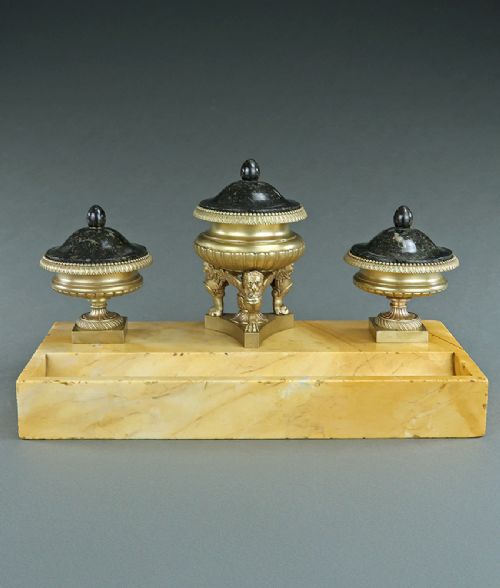


Ormolu Marble Inkwell
An ormolu marble inkwell combines cast gilt bronze mounts with a heavy stone base to anchor a desk.
Ormolu Marble Inkwell
An ormolu marble inkwell combines a heavy stone reservoir base with cast metallic mounts in desk accessories, inkstands, and complete desk sets. These pieces date across the nineteenth century and into the early twentieth century, spanning French Empire, Neoclassical, and Art Nouveau styles.
Buyers meet a range of forms on this page, from single wells to elaborate stands featuring lions or a bust of Napoleon. The materials vary across Sienna marble, green marble, vert marble, and onyx marble paired with ormolu, gilt bronze, brass, and gilded bronze.
How they were made
Maker workshops cut and polished natural stones such as Sienna, vert, and onyx marble into heavy bases to provide stable foundations for writing desks. Artisans then cast bronze components, applying fire gilding to create the bright ormolu surface finish.
Mounts and figures, including lions and sculptural busts, were pinned or screwed directly into the stone. Glass or porcelain liners sat inside the bronze collars to hold liquid ink safely without staining the surrounding marble.
Ormolu Marble Inkwell Retail Price Guide 2026
Typical asking prices for ormolu marble inkwell among the pieces listed under this phrase on Sellingantiques today, from the lower quarter to the upper quarter. They describe what is for sale here now, not the wider market.
Some inkwells feature a miniature bust of Napoleon keeping a stern watch over your daily correspondence.
What varies in quality
The choice and preparation of the stone dictate the overall visual weight. Richly figured Sienna and onyx marbles with well-matched bronze mounts occupy the upper tier of production.
Albert Marionnet
The Ormolu Marble Inkwell Glossary
- Ormolu
- Gilt bronze created by applying a mercury and gold amalgam to a cast bronze object and heating it to drive off the mercury. This historic technique yields a warm, durable golden surface.
- Encrier
- The French term for an inkstand or inkwell. These desk accessories often include pen trays and sanders alongside the central ink reservoir.
- Sienna marble
- A decorative yellow and brown mottled limestone quarried in Italy. It provides a striking, high-contrast background for gilt metal mounts.
- Vert marble
- A deep green ornamental stone frequently used in nineteenth-century desk sets. The dark tone contrasts sharply with bright ormolu mounts.
- French Empire
- A neoclassical design style spanning the early nineteenth century. It draws heavily on ancient Roman and Greek motifs, often featuring military emblems or classical figures.
Ormolu Marble Inkwell: Frequently Asked Questions
What is an ormolu marble inkwell?
An ormolu marble inkwell is a desk accessory that pairs a heavy stone base with cast and gilded bronze mounts. These pieces served as functional writing equipment on nineteenth-century desks.
They range from simple single wells to large desk sets complete with pen trays and matching covers.
How do you use them today?
These pieces function well on modern desks as decorative objects or pen holders. Many collectors keep them for display rather than active writing use.
Care should be taken to protect the stone and gilt surfaces from moisture and harsh cleaning agents.
How do I spot French Empire style?
French Empire pieces display classical symmetry, military trophies, and formal geometric lines. They reflect the taste of nineteenth-century Europe inspired by antiquity.
Ormolu mounts on these items usually feature sharp, architectural details.
What is the difference between ormolu and gilt bronze?
Ormolu specifically describes the historical mercury gilding process used on decorative bronzes during the eighteenth and nineteenth centuries. Gilt bronze is a broader term for any bronze object with a gold surface layer.
Both finishes provide a metallic golden sheen against the marble base.
Are Art Nouveau inkwells different?
Art Nouveau inkwells abandon strict classical symmetry in favour of fluid, organic lines inspired by natural forms. These pieces often feature whiplash curves and stylised floral motifs.
Artists such as Albert Marionnet worked within this expressive idiom.