
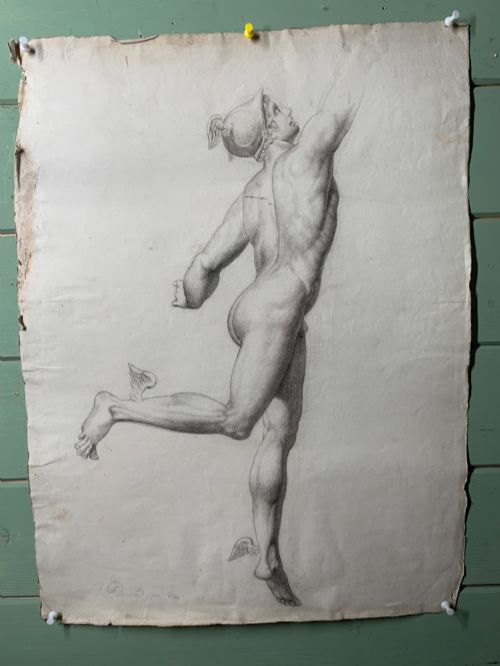


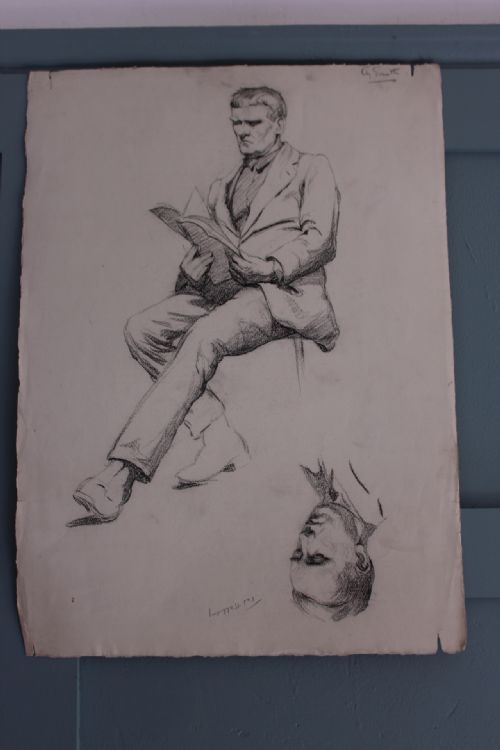


Original Graphite Figure Sketch
An original graphite figure sketch brings direct hand-drawn draftsmanship into a room, offering immediate connection to an artist's working process.
Original Graphite Figure Sketch
An original graphite figure sketch represents direct draftsmanship capturing human forms through pencil marks on paper. These works span multiple centuries, ranging from eighteenth-century portraits and academic studies to twentieth-century modern and surrealist interpretations.
The pieces available here include framed drawings and wall art executed on paper and toned paper. Portraiture and studies of seated or standing subjects dominate the forms, reflecting both formal academic training and informal artistic observation.
Examples stretch across Georgian, nineteenth-century academic, Art Deco, and mid-century modern movements. Buyers frequently encounter French academic works alongside British portraits and international modernist pieces.
Materials and construction methods
Artists executed these works primarily using graphite and pencil mediums directly applied to paper supports. Many sheets utilise toned paper to provide a neutral mid-tone foundation for the composition.
Several figures captured mid-thought across these pages have been quietly staring past their frames for over a century.
Assessing quality in figure sketches
The strength of line and sureness of proportion separate accomplished academic and modernist studies from simpler exercises. Confident handling of graphite demonstrates the artist's ability to render volume and expression economically.
The preservation of the paper support and the stability of the medium dictate the visual impact of the drawing. Well-maintained sheets retain crisp contrast between dark pencil marks and the original paper ground.
Augustus John·Faeq Hassan·Sir Nathaniel Dance Holland
The Original Graphite Figure Sketch Glossary
- Graphite
- A form of crystalline carbon used as a drawing medium in pencils. It produces grey or black marks that can be smudged or layered for shading.
- Toned paper
- Paper manufactured with an inherent colour such as grey, tan, or buff rather than plain white. It allows artists to work up both shadows and highlights efficiently.
- Academic realism
- A style of painting and drawing produced under the influence of European academies of art. It emphasises precise anatomical accuracy and classical proportions.
- White chalk
- An opaque white drawing material used on toned or coloured paper to create highlights. It adds volumetric form when combined with graphite.
- Surrealism
- A twentieth-century cultural movement that sought to release the creative potential of the unconscious mind. Works from this style often feature dreamlike figure arrangements.
Original Graphite Figure Sketch: Frequently Asked Questions
How should I frame an old graphite drawing?
Protect the paper from direct contact with the glass by using a mat or mount. Employ conservation-grade materials and keep the drawing away from direct sunlight to prevent fading.
Ensure the backing board is acid-free to preserve the paper fibre over time. Professional framing maintains proper tension and prevents humidity damage.
How do I identify the period of a sketch?
Examine the paper watermark, the style of clothing depicted, and the handwriting of any signatures or inscriptions. Stylistic indicators like neoclassical proportions or art deco framing lines offer strong chronological clues.
Compare the handling of the graphite with documented works from specific centuries. Academic hatching techniques often shift significantly between the Georgian era and the mid-twentieth century.
Are chalk and graphite drawings fragile?
Pencil and chalk mediums remain susceptible to smudging if the paper surface is touched or rubbed. The loose particles sit on the paper fibres without a heavy binder.
Glazing protects the delicate medium from physical disruption and atmospheric dust. Careful handling during mounting prevents accidental loss of pigment.
What is the difference between a sketch and a finished drawing?
A sketch typically records a rapid observation or serves as preliminary preparation for a larger painted composition. It prioritises gesture and line over complete tonal rendering.
Finished drawings contain fully developed shading, detailed anatomical corrections, and deliberate composition. Both forms offer direct insight into the artist's hand.