



Original Castle Watercolour
An original castle watercolour captures stone ramparts and coastal ruins across British landscapes through hand-painted washes and fine ink lines.
Original Castle Watercolour
An original castle watercolour represents British and Irish fortresses, from northern strongholds to southern coastal towers, rendered directly onto paper by artists recording historic architecture. These works span the late eighteenth century through the mid-twentieth century, capturing changing light on ancient masonry across various regional landscapes.
The selections available here predominantly feature Victorian, Edwardian, and mid-century British school depictions, showcasing specific locations like Bolton Castle, Windsor, and Bamburgh. Buyers encounter framed and unframed sheets executed in loose impressionistic strokes or tight topographical detail, reflecting both romantic ruin aesthetics and precise architectural recording.
Makers and regional artists utilised paper supports to build translucent layers of pigment, often combining pen and ink outlines with water-soluble paints. These pieces function historically as direct records of British heritage sites and artistically as expressions of landscape romanticism across different periods.
How they were made
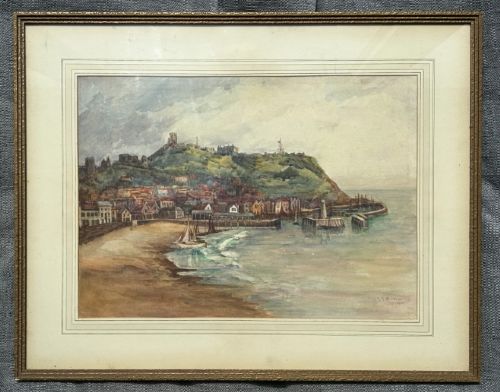
Artists applied watercolour pigment suspended in water onto heavy rag paper, building transparent washes of colour to denote sky, water, and stone. Many works incorporate pen and ink underdrawing or finishing lines to define architectural edges and masonry details.
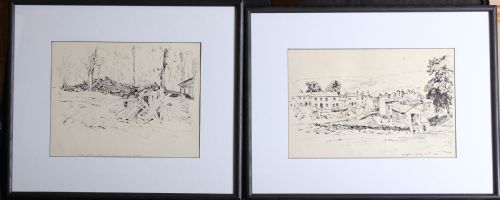
Gilt framing and glass protected these fragile works on paper from atmospheric moisture and surface damage. Monochrome or grisaille pieces relied entirely on grey and sepia tonal gradations rather than full colour palettes to create depth and shadow.
Listings feature works spanning the nineteenth century through the 1960s, employing watercolour pigment, ink, and glass-fronted frames.
What varies in quality
Technical mastery in handling translucent washes separates accomplished topographical works from rudimentary amateur sketches. The precision of ink draughtsmanship and the artist's ability to render atmospheric perspective on stone and sky dictate the visual success of the piece.
Condition plays a central role, distinguishing bright pigments preserved behind glass from faded sheets damaged by light exposure or acid migration from early mounts.
Fred Lawson·George Graham·David Cox Senior·Frederick Tully Lott·Frank Wood
The Original Castle Watercolour Glossary
- Grisaille
- A painting executed entirely in monochrome tones of grey, neutral grey, or sepia. This technique often served as a preparatory study or a finished monochrome artwork mimicking relief sculpture.
- Watercolour pigment
- Finely ground colour particles mixed with a water-soluble binder applied in thin transparent layers. These washes allow the white of the paper to reflect light back through the colour.
- British School
- A loose grouping of artists working in Britain sharing stylistic traditions rather than a formal academy. These painters focused heavily on domestic landscapes, coastal scenes, and historic architecture.
- Gilt
- A thin layer of gold applied to picture frames to enhance the presentation of the artwork. Period frames often feature intricate moulded gesso details beneath the metallic leaf.
Original Castle Watercolour: Frequently Asked Questions
How should I display my castle watercolour?
Hang these works on paper away from direct sunlight to prevent the watercolour pigments from fading over time. Conservation framing with acid-free mounts ensures the paper remains protected from environmental degradation.
Keep the pieces in rooms with stable humidity levels to avoid warping the paper or damaging the underlying ink and paint layers.
What subjects appear most frequently in these paintings?
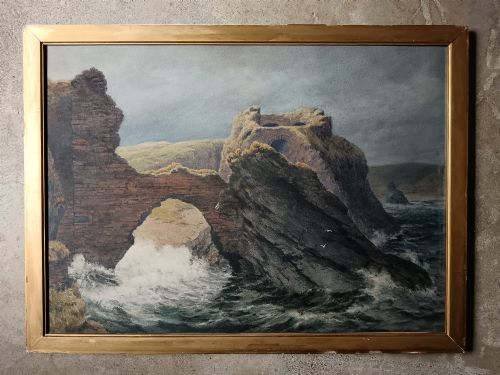
Northern strongholds like Bolton Castle and coastal fortresses such as Bamburgh and Dunluce dominate the regional subjects. Artists also recorded southern landmarks including Windsor Castle and various Welsh and Scottish historic ruins.
Many compositions place these fortresses within broader river valleys, coastal settings, or moody mountainous landscapes typical of British topography.
How do I date an antique watercolour?
Examine the paper quality, framing materials, and any handwritten signatures or inscriptions on the reverse of the sheet. Stylistic clues such as Victorian romanticism versus mid-century impressionism help narrow the creation period.
Comparison with known exhibited works by listed artists provides the most reliable chronological placement for unsigned sheets.
What is the difference between a sketch and a finished painting?
Sketches typically show rapid brushwork, visible pencil guidelines, and selective colour application meant to capture a quick architectural impression. Finished paintings display fully developed tonal washes, refined detail work, and often formal artist signatures.
Both forms offer genuine insight into the working methods of nineteenth and twentieth-century landscape painters.