



Original Architectural Watercolour
When you search for original architectural watercolour, you are looking at hand-painted studies of buildings, monuments, and interiors that capture historic forms on paper.
Original Architectural Watercolour
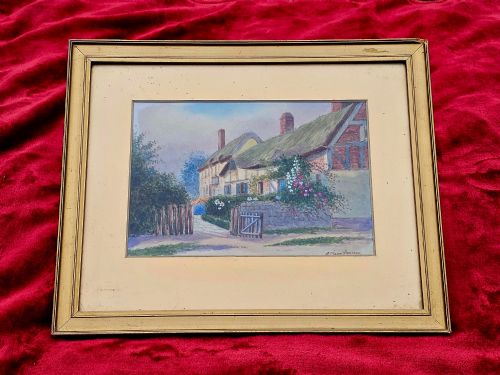
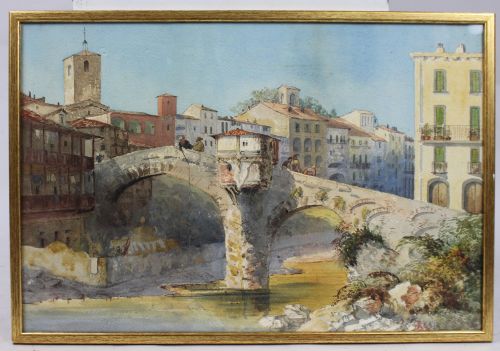
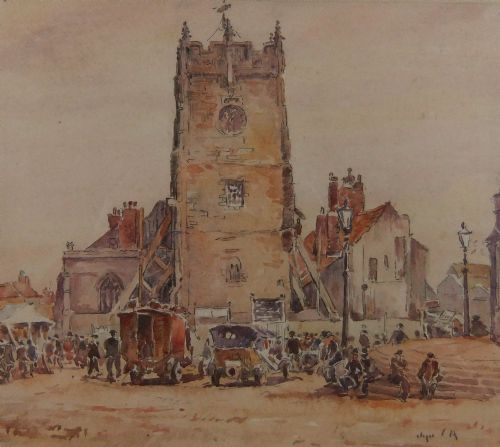
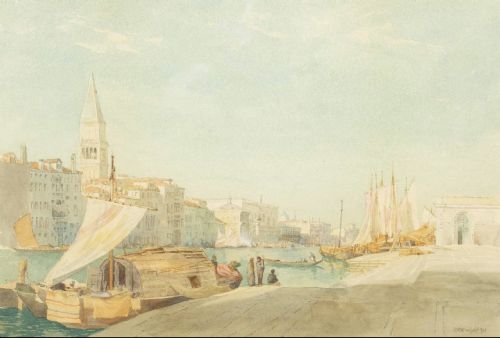
Original architectural watercolour works record specific buildings, street scenes, townscapes, and interior decorative schemes from the nineteenth and twentieth centuries. These paintings range from detailed studies of cathedrals and abbey ruins to lively views of market squares, bridges, and foreign street scenes.
The selections on this page span the Victorian era, the Edwardian period, and the mid-twentieth century, reflecting British and continental European subjects. Works often combine precise perspective drawing with fluid pigment application to document both grand civic architecture and vernacular cottages.
Buyers will encounter framed artworks and unframed sheets, many signed by listed artists or bearing period inscriptions that identify specific locations in Britain, Italy, France, and beyond.
Materials and technique
Artists painted these works on paper using watercolour pigment and water-soluble paint, frequently laying down initial guidelines in pencil or ink. Many examples incorporate ink lines to define intricate masonry, stone vaulting, or window tracery before applying washes of colour.
The handling combines controlled architectural draughtsmanship with expressive watercolour washes, utilising glass and wooden frames for preservation and display.
The listings span from the nineteenth century through the nineteen-fifties, utilising paper, watercolour, ink, and pencil.
Distinctions in quality
Quality rests upon the precision of the draughtsmanship and the confidence of the brushwork, separating hurried topographical sketches from highly resolved artistic studies. Masterful works demonstrate a clear understanding of perspective, light, and shadow on stone surfaces.
The reputation of the artist and the specific historical interest of the subject matter, such as identified cathedrals or named continental landmarks, further elevate individual pieces above standard topographical examples.
Thomas Ellison·A. Marie Parsons·Richard Henry Wright·Robert Leslie Howey·Alfred George Morgan·Fred Lawson·Sir Thomas Newenham Dean·Anne Dorrien Smith·Charles James Lauder·Rowland Henry Hill·Stanley Orchart·Louie Stanley Maurice Prince·G Villiers Stuart·George Whyatt·Vittore Zanetti Zilla·Joseph W. Milliken·Edith E Caswall·Hercules Brabazon Brabazon·David Small·John Sowden·Jack Merriott·Tom Dudley·David Law·Noel Harry Leaver·Wilfred Knox
The Original Architectural Watercolour Glossary
- Watercolour
- A paint consisting of colour suspended in a water-based solution, applied to paper to create translucent washes.
- Topographical
- Depicting accurate views of specific places, buildings, or landscapes, common in nineteenth-century architectural art.
- Diptych
- A painting comprising two separate panels or sheets displayed together as a single matched pair.
- Wash
- A thin, fluid layer of diluted watercolour pigment spread evenly across paper to render skies, walls, or shadows.
- Provenance
- The documented history and ownership trail of an artwork, often established through signatures or inscriptions.
Original Architectural Watercolour: Frequently Asked Questions
What is an architectural watercolour?
An original architectural watercolour is a hand-painted artwork focusing on buildings, interiors, or townscapes created using water-based pigments on paper. These pieces range from precise studies of church vaulting to atmospheric street scenes.
Artists used ink, pencil, and watercolour to capture the specific details of historical structures across Britain and Europe.
How were these watercolours used?
Many of these works served as preparatory studies for larger projects, records of foreign travel, or finished cabinet pieces for Victorian and Edwardian collectors. Architects and artists produced them to document specific structural details, ruins, and civic spaces.
Over time, these paintings transitioned into decorative fine art collected for their historical and aesthetic value.
How should I display watercolour art?
Watercolour paintings require protection behind glass and away from direct sunlight to prevent the pigments from fading over time. Proper framing with acid-free mounts ensures the paper remains stable and secure in domestic environments.
Keeping them in rooms with stable humidity levels preserves both the paper support and the framing materials.
How do I identify the period of a piece?
Dating relies on stylistic clues, artist signatures, period framing, and ink inscriptions naming specific dates or locations. Victorian and Edwardian works often feature distinct paper types and handwriting styles characteristic of the nineteenth and early twentieth centuries.
Archival records and artist biographies help narrow the window of creation when a specific year is absent.