


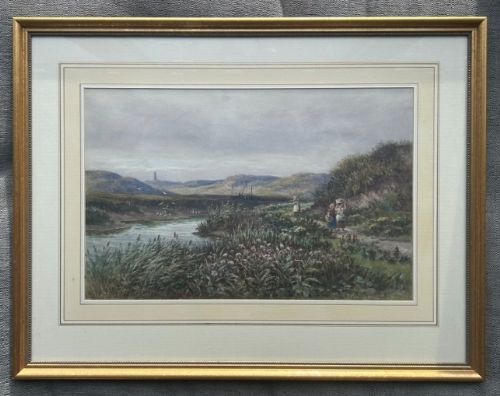


Original 1880s Artwork
Original 1880s artwork brings genuine Victorian character to a room, offering authentic paintings and sketches from the final decades of the nineteenth century.
Original 1880s Artwork
When you search for original 1880s artwork, you encounter genuine Victorian paintings and works on paper created during the decade of 1880 and surrounding years. These pieces span various traditional subjects including maritime scenes, rural English landscapes, floral still lifes, and figure studies.
The selections available here lean heavily into Victorian academic and marine styles, alongside Luminist and French Realism approaches. Works range from intimate pencil and watercolour sketches to substantial framed oil paintings on canvas.
Subject matter reflects the interests of the period, capturing castles, coastal views, river scenes, and domestic moments. Each piece serves as a direct window into the artistic output of the late nineteenth century.
Factors that distinguish quality
Quality in these period pieces rests upon the surety of the artist's hand and the successful handling of light and composition. A stronger work demonstrates confident brushwork or pencil control, creating depth and convincing atmosphere within the scene.
The preservation of the medium also shapes the piece, from the stability of the oil paint and canvas to the retention of pigment vibrancy in watercolours. Framing and the presence of original signatures further distinguish the individual works.
Original 1880s Artwork Retail Price Guide 2026
Typical asking prices for original 1880s artwork among the pieces listed under this phrase on Sellingantiques today, from the lower quarter to the upper quarter. They describe what is for sale here now, not the wider market.
A French floral still life from eighteen-eighty-four preserves humble anemones arranged in a wicker basket.
Frans Gailliard·William Frederick Settle·James Orrock·Colin H Greenwood·Robert Anderson·Montagu Barstow·Robert Gemmell Hutchison·William Edward Millner
The Original 1880s Artwork Glossary
- Grisaille
- A painting executed entirely in shades of grey or neutral greyish-brown, often used for preparatory studies or to imitate sculpture.
- Gouache
- An opaque water-based paint consisting of pigment, water, and a binding agent such as gum, producing a heavier finish than transparent watercolour.
- Luminism
- An American and European landscape painting style from the mid-to-late nineteenth century that emphasises effects of light in landscapes, using concealed brushstrokes.
- Gesso
- A plaster-like mixture used as a base for moulding or framing before painting or gilding takes place.
- Victorian Academic
- Art produced in accordance with the standards and styles taught by official European art academies during the reign of Queen Victoria.
Original 1880s Artwork: Frequently Asked Questions
How do I identify an 1880s painting?
Examine the materials, stretcher bars, and framing style, which often match Victorian manufacturing methods. Signatures, dates inscribed on the reverse, and stylistic markers specific to the late nineteenth century provide further confirmation.
Paper quality and canvas weave also offer clues to the period. Comparing the technique to documented artists of the decade helps verify the creation date.
How should I care for a watercolour from this era?
Watercolours are sensitive to light and require placement away from direct sunlight to prevent fading. Framing behind glass with acid-free mounts protects the paper from environmental damage and atmospheric pollutants.
Maintain stable humidity levels in the room to prevent warping or foxing on the paper. Professional conservation framing ensures the longevity of works on paper.
What subjects were popular in the 1880s?
Artists of this decade frequently painted maritime scenes, coastal views, rural landscapes, and still life compositions. Genre scenes depicting everyday domestic or working life were also widely produced.
Topographical views of castles and rivers appealed to collectors of the period. Floral still lifes demonstrated technical skill with colour and texture.
How do oil and watercolour differ here?
Oil paintings on canvas offer robust surfaces with visible brush texture and rich colour saturation. Watercolours on paper provide a more delicate, transparent quality that captures light differently.
Oils are generally more resilient and mounted on stretchers, whereas watercolours require framing under glass for physical protection. Both mediums represent distinct facets of late nineteenth-century art.