
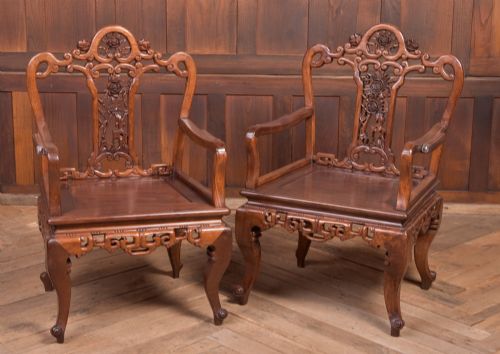


Oriental Wooden Armchairs Pair
These oriental wooden armchairs pair offerings bring substantial historical seating into your rooms, combining structural timber with traditional craftsmanship from the nineteenth and early twentieth centuries.
Oriental Wooden Armchairs Pair
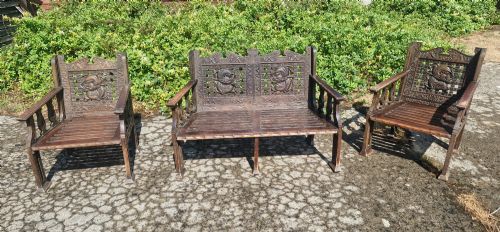
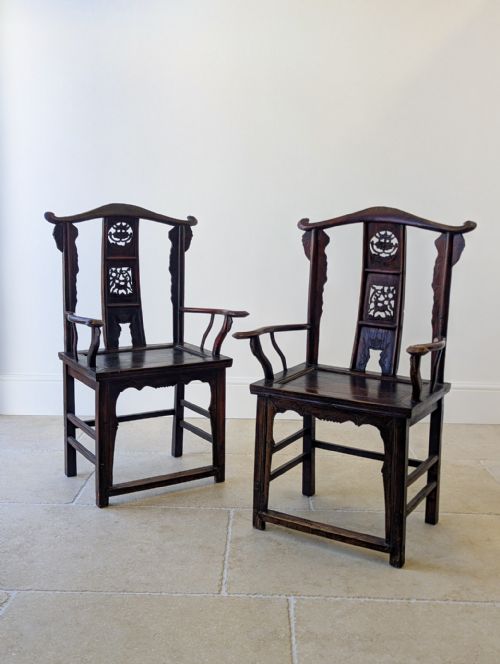
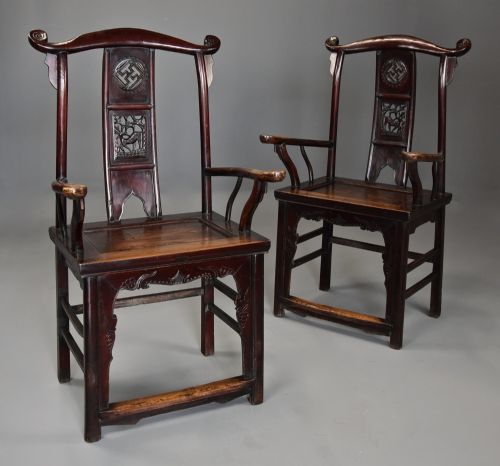
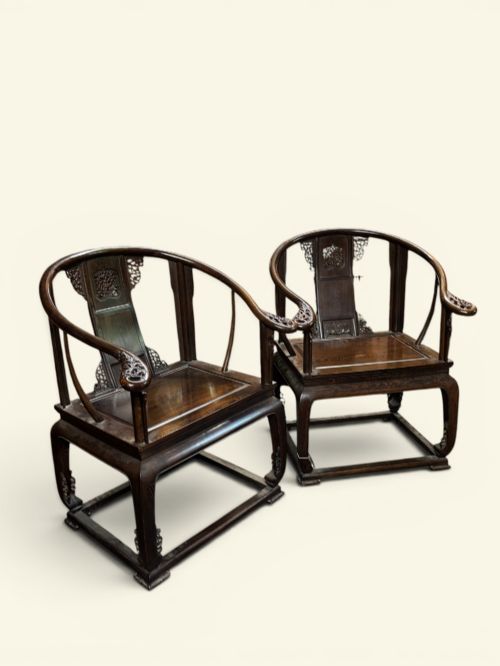
When you search for an oriental wooden armchairs pair, you are examining seating options spanning the nineteenth century through to nineteen twenty, including Victorian interpretations and specific styles from the Qing Dynasty. The pieces take several distinctive forms, most notably yoke-back chairs, horseshoe-back designs, scholars chairs, and corner chairs.
These pairs serve both functional seating roles and decorative focal points, reflecting diverse regional aesthetics from Chinese Ming and Qing traditions to British colonial interpretations. Each set demonstrates the matched proportions and symmetry valued by makers of these periods.
Materials and construction methods
The makers utilised durable timbers including elm, teak, rosewood, and dark hardwood to build frames capable of enduring decades of daily use. Joinery techniques often relied on precise interlocking wood joints without relying on metal fasteners.
Surface treatments recorded in the evidence include applied red lacquer and intricate brass inlay work set directly into the wood. Some seating also incorporates woven cane elements within the seat bases to provide flexible support.
Listings incorporate items dated from eighteen fifty through to nineteen twenty, featuring materials such as elm, teak, rosewood, cane, and red lacquer.
Distinctions in quality and execution
The separation between standard production and superior examples lies in the depth of carving, the preservation of original surface finishes such as red lacquer, and the clarity of timber grain. Chairs displaying a good natural patina or intact brass inlay demonstrate careful historic maintenance and superior initial material selection.
Structural integrity and the fidelity of historic styles, such as authentic Qing Dynasty yoke-back proportions or scholar chair lines, further distinguish the range. Consistency of matching within a pair indicates whether two seats were conceived together from the outset.
The Oriental Wooden Armchairs Pair Glossary
- Yoke-back
- A traditional chair design featuring a crestrail that curves upwards and outwards resembling an ox yoke. This form provides distinct head support and marks scholars and official seating.
- Horseshoe-back
- A continuous curved arm and backrail that sweeps down in a single fluid line from the top to the seat supports. This ergonomic form offers rounded armrests for comfort.
- Elm
- A resilient hardwood widely utilised in Chinese cabinet making for its toughness and fibrous grain. It accepts lacquering and finishing treatments readily.
- Lacquer
- A durable natural resin coating applied in multiple layers to seal and decorate wooden surfaces. Red variants are frequently preserved on nineteenth-century seating.
- Patina
- The surface sheen and colour depth developed by timber and lacquer over decades of handling and ageing. A good patina reflects organic wear rather than artificial distress.
Oriental Wooden Armchairs Pair: Frequently Asked Questions
How do I date an oriental wooden armchairs pair?
Dating relies on combining stylistic evidence with material indicators such as timber type, lacquer application, and joinery wear. Nineteenth-century examples often display specific regional forms aligned with Qing Dynasty aesthetics.
Examination of the timber's surface degradation and the oxidation of the wood beneath finishes also helps establish the age of the pieces.
Where were these chairs originally placed?
Historic Chinese armchairs frequently occupied scholar's studies, reception halls, or ancestral homes where seating hierarchy mattered. Anglo-Indian elbow chairs served colonial residences and drawing rooms.
Today, these pairs transfer easily into modern living spaces as statement seating or reading chairs.
Are cane seats original on these chairs?
Cane work was utilised historically on specific elbow and side chair variants to provide lightweight and breathable seating surfaces. Evaluating the tension and material integration helps determine authenticity.
Replacements often utilise modern materials that contrast with nineteenth-century hardwood frames.
How should I care for lacquered timber?
Lacquered surfaces require stable indoor humidity levels and protection from direct sunlight to prevent cracking or fading. Dusting should be performed with a soft, dry cloth.
Avoid chemical polishes and liquid cleaners that might degrade the historic finish or soften the underlying resin.
What defines a scholar chair?
Scholar chairs feature restrained geometric lines and sturdy yoke-backs designed to promote upright posture during reading and writing. They avoided excessive ornamentation in favour of balanced proportions.
Elm and dense hardwoods were the preferred materials for these functional scholar seats.