


Open Twist Stands
Open twist stands comprise tall candlesticks and multi-tiered whatnots carved with helical turns, offering a striking vertical line for period interiors.
Open Twist Stands
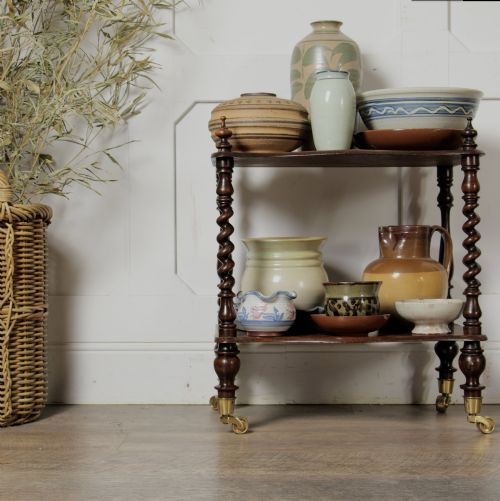
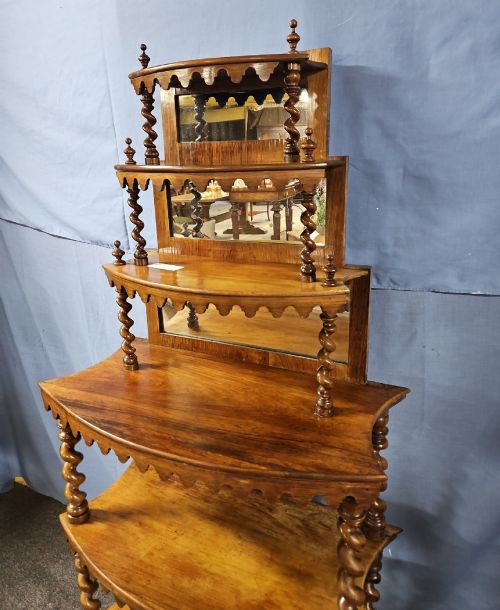
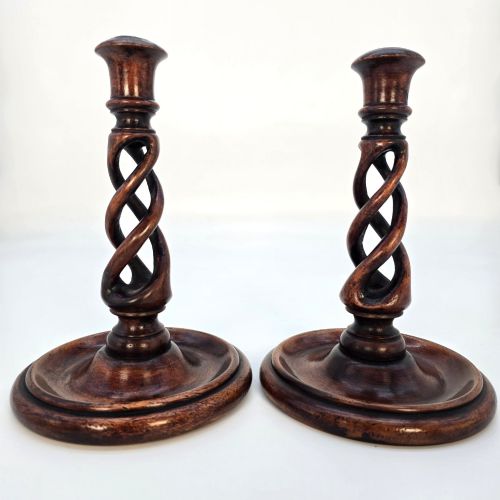
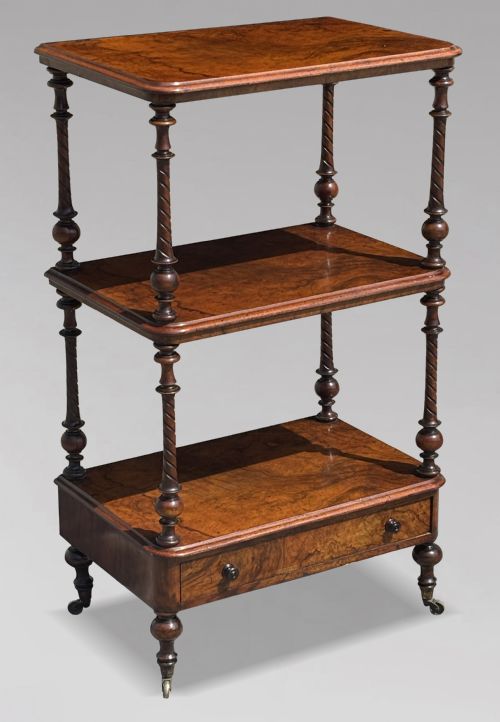
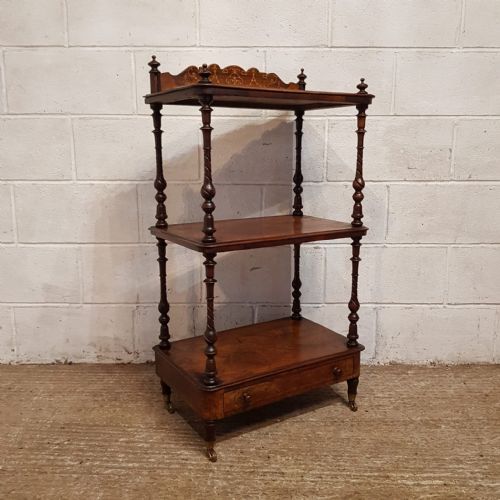
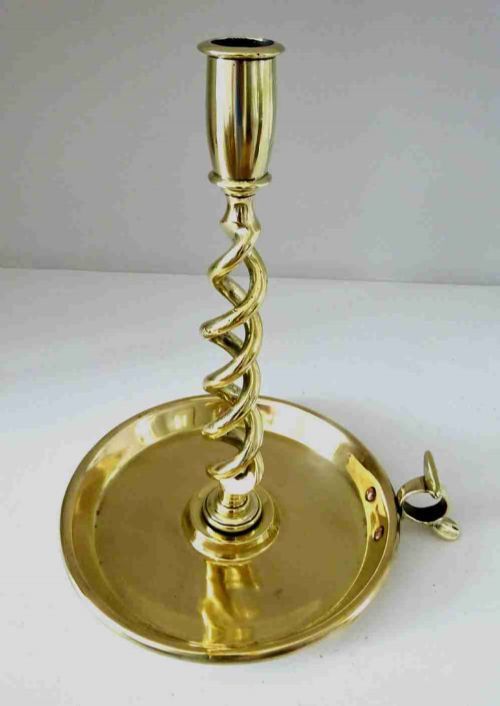
Open twist stands encompass a distinct group of antique furnishings featuring helical or spiral shafts, appearing primarily as tall candlesticks and multi-tiered display shelves. When searching for open twist stands, buyers encounter items ranging from towering wooden whatnots and etageres to pairs of brass or oak candlesticks designed to elevate interior spaces.
The pieces on this page span the eighteenth, nineteenth, and early twentieth centuries, drawing on periods such as the Georgian, Regency, Victorian, and Edwardian eras. Forms vary from six-tier burr walnut display units and mahogany bookstands to slender oak and fruitwood shafts supported by fitted bases.
Makers and manufacturers utilised styles stretching from Jacobean Revival to Arts and Crafts and French Chateau influences. The resulting inventory provides functional shelving units and decorative lighting supports that anchor a room with architectural rhythm.
Materials and construction methods
Makers constructed these stands using dense cabinet timbers like walnut, burr walnut, rosewood, mahogany, oak, and fruitwood, alongside cast or turned brass. Timber sections were shaped on lathes or hand-carved to achieve the characteristic helical open twist, then joined with traditional cabinetmaking techniques suited to multi-tier shelving and slender candlestick shafts.
Surface finishes rely on the natural grain of rosewood and walnut or incorporate glass inserts, mirrored backings, and fitted brass tops. Candlestick mounts and whatnot galleries frequently integrate brass components to secure structural joints and accentuate the turned wooden profiles.
Distinctions in craftsmanship
Quality in these stands rests upon the precision of the helical carve and the integrity of the timber selection. Finer examples display crisp, deep twists with continuous lines across multi-tiered shelves or tall candlestick shafts, utilising highly figured burr walnut, rosewood, or padouk rather than plain secondary woods.
Structural stability dictates the upper tier of the range, particularly in multi-tier whatnots and etageres where vertical columns must support heavy shelf loads without wobble. Superior pieces demonstrate expert joinery at the tier intersections and refined turning that maintains symmetry throughout the height of the object.
The Open Twist Stands Glossary
- Whatnot
- A piece of furniture consisting of a set of open shelves for small objects, popular in the nineteenth century. These units often feature multiple tiers supported by turned columns.
- Etagere
- A French term for a piece of furniture with a series of open shelves for displaying ornaments. They serve a similar decorative purpose to whatnots.
- Barley twist
- A carved wooden or cast metal column resembling a twisted rope or barley sugar stick. This motif defines the structural shafts of many candlesticks and stands.
- Demi-lune
- A half-moon shape used for console tables and wall-adjacent display furniture. Such pieces fit snugly against vertical surfaces while projecting outward.
- Padouk
- A heavy tropical hardwood valued for its durability and rich red-brown tone. Makers utilised it in nineteenth-century Anglo-Indian cabinetry.
Open Twist Stands: Frequently Asked Questions
What is an etagere?
An etagere is a multi-tiered open shelf unit designed for displaying decorative objects, books, or small collections in a living space.
These pieces provide vertical storage and visual interest without enclosing items behind cabinet doors, making them suitable for parlours and drawing rooms.
How were whatnots used?
Victorian households utilised whatnots to hold ornaments, books, and curiosities within easy reach in sitting rooms and libraries.
Their stacked tier arrangement allowed families to display numerous decorative items while occupying a minimal footprint on the floor.
How do I date a twist stand?
Dating relies on identifying the primary timber species, construction joinery, and stylistic revival influences evident in the piece.
Early examples often utilise fruitwood or oak with hand-cut joins, while later Victorian and Edwardian items frequently feature burr walnut veneers and machine-assisted turning.
Where should I place a whatnot?
Whatnots work well against plain walls in hallways, living rooms, or bedrooms where their open shelves can display ceramics, books, or plants.
Their slender profiles and mirrored or wooden tiers help catch ambient light while keeping floor areas uncluttered.