
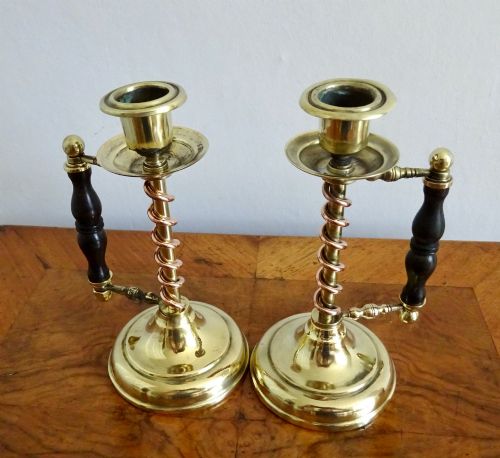

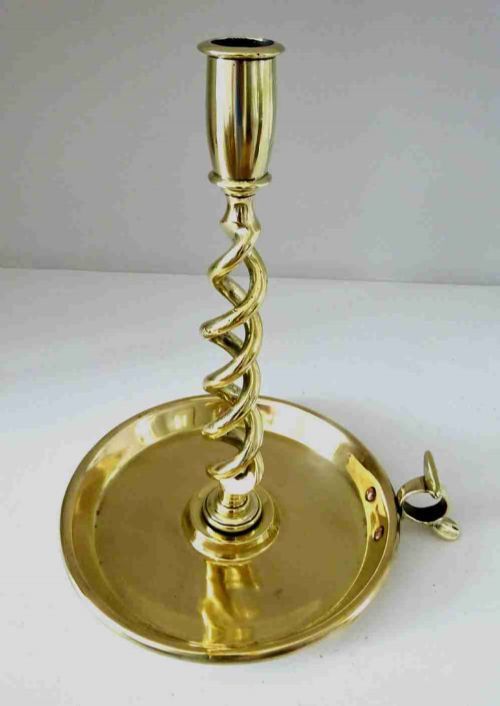


Edwardian Spiral Candlesticks
Edwardian spiral candlesticks bring tactile warmth to a room through turned timber and polished metal.
Edwardian Spiral Candlesticks
Edwardian spiral candlesticks combine the domestic lighting forms of the early twentieth century with fluid turned profiles. When you search for Edwardian spiral candlesticks, you encounter pieces that translate earlier styles into domestic accessories.
The selections on this page span the late nineteenth century through to the nineteen-twenties, incorporating Victorian remnants and Arts and Crafts influences. Oak and brass predominate, creating heavy proportions suitable for tabletop display.
Makers utilised both turned wood and cast metal, sometimes combining materials within a single pair. These objects served to illuminate rooms before electric lighting dominated, and they survive today as decorative mantel and table ornaments.
Construction and Materials
Turned wood forms the core of many pieces, shaping oak into barley twist columns that require precise lathe work. Wood sections are frequently joined to fitted bases to ensure stability on flat surfaces.
Brass and copper components provide contrast and durability, appearing as drip pans, nozzles, or weighted bases. Metal parts are cast or spun, then polished to highlight the reflective surfaces against dark timber.
Listings feature oak, brass, and copper, spanning Victorian, Edwardian, and Arts and Crafts styles.
Judging Quality
Quality rests in the precision of the turning and the harmony of mixed materials. Sharply defined twists in the timber indicate skilled lathe work, whereas softer profiles suggest hurried production.
Proportion and weight distinguish finer examples from standard household items. Well-weighted bases and substantial brass fittings provide structural balance that flimsy alternatives lack.
T Thomason & Co
The Edwardian Spiral Candlesticks Glossary
- Barley Twist
- A cylindrical column carved or turned in a helical spiral resembling a stalk of barley. This profile became popular in revival furniture and lighting.
- Arts and Crafts
- A design movement valuing handcraft, traditional materials, and simple utility over industrial mass production. Objects from this tradition emphasise honest construction.
- Drip Pan
- A small metal collar fitted beneath the candle nozzle to catch melting wax. It protects the wooden or metal shaft below.
- Turned Wood
- Wood shaped on a lathe by rotating the material against cutting tools. This technique creates symmetrical spindles and columns.
Edwardian Spiral Candlesticks: Frequently Asked Questions
How do I clean brass components safely?
Use a soft cloth and a mild metal polish designed for unlacquered brass. Avoid abrasive pads that scratch the historic surface.
Take care to keep liquid polish away from any adjacent wood sections to prevent staining the grain.
Can these candlesticks be converted into table lamps?
Certain taller specimens lend themselves to electrical conversion by threading a cord through the central axis. This modification adapts antique turnings for modern illumination.
Retaining the original candle socket preserves historical integrity for collectors who prefer unmodified items.
How do I identify oak versus other timbers?
Oak displays distinct visible grain patterns with medullary rays appearing as small flecks across the surface. Other woods used in these turned pieces show smoother or tighter grain structures.
Darker patination often develops over decades of handling and exposure to light.