
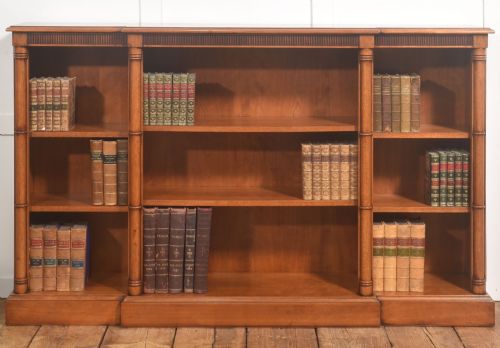
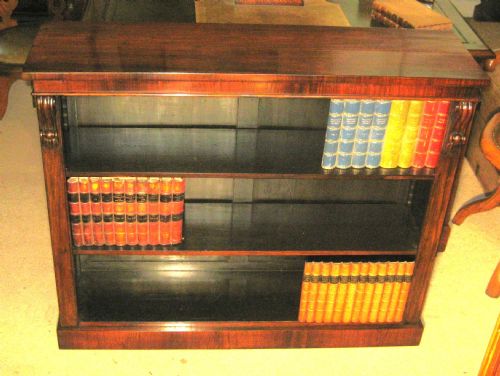
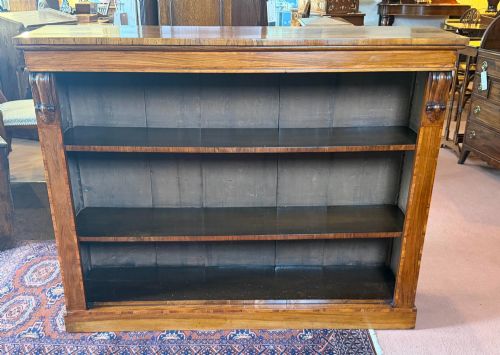
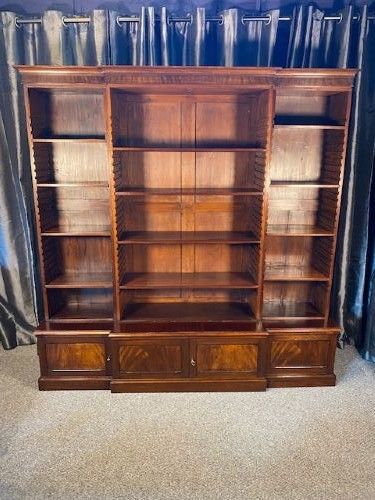
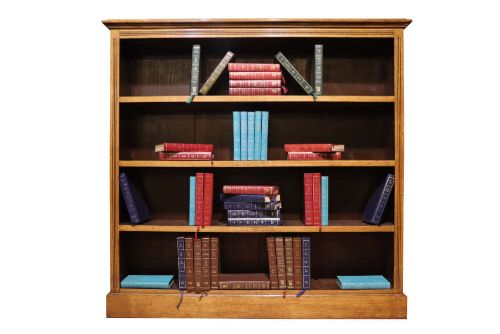
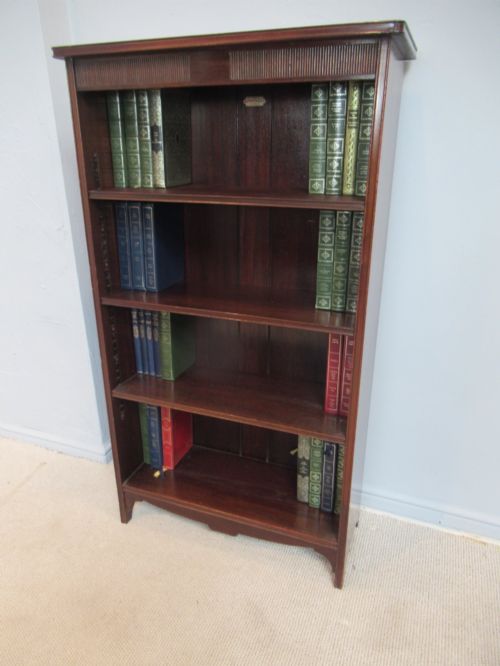
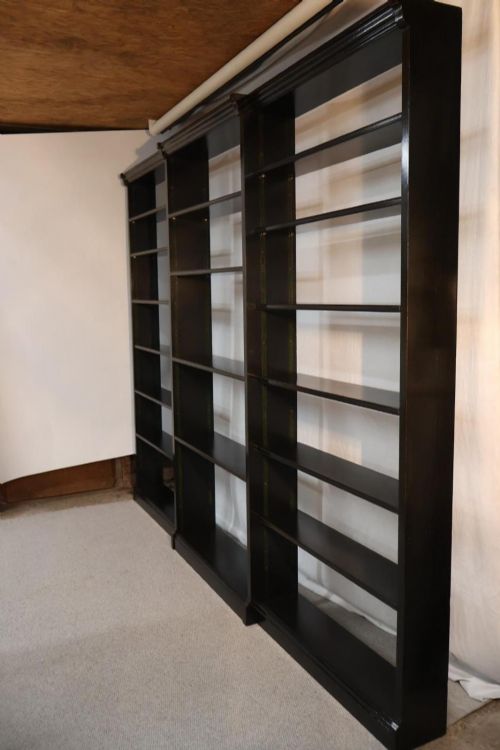


Open Face Book Shelves
Open face book shelves offer an honest display for a library, bringing timber grain and period proportion straight to the wall.
Materials and Construction
Cabinet makers utilised solid timbers alongside flame mahogany veneer to construct these shelves, building carcases from oak, mahogany, walnut and rosewood. Ebonised wood appears alongside brass mounts for decorative contrast on specific pieces.
Many examples incorporate height-adjustable shelves supported by wooden bearers or brass tracks, allowing the interior space to accommodate volumes of varying heights. Joinery methods reflect the period of manufacture, ranging from traditional dovetailing in nineteenth-century workshops to early twentieth-century construction.
Assessing Quality and Proportion
Quality in these pieces rests upon the selection of timber, such as figured rosewood or flame mahogany veneer, and the crispness of any carved detailing. Finer examples display balanced proportions and careful attention to structural joints that maintain rigidity across wide spans.
The integration of adjustable shelving mechanisms and solid brass hardware distinguishes more considered cabinet making from simpler utility pieces. Secondary woods used for carcase backs and interior linings also indicate the standard of workshop production.
Several bookcases come with adjustable shelves, sparing future generations from the tyranny of fixed shelf heights.
Waring and Gillows
The Open Face Book Shelves Glossary
- Breakfront
- A cabinet design where the central section projects forward from the flanking wings. This configuration breaks the linear monotony of long walls.
- Flame mahogany veneer
- A thin slice of mahogany timber cut from the fork of the tree to create a distinctive flickering flame pattern. Cabinet makers applied this to prominent surfaces for visual depth.
- Ebonised wood
- Timber treated with a dark stain or chemical process to resemble ebony. It provides a stark, formal contrast in nineteenth-century furniture.
- Regency
- A British design period spanning the early nineteenth century, noted for classical restraint and influenced by archaeological discoveries. Pieces from this era often incorporate clean architectural lines.
Open Face Book Shelves: Frequently Asked Questions
How do I adjust the shelves?
Many period open bookcases feature adjustable shelving resting on wooden support strips or brass rack systems inside the carcase.
Lifting the shelf allows the supporting pegs or brackets to be repositioned into alternative slots to fit different book heights.
Are these shelves suitable for heavy books?
Solid oak and mahogany pieces provide robust support for dense volumes, particularly those featuring fixed partitions or sturdy vertical dividers.
Shorter shelf spans naturally resist sagging better than wide boards loaded with heavy folios.
How do I identify a Victorian bookcase?
Victorian pieces frequently utilise dense timbers like rosewood or heavy mahogany, sometimes featuring deep carved ornamentation or ebonised surfaces.
Construction details such as hand-cut dovetails and timber backboards help confirm nineteenth-century origin.
Where should I place an open bookcase?
These pieces suit studies, living rooms and libraries where direct access to books is desired without opening glass doors.
Placing them away from direct sunlight and heat sources protects the timber and veneer from drying out.