



Open Corner Display Shelf
An open corner display shelf uses neglected angles to present collections, emerging most often in mahogany and walnut across the Victorian period.
Open Corner Display Shelf
An open corner display shelf takes the form of tiered stands, etageres, and corner cabinets designed to fit domestic room angles. These pieces originate primarily from the Victorian and Georgian eras, spanning the 18th, 19th, and early 20th centuries.
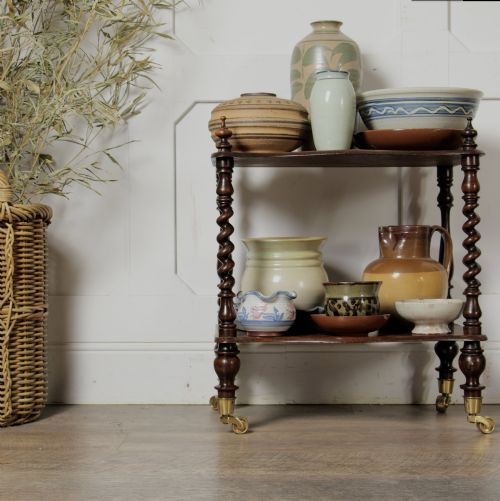
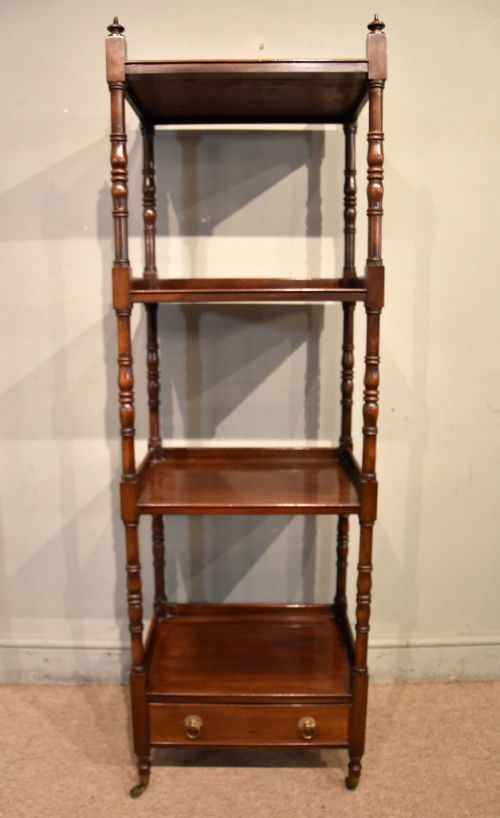
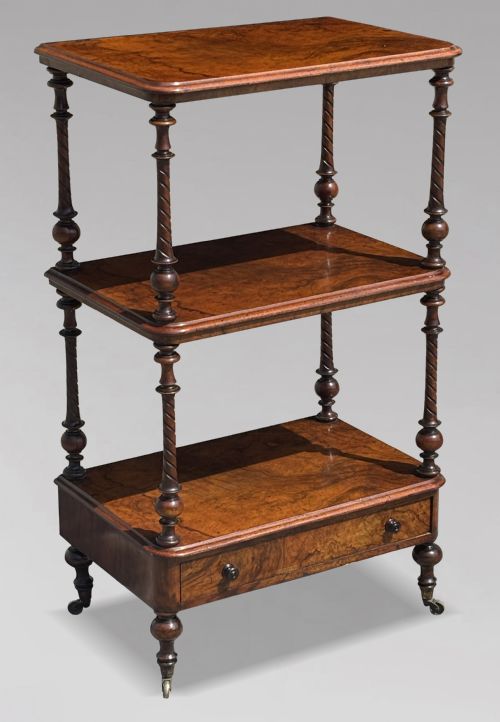
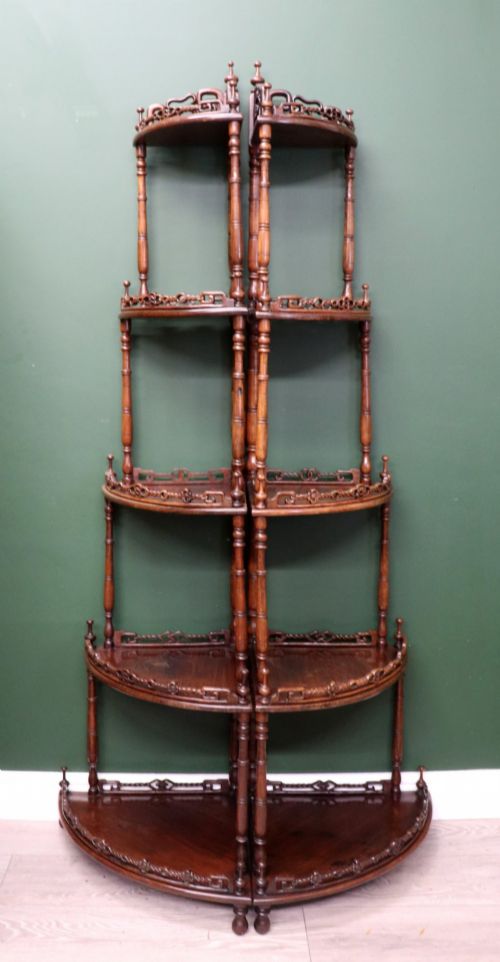
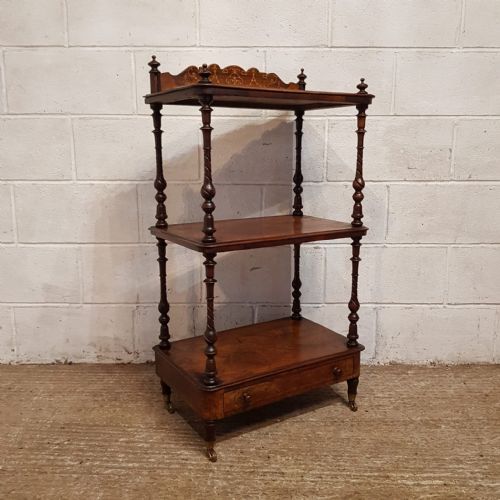
The version a buyer meets most frequently on this page is the multi-tiered walnut or mahogany whatnot, standing independently or hugging a room corner. Makers constructed these units with three to six shelves supported by turned or barley twist columns.
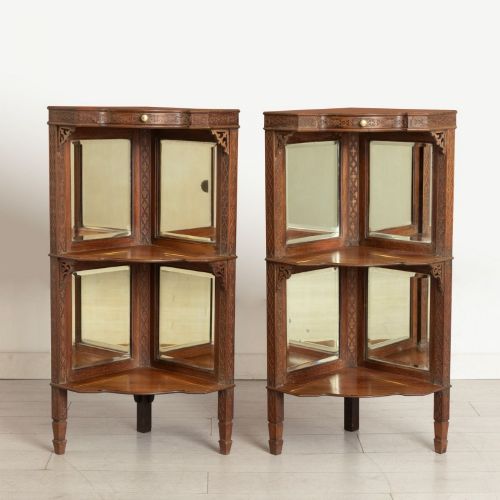
Early examples date back to the Georgian and Regency periods, while later iterations draw on Edwardian and Victorian country aesthetics. Simple pine corner units and grand burr walnut display pieces sit alongside one another in this selection.
Materials and Construction
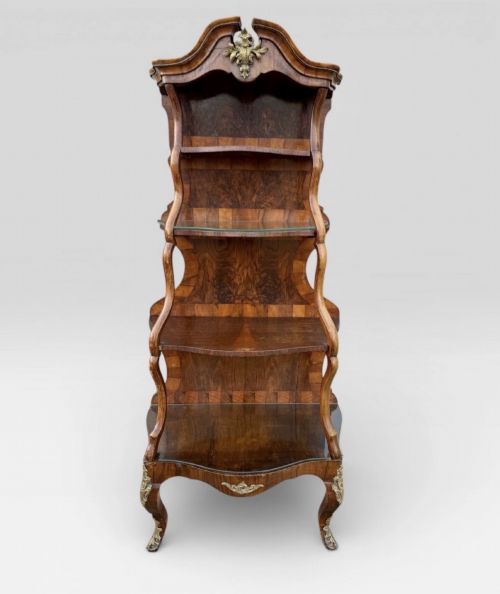
Cabinet makers utilised dense hardwoods including mahogany, rosewood, walnut, and burr walnut, often applying delicate inlay work or brass mounts. Lighter woods like birdseye maple and oak appear in specific regional and period pieces.
Tiered shelves rely on slender vertical supports, ranging from plain cylindrical uprights to hollow barley twists. Structural integrity depends on the tight joining of horizontal platforms to vertical corner uprights or wall fixings.
Period origins on this page stretch from the 18th century through the Georgian, Regency, William IV, Victorian, and Edwardian eras.
The Measure of Craft
The choice of timber veneer dictates the visual depth of a piece, with figured burr walnut and rich rosewood sitting at the upper end of the scale. Plain pine and standard mahogany serve utilitarian or provincial domestic roles.
Refinement of turning on the upright columns and the crispness of inlaid details separate standard workshop production from exhibition pieces. Matched pairs and multi-tiered stands with integrated drawers demand greater joinery skill than simple three-shelf units.
Edwards & Roberts
The Open Corner Display Shelf Glossary
- Whatnot
- A set of open shelves used for displaying ornaments and books. These pieces gained popularity in the 19th century and often feature multiple tiers.
- Etagere
- A piece of furniture consisting of a set of open shelves for displaying small objects or ornaments. The term is frequently used interchangeably with whatnot in period listings.
- Burr walnut
- Wood taken from a walnut tree growth, yielding complex, swirling grain patterns. Cabinet makers prized this material for high-status Victorian display furniture.
- Barley twist
- A carved wooden column resembling the spiral shape of twisted barley. This decorative turning technique appears widely on 19th-century supports.
- Demi-lune
- A half-moon shape used for table and cabinet tops designed to sit flush against a wall. This profile softens the transition between furniture and room corners.
Open Corner Display Shelf: Frequently Asked Questions
What is an open corner display shelf used for?
These shelves provide storage and display space for ceramics, small sculptures, and books in domestic interiors. Multiple tiers allow owners to arrange collections vertically without occupying valuable floor space.
Corner placements turn dead architectural angles into decorative focal points. Many historical examples served as general display units in Victorian drawing rooms.
How do I tell a Victorian whatnot from a Georgian one?
Georgian pieces generally display simpler geometric lines, lighter mahogany construction, and restrained classical proportions. They often reflect earlier cabinet-making traditions before the multi-tiered whatnot gained widespread popularity.
Victorian variants frequently embrace heavier timbers, burr walnut veneers, inlaid decoration, and elaborate turnings like barley twists. The sheer variety of tiers, from three up to six, expands significantly during the 19th century.
Are these shelves sturdy enough for heavy books?
Most tiered stands and etageres were built to hold lighter decorative objects, ceramics, and small display items rather than dense libraries. The slender uprights and corner brackets suit ornamental display rather than heavy weight loads.
Floor-standing units with four or five solid hardwood tiers offer better stability than hanging corner cupboards. Securing taller structures to the wall prevents tipping.
How do I clean mahogany and walnut shelves?
Maintenance requires dusting with a dry, soft lint-free cloth to prevent particulate buildup on carved mouldings and turned columns. Avoid chemical sprays that can degrade historic French polish or wax finishes.
Periodic application of quality beeswax feeds the timber and maintains the natural lustre of walnut and mahogany surfaces. Keep pieces away from direct heat sources to prevent wood splitting.