

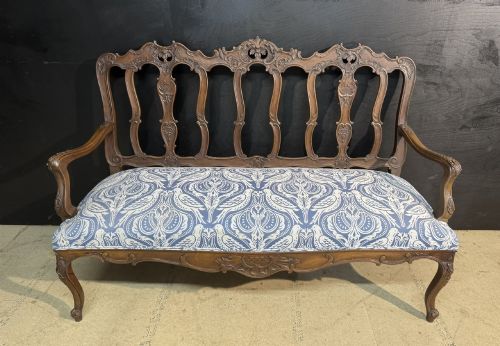


Open Back Settee
An open back settee offers a clever marriage of chair and couch, bringing light and elegance to a room without heavy upholstery blocking the view.
Open Back Settee
An open back settee combines the seating capacity of a couch with the pierced, wooden framework of dining or parlor chairs joined together in a single long frame. When you search for an open back settee, you are looking at forms spanning the nineteenth century, including Georgian and Regency revivals alongside Victorian and Edwardian interpretations.
The most common versions met here take the form of chair back settees, where two, three, or four chair frames merge into a continuous seat. These pieces frequently draw upon Hepplewhite, Chippendale, and Biedermeier design vocabularies, utilising exposed timber to define the silhouette.
Makers produced these pieces in walnut, mahogany, maple, and painted wood, often incorporating brass details or gilt. The seating surfaces are typically upholstered in fabric, velvet, or leather, leaving the wooden tracery of the backrest entirely visible.
How they were made
Cabinetmakers constructed the frames of solid hardwoods such as mahogany and walnut, employing traditional joinery to ensure the interconnected chair backs remained rigid under weight. Skilled hands carved shield backs, pierced splats, and open arms directly into the timber.
Surface decoration involved careful polishing of the grain, alongside applications of gold leaf on painted wood frames or delicate inlay work. Upholsterers then fitted drop-in or fixed seats using fabric, velvet, or leather over traditional stuffing.
Open Back Settee Retail Price Guide 2026
Typical asking prices for open back settee among the pieces listed under this phrase on Sellingantiques today, from the lower quarter to the upper quarter. They describe what is for sale here now, not the wider market.
Some nineteenth century makers apparently decided that ordinary sofas were simply far too solid for their own good and let the daylight straight through.
What varies in quality
The distinction between ordinary and exceptional examples rests in the crispness of the timber carving and the ambition of the design. Pieces that emulate Hepplewhite or Chippendale styles with finely pierced splats and balanced proportions demand greater joinery skill than simpler vernacular versions.
Materials also set the tier of the piece, with richly figured walnut or mahogany, combined with gilt accents or inlaid satinwood, marking out the more sophisticated workshops of the nineteenth century.
The Open Back Settee Glossary
- Chair back settee
- A long seating form constructed with a backrest that mimics a row of joined chairs. This design keeps the room visually open.
- Shield back
- A spade-shaped chair back design popularised in the eighteenth century and revived later. It provides a distinct curved silhouette to the upper frame.
- Open arm
- A chair or settee arm without upholstery padding over the wood. This leaves the structural supports exposed to view.
- Inlay
- A technique where contrasting woods or materials are fitted into recessions in the primary surface. It decorates the mahogany or walnut framework.
Open Back Settee: Frequently Asked Questions
What is an open back settee?
An open back settee is a long seat whose backrest is constructed from open wooden frames rather than a solid, upholstered panel. This design allows light to pass through the piece.
Such seating often takes inspiration from historic chair designs, linking several chair backs together into one cohesive furniture form.
Where should I place an open back settee?
These settees work well in places where a solid sofa would block light or break up a view across a room. They suit hallways, bedrooms, or drawing rooms.
Because the back is decorative, placing the piece where people can walk around it or see it from behind highlights the woodwork.
How do I identify the style?
Style identification relies on examining the woodwork and the shape of the backrest splats. Hepplewhite and Chippendale revivals feature distinct shield or interlaced ribbon patterns.
Biedermeier and Regency examples lean towards cleaner lines, painted surfaces, or gilt highlights reflecting nineteenth century tastes.
Are these settees comfortable?
Comfort depends on the depth of the seat and the padding provided by the upholstery. While the wooden backrest offers firm support, the seat itself is usually cushioned with fabric, velvet, or leather.
Many period examples were designed for formal sitting rather than lounging.