


Officials Hat Chairs
Officials hat chairs are distinctive traditional Chinese seating forms valued for their elegant crestrails, and buyers seek them for striking silhouette and history.
Officials Hat Chairs
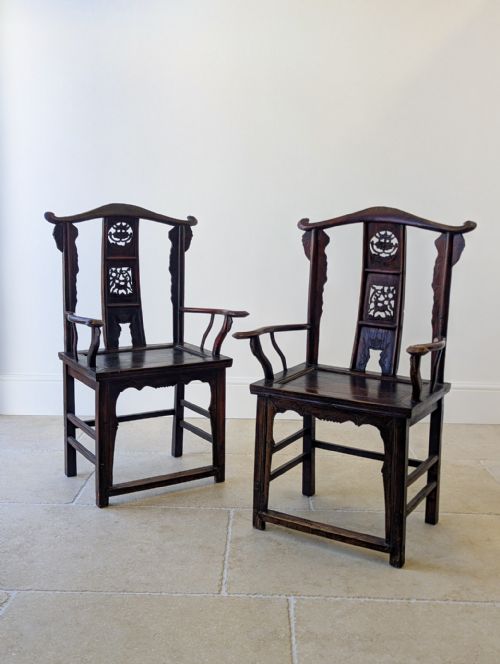
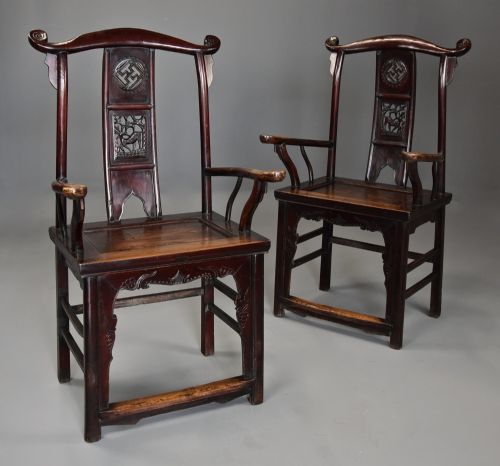
Officials hat chairs, also known as yoke-back armchairs or scholars chairs, are traditional Chinese seating pieces named for the distinctive shape of their top rail which resembles a Ming dynasty official headwear. Buyers examining this page encounter nineteenth-century examples spanning the Victorian era and Qing dynasty production. The forms include armchairs, side chairs, hall chairs, and benches created in traditional Chinese styles.
Most pieces available are pairs of nineteenth-century armchairs or yoke-back chairs dating around eighteen eighty or eighteen seventy. The selection also contains individual armchairs, side chairs, and blonde wood benches originating from the nineteenth and early twentieth centuries. These forms reflect classic domestic and scholarly seating traditions adapted across the nineteenth century.
How officials hat chairs were made
Construction relies upon traditional Chinese joinery executed in timbers such as elm, hardwood, softwood, and blonde wood. Artisans shaped these domestic woods into sturdy frames capable of supporting upright posture without heavy upholstery.
Surfaces frequently feature finishes of lacquer, red lacquer, gold leaf, or painted wood. These applied coats protect the underlying timber while providing the characteristic coloured or polished appearance seen on nineteenth-century examples.
Listings include nineteenth-century elm, lacquer, and painted wood forms originating from Qing dynasty traditions.
What varies in quality
Quality rests upon the preservation of original surface treatments and timber character. Pieces retaining untouched red lacquer, gold leaf, or aged elm patination stand apart from examples with diminished or heavily restored finishes.
Proportion and structural crispness define the finer pieces in this range. The definition in the crestrail curve and the integrity of matched pairs dictate the distinction between standard room furniture and superior scholarly seating.
The Officials Hat Chairs Glossary
- Yoke-back
- A chair design featuring a crestrail that curves upwards at the ends like a traditional official headdress. This shape provides comfortable shoulder support and defines the scholarly aesthetic.
- Elm
- A durable hardwood utilised extensively in traditional Chinese furniture making. It accepts lacquer finishes well and develops a rich patination over centuries of use.
- Lacquer
- A protective and decorative coating derived from tree sap applied in multiple layers. Historic examples often display red pigmentation or gold leaf accents.
- Patina
- The surface sheen and colour acquired by wood and lacquer through age and handling. Good patination indicates authentic historic wear.
- Qing Dynasty
- The final imperial dynasty of China lasting from sixteen forty-four to nineteen twelve. Many decorative arts and seating forms available date from the late nineteenth century of this period.
Officials Hat Chairs: Frequently Asked Questions
What makes an officials hat chair distinct?
The defining feature is the curving top crestrail that extends beyond the upright posts. This silhouette resembles the winged hats worn by imperial officials.
These chairs were designed for upright posture, reflecting the formal manners of scholars and officials in traditional Chinese households.
Where were these chairs used in a home?
They served as formal seating in reception halls, studies, and scholars' rooms. Pairs were often arranged symmetrically against walls or beside tables.
Today, buyers place them in living rooms, hallways, or studies where their sculptural silhouettes act as focal points.
How do I care for lacquered wood furniture?
Lacquered surfaces require gentle dusting with a soft, dry cloth to prevent abrasion. Avoid placing them in direct sunlight or areas with fluctuating humidity.
Maintaining stable indoor conditions preserves the original red lacquer, gold leaf, and underlying timber.
How can I tell the period of these chairs?
Dating relies on timber characteristics, construction methods, and surface wear consistent with nineteenth-century production. Nineteenth-century examples often display traditional elm grain and authentic lacquer patination.
Comparative analysis of Qing dynasty styles helps distinguish nineteenth-century pieces from later twentieth-century interpretations.