
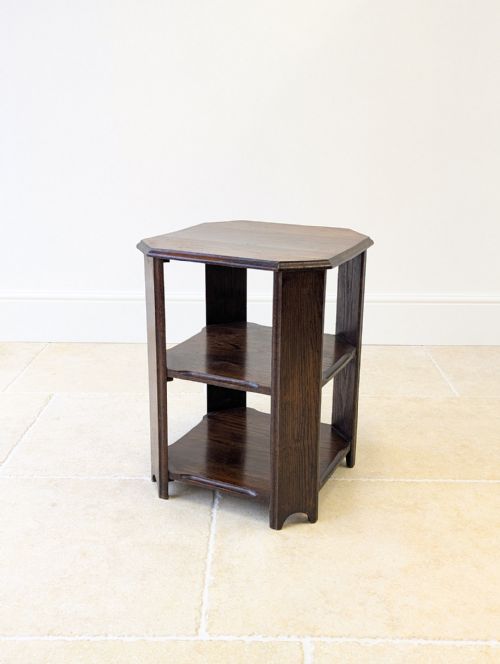
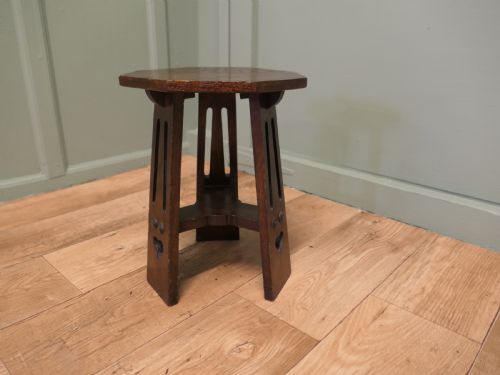
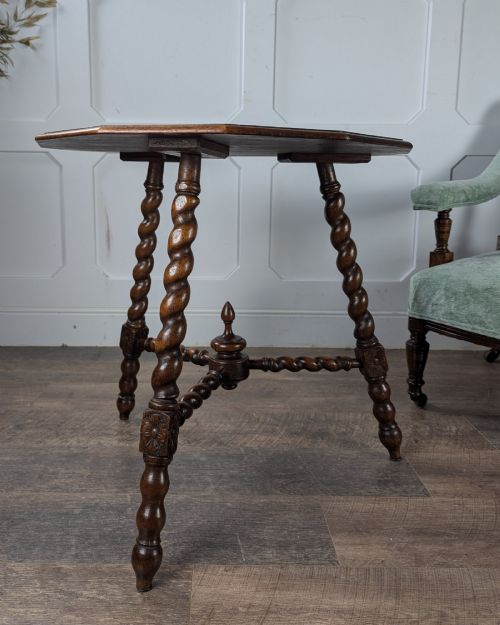
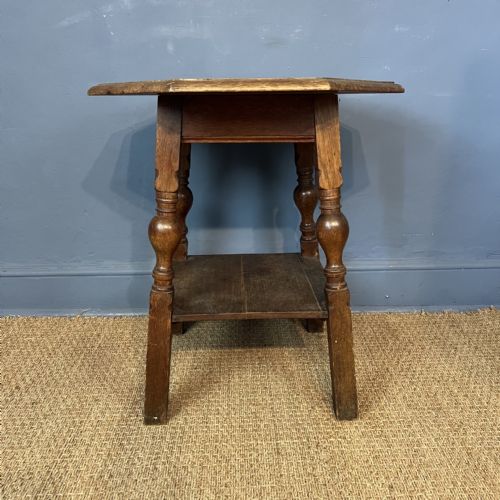
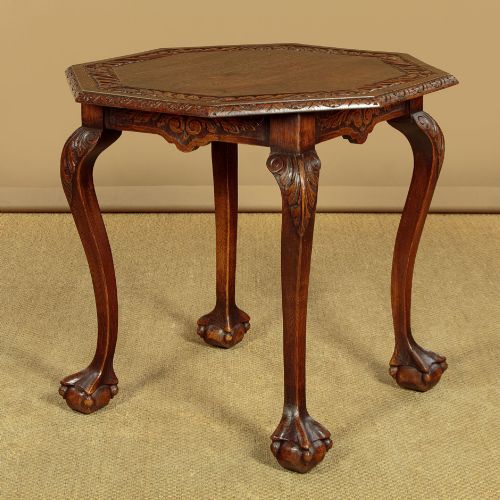
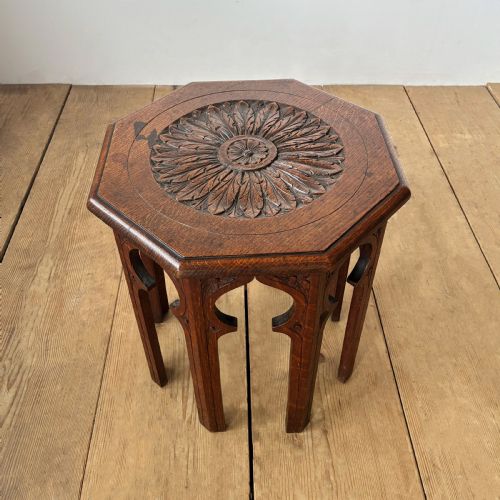


Octagonal Oak Plant Stand
An octagonal oak plant stand brings architectural geometry and hard timber into a corner, holding a heavy pot or a lamp with sturdy grace.
Octagonal Oak Plant Stand
When you search for an octagonal oak plant stand, you encounter pieces that double as occasional tables, candle stands and multi-tiered etageres. The examples here span from the eighteenth century through the Victorian era and the Arts and Crafts movement into the nineteen-thirties.
Most pieces you meet on this page wear the straight-grained timber and unpretentious build characteristic of Arts and Crafts workshops or later revival periods. They take the form of small side tables with eight-sided tops, supported by barley twist legs or upright columns.
Moorish Revival and Gothic influences occasionally shape the profile, giving you pierced decoration or pegged construction. Whether used for foliage or as a low coffee table, each piece relies on solid oak to carry its weight.
How they were made
Makers built these stands using solid oak and selected hardwoods, joining tops and legs with traditional pegs and mortise joints. Timber selection focused on durability and grain pattern, allowing the wood to handle damp pots and daily knocks.
Carving and turning shaped the uprights, producing barley twist columns or chamfered posts that define the legs. Some pieces feature limed finishes or dark wax treatments applied to protect the surface while accentuating the growth rings.
Listings include solid oak pieces from the eighteenth century, the Victorian era, and nineteen-thirties revivals.
What varies in quality
The distinction between ordinary and exceptional work lies in the crispness of the carpentry and the thickness of the oak top. Superior pieces display hand-cut joints and thoughtful proportions that keep the eight-sided form balanced.
Surface treatment and timber selection also set pieces apart. Better examples utilise dense, quartersawn oak with prominent medullary rays, finished with deep patination rather than modern varnishes.
Liberty and Co
The Octagonal Oak Plant Stand Glossary
- Octagonal
- Having eight sides and eight angles. This geometric plan creates a compact footprint while offering more surface area than a square.
- Barley twist
- A type of turning shaped like a spiral rope. It became popular during the seventeenth century and returned in later revival furniture.
- Etagere
- A piece of furniture consisting of a set of open shelves for displaying small objects. They often feature multiple tiers supported by slender columns.
- Quartersawn
- Timber cut radially from the log so the growth rings meet the face at a steep angle. This method produces stable boards with decorative grain patterns.
- Limed oak
- Wood treated with a white pigment or lime to highlight the open grain. This finish gained popularity during the art deco period.
Octagonal Oak Plant Stand: Frequently Asked Questions
What is an octagonal oak plant stand?
An octagonal oak plant stand is a small piece of furniture with an eight-sided top, designed originally to elevate ferns or heavy ceramic pots. These versatile items also function as side tables or low coffee tables in compact spaces.
They appear in various styles from the eighteenth century onwards, utilising solid oak and durable hardwoods to support heavy loads without tipping.
How do I identify Arts and Crafts pieces?
Arts and Crafts stands emphasise honest construction, visible joinery, and the natural grain of solid oak. They reject mass-produced ornamentation in favour of simple geometric forms and practical utility.
Look for pegged joints, chamfered edges, and occasionally carved decoration that reflects medieval or gothic design influences.
Can these stands hold heavy pots?
Solid oak construction provides the structural strength required to support heavy ceramic planters and damp soil. The eight-sided top distributes weight evenly across the central pillar or multiple legs.
For extra security, look for pegged under-tiers or cross-stretchers between the legs that brace the entire frame against lateral movement.
Where should I place an etagere?
Multi-tiered etageres and plant stands fit well in corners or beside seating where vertical display space is needed. Their compact footprints allow them to hold lamps, books, or trailing plants without crowding a room.
Keep them away from direct heat sources and sudden temperature changes to protect the historic oak timber from drying out or splitting.
What is barley twist turning?
Barley twist turning is a decorative woodworking technique that shapes timber into a continuous spiral column. This classical detail adds texture and visual movement to the legs of tables and stands.
Originating in earlier centuries, the motif saw a major revival during the Victorian period and the early twentieth century on oak occasional furniture.