
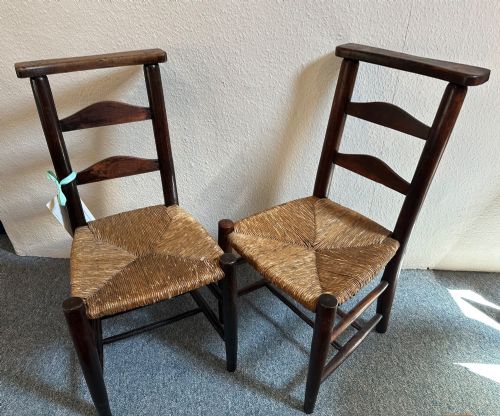


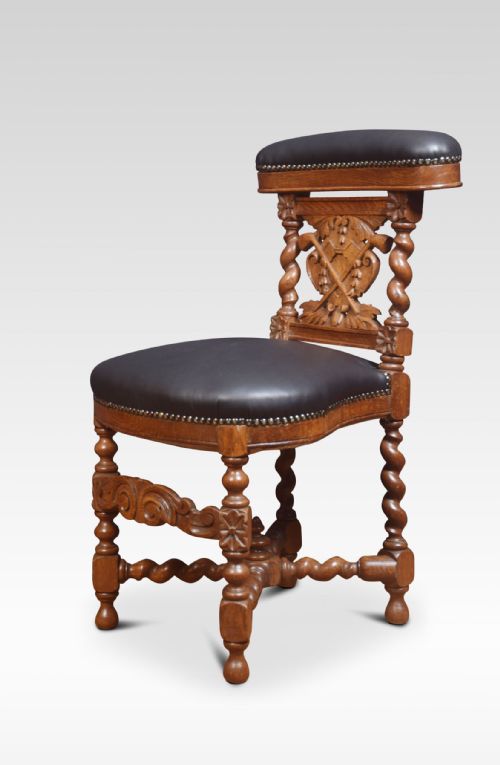


Oak Prayer Chair
An oak prayer chair brings centuries of ecclesiastical craft and quiet domestic devotion directly into your sitting room.
Oak Prayer Chair
An oak prayer chair is a specialised devotional seat designed for private contemplation or church service, often incorporating a kneeling shelf or low seat.
The versions you meet on this page span the nineteenth century and the Edwardian era, bearing stylistic roots in Gothic Revival, Jacobean Revival and Victorian ecclesiastical design.
Forms range from simple side chairs and occasional chairs to metamorphic prie-dieu seats, rector's chairs, and pieces bearing marks from notable institutions like St Paul's Cathedral.
Makers utilised sturdy timbers to create functional devotional furniture that served both grand cathedrals and modest chapel interiors.
Materials and construction
Carpenters relied primarily on solid oak, supplemented occasionally by mahogany and walnut, shaping structural elements with traditional joinery and deep relief carving.
Designers incorporated secondary materials such as brass plaques, metal fittings, leather, rush, and woven fabric to enhance both durability and devotional utility.
Craftsmen applied fretted top rails, incised detailing, and sculptural elements like those found in Black Forest styles to elevate plain timber into distinctive ecclesiastical seating.
Some chairs bear direct marks from St Paul's Cathedral, bringing a literal piece of London's skyline straight to your fireside.
Assessing quality and character
Quality rests in the depth and clarity of the woodwork, distinguishing deeply carved relief work and crisp architectural tracery from simpler, utilitarian workshop output.
The integration of original hardware, such as engraved dedication plaques or cathedral stamps, separates standard institutional seating from pieces with documented provenance.
The Oak Prayer Chair Glossary
- Prie-dieu
- A devotional desk or chair designed specifically for kneeling and prayer, usually featuring an upper rest for the arms and a lower shelf for the knees.
- Gothic Revival
- An architectural and decorative style drawing on medieval forms, featuring pointed arches, trefoils, and heavy timber construction.
- Metamorphic
- A descriptive term for furniture engineered to fold, shift, or transform into a secondary configuration, such as a seat converting into a kneeling bench.
- Ecclesiastical
- Pertaining to the Christian church and its clergy, denoting items manufactured specifically for use within religious buildings.
Oak Prayer Chair: Frequently Asked Questions
What is a prie-dieu chair?
A prie-dieu is a dedicated devotional seat featuring a padded or carved shelf at the top for resting arms during prayer. Below the seat or attached to the front, a matching kneeler allowed the user to maintain a reverent posture.
These pieces were common in Victorian and Edwardian homes for private morning and evening worship. They combine domestic comfort with austere religious design.
How do I date an oak prayer chair?
Dating relies heavily on stylistic markers, timber patination, and any accompanying maker marks or engraved brass plaques. Pieces from the mid-nineteenth century often display heavy Gothic Revival motifs, while Edwardian examples can feature lighter framing.
Comparing construction joints and hardware with known ecclesiastical commissions helps narrow the decade of manufacture. Institutional stamps can also point directly to specific cathedral or church orders.
Were these chairs used in homes?
Many prayer chairs were manufactured specifically for domestic use, allowing devout families to conduct private prayer within their bedrooms or studies. Wealthier Victorian households frequently maintained dedicated rooms for daily devotions.
Simultaneously, larger batches were produced for cathedrals and parish churches, some of which eventually entered the domestic market. Their compact footprints make them versatile for modern hallways and corners.
What is a metamorphic prayer chair?
A metamorphic prayer chair includes a clever mechanical design allowing the backrest or seat to pivot and fold into a kneeling bench. This dual-purpose engineering saved space in smaller vestries or private chapels.
Makers used discrete hinges and pivots that maintained the structural integrity of the oak frame while enabling the transformation. They represent clever nineteenth-century carpentry tailored to specific liturgical needs.