

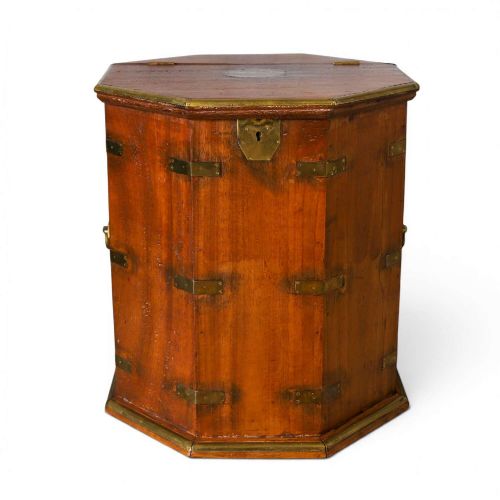


Oak Military Chest
An oak military chest is a robust, modular box designed for campaign travel, prized for its clever storage and brass detailing.
Oak Military Chest
An oak military chest is built in sections to withstand frequent transport by officers on campaign. These pieces appear most frequently as two-part drawer chests, trunks, and presentation boxes from the nineteenth century, including Victorian examples.
The form prioritises structural integrity and portability, featuring recessed brass handles and reinforced corners to endure rough handling. Examples range from plain storage trunks to fitted chests of drawers and specialised silverware or deed boxes.
Most entries belong to the broader Victorian period or mid-nineteenth century, retaining the characteristic modular stacking design. Buyers encounter both utilitarian travel chests and inscribed presentation pieces associated with specific regiments.
Materials and construction
Makers utilised solid oak, sometimes pollard oak, paired with secondary woods like pine for interior drawer linings. Brass strapping, corner brackets, and flush-fitting hardware protected the edges and allowed units to pack tightly together.
Iron fittings and hinges provided additional strength on heavy trunks and silver chests, whilst velvet linings occasionally protected delicate contents. Paintwork appears in the form of regimental inscriptions and personalised campaign letter-work.
Oak Military Chest Retail Price Guide 2026
Typical asking prices for oak military chest among the pieces listed under this phrase on Sellingantiques today, from the lower quarter to the upper quarter. They describe what is for sale here now, not the wider market.
The inventory records pieces linked to specific historical units, including the Boer War and the Highland Light Infantry.
Assessing quality and origin
Quality rests in the precision of the brass work, the tightness of the joinery between stacked sections, and the presence of original inscriptions or regimental provenance. Finer items exhibit superior timber selection, such as figured pollard oak, and retain their original recessed hardware.
Utility pieces made for straightforward transport sit at the simpler end, whilst bespoke officer chests with secretaire drawers or specialised silver fittings represent higher tiers of craftsmanship. Original period documentation or clear military provenance elevates a piece above standard stock.
Army And Navy CSL
The Oak Military Chest Glossary
- Campaign chest
- A modular chest of drawers built in two or more sections with recessed handles for military transport.
- Brass bound
- Furniture reinforced with brass corners, straps, and banding to protect against knocks during travel.
- Secretaire chest
- A chest featuring a fitted writing drawer that pulls out and drops down to reveal small compartments.
- Pollard oak
- Oak timber taken from trees pollarded to produce heavily figured, knotted grain patterns prized by cabinet makers.
- Presentation box
- A commemorative box or small chest given to mark an officer's service or a regimental event.
Oak Military Chest: Frequently Asked Questions
Why are these chests made in two parts?
Two-part construction made heavy furniture manageable to pack, load, and transport on active military campaigns. Each section stacked securely upon the other for stability during transit.
This modular design allowed officers to move their essential belongings swiftly without damaging the timber framework.
How do I spot a genuine campaign chest?
Genuine examples feature flush brass handles that fold flat into the drawer fronts so nothing catches during movement. Look for reinforced corners and sectional locking systems designed for travel.
Original pieces often show honest wear and carry regimental inscriptions or maker stamps inside the drawers.
Can I use an oak military chest in a modern bedroom?
These chests function exceptionally well as bedside tables, living room storage, or bedroom drawer units due to their compact proportions. Their robust construction suits everyday domestic use.
The classic timber finish and brass details complement both traditional and contemporary interiors.
What is the difference between a trunk and a chest of drawers?
Trunks open from the top with a hinged lid to provide deep, open storage for bulky items or uniforms. Chests of drawers feature horizontal sliding drawers accessible from the front.
Both formats were adapted for military travel, though chests offered better organisation for daily garments.
How do I care for the oak and brass?
Maintain the timber by applying a traditional beeswax polish occasionally to preserve the grain and prevent the wood from drying out. Avoid excessive moisture and direct heat sources.
Clean the brass hardware gently with a soft cloth, leaving the natural patina intact rather than polishing it to a bright shine.