
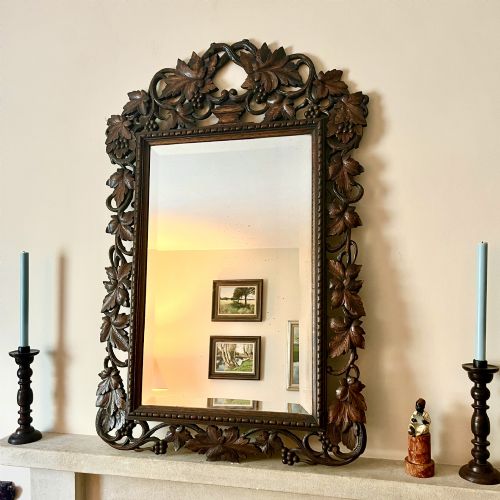
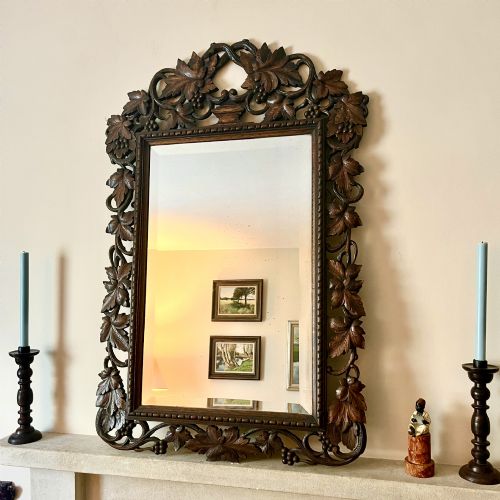


Oak Leaf Carved Mirror
An oak leaf carved mirror brings tactile depth and rich natural grain to a room through robust timber frames.
Oak Leaf Carved Mirror
An oak leaf carved mirror combines sturdy timber construction with intricate foliage decoration, spanning wall mirrors and table mirrors. Pieces on this page predominantly date from the nineteenth century, including Victorian and Edwardian examples, alongside earlier eighteenth-century work.
Makers shaped these frames in diverse styles ranging from Rococo Revival and Black Forest to Arts and Crafts and Renaissance Revival. The forms vary from large wall hung pieces to cushion frame mirrors and vanity mirrors designed for dressing spaces.
How they were made
Craftsmen shaped these frames from solid oak and carved wood, frequently applying gesso to form relief details before adding gold leaf accents. The mirror glass itself is typically bevel edged and housed within deep cushion frames or structured wooden borders.
Regional workshops utilised traditional hand-carving techniques to render naturalistic foliage motifs with deep undercutting. Some variations integrate painted finishes alongside the exposed carved oak grain.
Some Victorian frames are carved so deeply with foliage that real forest debris settles happily into the leaves if left undusted.
What varies in quality
Quality rests upon the depth and crispness of the foliage carving, where sharper, more undercut leaf work indicates superior hand execution. The integrity of the original oak timber and the retention of early gilding or gesso likewise elevate a piece above simpler production.
The sophistication of the stylistic revival, from straightforward Victorian framing to complex French Rococo or Black Forest compositions, dictates the relative refinement of the mirror.
The Oak Leaf Carved Mirror Glossary
- Gesso
- A plaster-based compound applied to wood surfaces to create a smooth base for gilding or to build up low-relief carved details. It provides the crisp white ground beneath gold leaf layers.
- Cushion Frame
- A convex, rounded frame profile that swells outward toward the outer edge. This bold volumetric shape creates strong shadows around the mirror glass.
- Black Forest
- A nineteenth-century carving style originating in Switzerland, known for highly naturalistic renderings of local flora and fauna. These pieces often feature deeply detailed foliage and animal motifs.
- Rococo Revival
- A nineteenth-century design movement resurrecting the asymmetrical scrolls, C-scrolls, and organic plant forms of the eighteenth-century French style. It relies heavily on swirling ornamentation.
- Bevel Edge
- A glass edge ground and polished to an angled slope, creating a decorative framed border within the glass itself. This technique catches light distinctively around the perimeter.
Oak Leaf Carved Mirror: Frequently Asked Questions
Where should I hang an oak leaf carved mirror?
These pieces suit principal reception rooms, hallways, or above mantelpieces where their robust timber frames can anchor the wall space.
Position them opposite windows to maximise the reflection of natural light while showcasing the carved foliage detail.
How do I care for the carved oak frame?
Dust the deep crevices of the carving regularly with a soft, dry brush to prevent the accumulation of debris in the leaf work.
Avoid liquid cleaners or polishes that might damage the underlying gesso or alter the dry surface of the aged timber.
What periods do these mirrors come from?
The selection spans primarily the nineteenth century, encompassing Victorian, Edwardian, and earlier eighteenth-century examples.
Stylistic markers such as Rococo Revival or Arts and Crafts influence help align specific pieces with their respective decades of production.