



Oak Enfilade Credenza
An oak enfilade credenza brings substantial storage and French provincial character into a room.
Oak Enfilade Credenza
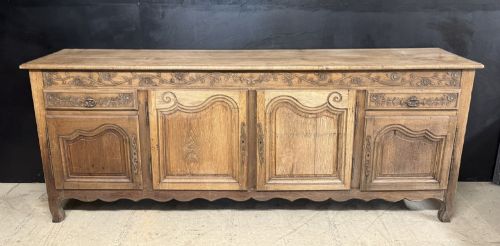
When you search for an oak enfilade credenza, you are looking at substantial French storage furniture designed for dining rooms and large living spaces. These low, long sideboards and buffets provide immense surface area and deep cupboard space behind multiple doors. You will frequently encounter nineteenth-century pieces alongside mid-twentieth-century examples and earlier eighteenth-century forms.
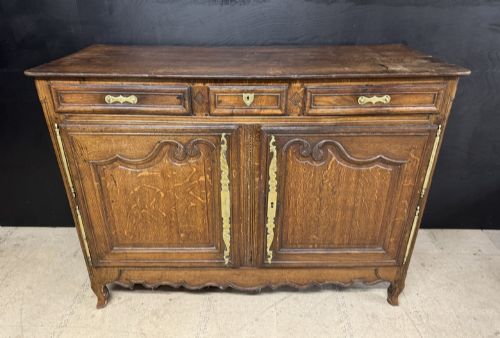
The versions you meet on this page lean heavily towards French provincial, Louis XV style, and French Art Deco aesthetics. Regional makers utilised solid oak and chestnut, often pairing the timber with marble tops or parquetry surfaces. Form follows function with these cabinets, offering long lines that anchor a dining room wall effectively.
How they were made
Joiners built these heavy cabinets using solid oak and occasionally chestnut, framing panels by hand with traditional mortise and tenon joints. Carved ornamentation on doors and rails was executed directly into the timber rather than applied as separate mouldings. Surfaces were finished simply or painted, while parquetry tops showcased precise geometric wood placement.
Hardware played an essential functional and decorative role, with heavy brass and wrought iron hinges and keyplates securing the long doors. Later twentieth-century pieces incorporated marble tops, adding substantial weight and a cool, durable surface to the wooden carcass. Every material was chosen to withstand generations of daily use in busy French households.
Oak Enfilade Credenza Retail Price Guide 2026
Typical asking prices for oak enfilade credenza among the pieces listed under this phrase on Sellingantiques today, from the lower quarter to the upper quarter. They describe what is for sale here now, not the wider market.
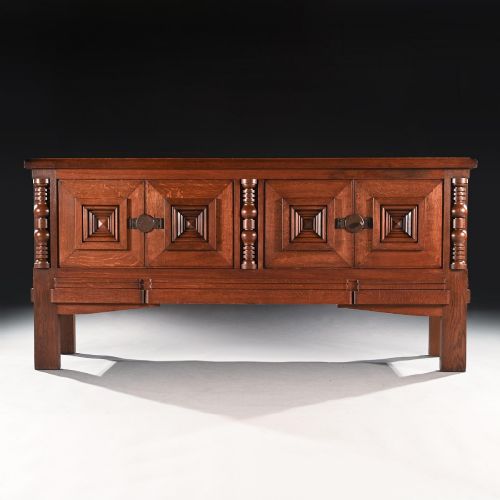
One exceptional twentieth-century cabinet bears the documented signature of Charles Dudouyt, proving that even heavy oak storage can embrace modern French style.
What varies in quality
Quality in these long cabinets lies in the crispness of the timber carving and the architectural proportion of the facade. Superior examples display deep, deliberate hand-carving that integrates harmoniously with the stiles and rails, whereas lesser pieces rely on shallow, mechanical decoration. The integration of materials, such as a tightly fitted marble slab set neatly into the oak frame, distinguishes the better workshops.
Construction heft and timber selection also divide the standard range from the exceptional. Dense, mature oak boards with straight grain and minimal warping indicate a higher grade of manufacture from the outset. Original brass or wrought iron hardware that fits the scale of the doors without sagging adds considerably to the integrity of the piece.
Charles Dudouyt
The Oak Enfilade Credenza Glossary
- Enfilade
- A long sideboard or buffet featuring a continuous line of multiple doors across the front facade. This form originates in grand French interiors for serving food and storing dining ware.
- Parquetry
- A geometric mosaic of wood pieces used for decorative surfaces, frequently seen on table and sideboard tops. Craftsmen laid contrasting timber grains together to create subtle patterns.
- Buffet
- A low piece of furniture designed for holding crockery and serving meals. These storage units form a primary category alongside sideboards and credenzas.
- Louis XV Style
- A decorative design movement characterised by asymmetrical curves, natural floral motifs, and cabriole legs. Furniture from this tradition emphasises flowing organic lines over rigid symmetry.
Oak Enfilade Credenza: Frequently Asked Questions
What is an enfilade?
An enfilade is a long, low storage cabinet featuring a series of doors spanning the entire length of the front facade. These pieces were traditionally built to serve food and store dining room accessories in French homes.
Their extended horizontal proportions provide vast top surfaces and deep interior cupboards. They function effectively as room anchors in large dining spaces or wide hallways.
How do I date an oak sideboard?
Dating relies on observing construction methods, hardware styles, and the overarching design movement of the cabinet. Eighteenth-century pieces show hand-riven timber and regional provincial carving, while nineteenth-century examples often adopt heavier Renaissance revival details.
Mid-century pieces introduce cleaner lines and materials like marble or parquetry. Comparing the jointing inside the cupboards reveals the period of manufacture.
Where should I place an enfilade?
These cabinets suit long walls in dining rooms, living areas, or wide entrance halls where their substantial length can be appreciated. Because they offer deep interior storage, they hold heavy tableware, linens, or books with ease.
Ensure you measure the floor space and clearance for the doors to swing open fully. Their low profile also allows paintings or mirrors to be hung comfortably above them.
What wood was used?
Solid oak serves as the primary timber for the vast majority of these cabinets, providing immense strength and durability. Regional makers also worked with chestnut, particularly in provincial French pieces.
Secondary materials include marble for table tops and brass or wrought iron for functional hardware. Walnut occasionally appears in specific twentieth-century modernist interpretations.