


Oak Barograph Barometer
These oak barograph barometers are mechanical recording weather instruments housed in timber cases, prized for tracking atmospheric pressure over the week.
Oak Barograph Barometer
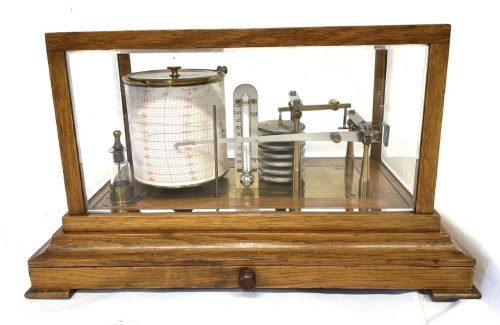
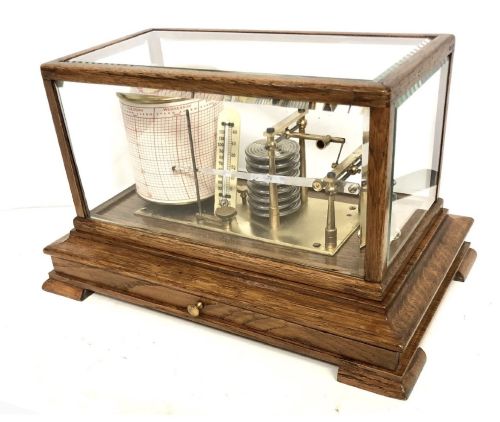
An oak barograph barometer combines a recording weather instrument with a timber housing, often incorporating a thermometer, bevelled glass panels, and a chart drawer below the mechanism. These scientific instruments record air pressure continuously onto paper charts, tracing the shifting weather patterns of the Victorian, Edwardian, and early twentieth-century periods.
The versions most commonly met on this page span the late nineteenth century through to the 1940s, featuring sturdy oak cases alongside occasional examples in mahogany. Many include subsidiary barometer dials or combination weather station formats alongside the rotating drum.
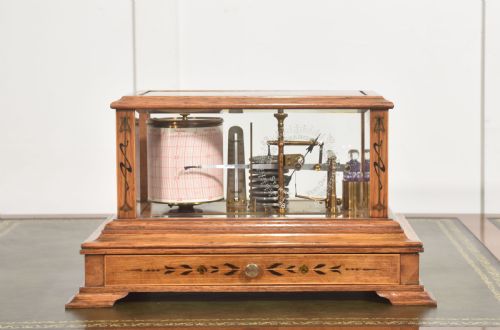
Makers and retailers such as Short & Mason, Negretti & Zambra, and Hezzanith appear frequently within these listings, reflecting the prominence of British scientific instrument manufacturing. Styles range from plain utilitarian Victorian and Edwardian boxes to pieces adorned with Art Nouveau inlay.
Materials and construction
The heavy timber frames rely on solid or veneered oak, paired with brass movements, steel linkages, and glass viewing covers, often formed of five-glass panelled cases with bevelled edges. Paper recording charts and metal ink pens record the mechanical movement driven by stacked vacuum chambers.
Cabinetmakers constructed the housing boxes with integrated lower drawers to store replacement weekly paper charts, whilst instrument makers assembled the delicate aneroid barograph mechanisms and thermometer strips inside the glazed compartments.
Many surviving barographs still contain forgotten ink stains on their brass beds, left behind by Victorian observers recording sudden storms.
Judging quality in scientific instruments
Quality rests upon the crispness of the maker's signature engraved on the bedplate and the precision of the brass mechanism, alongside the clarity and thickness of the bevelled glass panels. Well-executed timber cabinetry featuring dovetail joints and decorative touches like Art Nouveau inlay elevates a standard utility instrument into a finer domestic object.
The presence of original accessories such as the chart drawer, recording arm, and matching thermometer scales distinguishes a complete survival from a depleted housing.
Hezzanith·Short & Mason·Negretti & Zambra·Jules Richard·Dobbie son and Hutton
The Oak Barograph Barometer Glossary
- Barograph
- A self-recording barometer that traces atmospheric pressure onto a paper chart over a weekly cycle. It uses stacked aneroid metal capsules connected to an inked nib.
- Aneroid barometer
- An instrument for measuring air pressure without liquids, using a flexible metal box that expands or contracts as pressure changes. This movement turns the pointer on a dial.
- Bevelled glass
- Glass panes with angled edges fitted into the cabinet frame. This technique adds depth and light reflection to the viewing windows.
- Chart drawer
- A shallow compartment built into the wooden base below the instrument mechanism. It stores spare weekly recording papers and spare ink bottles.
Oak Barograph Barometer: Frequently Asked Questions
How does a barograph work?
A barograph operates through stacked metal capsules that expand and contract with shifts in atmospheric pressure. These micro-movements transfer through a series of brass levers to an arm holding an inked nib, which marks a rotating paper drum.
The rotating drum is driven by an internal clockwork mechanism, completing one full rotation every seven days to provide a continuous visual history of local weather patterns.
What is the difference between a barometer and a barograph?
A standard barometer indicates only the current air pressure reading via a single pointer on a dial face. It shows the atmospheric pressure at the exact moment you look at it.
A barograph records that pressure continuously onto a paper chart over an entire week, allowing you to see the rising and falling trends that indicate incoming weather changes.
Where were these instruments placed in a home?
These instruments typically sat in prominent reception rooms, libraries, or hallways of Edwardian and Victorian homes where guests could observe the scientific mechanism and recent weather trends. Their polished oak and brass cases served as both functional scientific tools and decorative household furniture.
They required stable locations away from direct heat sources and heavy vibrations to ensure the delicate aneroid capsules recorded atmospheric changes accurately.
How do I date an oak barograph?
Dating relies on stylistic clues in the oak case, such as Edwardian architectural mouldings, Late Victorian proportions, or Art Nouveau floral inlay. Maker signatures, paper chart styles, and patent dates engraved on the brass bedplate also help narrow the decade of manufacture.
Later models from the 1930s and 1940s often feature lighter oak tones and simplified cabinet designs compared to the heavier dark timber cases of the nineteenth century.