





North Wales Landscape Art
North wales landscape art captures the dramatic topography and atmospheric waterways of the region through nineteenth-century oils and watercolours.
North Wales Landscape Art
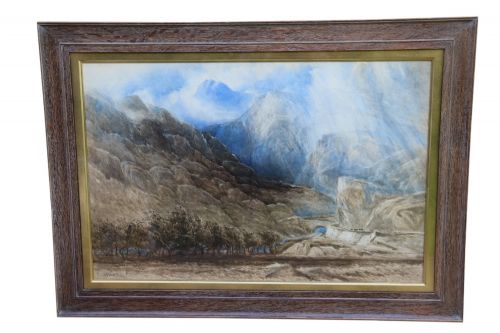
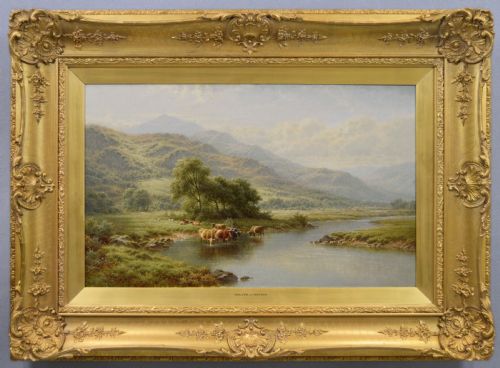
North wales landscape art brings nineteenth-century mountain passes, river valleys and historic castles directly onto the wall. Buyers encounter framed oil paintings on canvas alongside delicate watercolours and painted ceramic plaques.
The nineteenth century dominates the selection, spanning Victorian naturalism and pastoral realism. Common subjects range from the Llugwy and the Conwy to the slopes of Snowdon.
Oil paintings on canvas and paper watercolours form the core of what is available. Collectors also find decorative earthenware plaques hand-painted with local views.
Materials and Technique
Artists painted oil on canvas or applied watercolour to paper, often framing the finished works in moulded wood frames with gesso and gilt highlights. Copeland earthenware pottery plaques provide an alternative ceramic surface for painted Welsh scenes.
Giltwood and gesso frames define the presentation of nineteenth-century canvases. The combination of oil pigments, canvas supports and heavy decorative frames characterises the principal pieces.
North Wales Landscape Art Retail Price Guide 2026
Typical asking prices for north wales landscape art among the pieces listed under this phrase on Sellingantiques today, from the lower quarter to the upper quarter. They describe what is for sale here now, not the wider market.
Listings include oil on canvas, watercolours on paper, and decorated earthenware plaques spanning the nineteenth and early twentieth centuries.
Evaluating Quality
Quality rests in the handling of light across mountainous terrain and the fidelity of local topographical details. Skilled brushwork distinguishes accomplished plein-air observation from formulaic studio production.
The preservation of the original canvas, the depth of the oil pigment and the integrity of the period giltwood frame elevate individual pieces. Hand-painted ceramic plaques depend upon the precision of the miniature ceramic decoration.
Henry Martin Pope·Copeland Pottery·William Yale·Thomas Spinks·Clarence Henry Roe·William Mellor·Walter J Watson·J Barclay·John Cuthbert Salmon·Samuel Sidley·Thomas Swift Hutton·Carleton Grant·George Parson-Norman·James Poole
The North Wales Landscape Art Glossary
- Giltwood
- Wood carved and covered with a thin layer of gold leaf or gilt. This finish frames many nineteenth-century oil paintings.
- Gesso
- A plaster-like mixture applied to wood frames before gilding. It provides a smooth base for intricate moulded ornament.
- Watercolour
- Pigments suspended in a water-soluble vehicle, painted on paper. These works require protective glass glazing.
- Earthenware
- Porous pottery fired at lower temperatures. Copeland plaques utilise this ceramic body for hand-painted views.
- Victorian Naturalism
- An art movement focusing on realistic depictions of the natural world. Landscapes from this period emphasise observed topographical accuracy.
North Wales Landscape Art: Frequently Asked Questions
What periods do these paintings come from?
The selections date primarily from the nineteenth century, encompassing Victorian naturalism and pastoral styles. Artists painted these Welsh scenes between eighteen-forty and nineteen-twenty.
Works from this era reflect contemporary interest in British topography and picturesque scenery. Dates are established through artist signatures, historical records and stylistic evidence.
How should I hang an oil painting?
Hang oil paintings away from direct sunlight and fluctuating heat sources to protect the canvas and paint layers. Secure the frame directly to wall studs using appropriate picture hooks.
Ensure the wall is structurally sound to support heavy giltwood frames. Regular dusting with a soft, dry brush keeps the surface clean.
Are watercolours framed differently from oils?
Watercolours on paper require framing behind glass to protect the delicate medium from moisture and atmospheric pollutants. Oil paintings on canvas are left unglazed to allow the paint surface to breathe.
Paper works also utilise matting boards to separate the painted surface from the glass. This prevents condensation damage over time.
How do I identify a painted pottery plaque?
Ceramic plaques feature hand-painted porcelain or earthenware surfaces mounted within frames. Makers such as Copeland produced these decorative items with specific numbered titles on the reverse.
The painted scene is fired directly into the ceramic glaze, creating a glossy and durable finish. Signatures of the porcelain decorator often appear alongside the manufacturer marks.