



Nineteenth Century Harbour Landscape
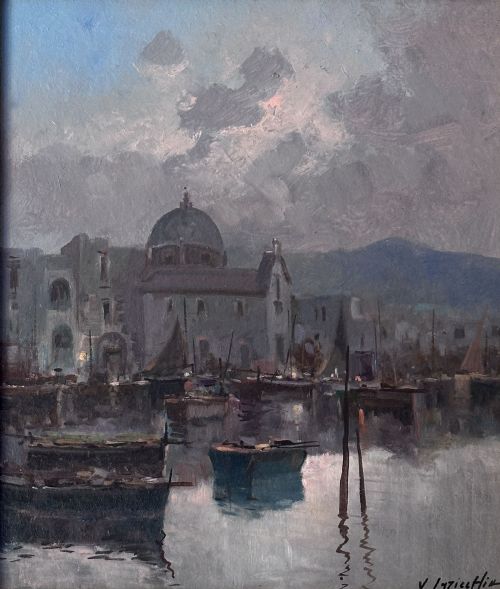
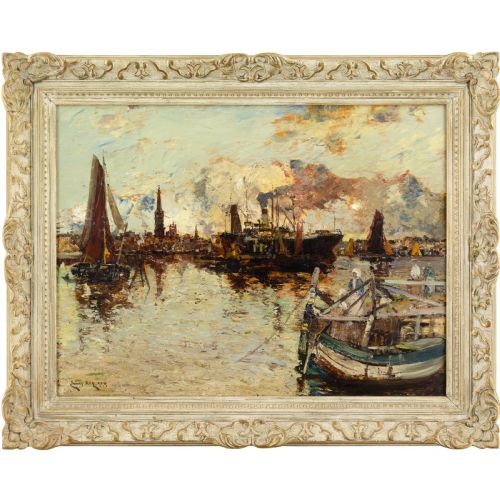
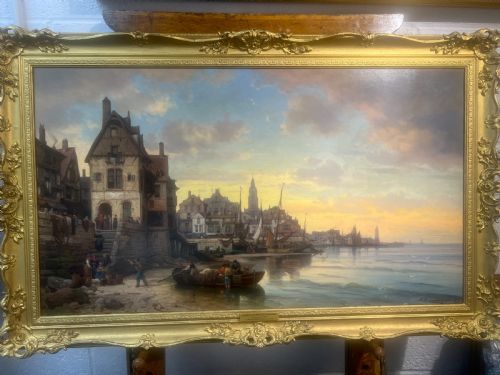
Nineteenth century harbour landscape paintings capture bustling maritime quays, quiet coastal inlets and historic European ports through the evolving brushwork of the period.
Nineteenth Century Harbour Landscape
A nineteenth century harbour landscape brings together maritime shipping, coastal architecture and domestic port activity in oil paint or watercolour. These works range from busy scenes of continental quaysides and Venetian canals to quiet depictions of British fishing ports and river boat yards.
The pieces appearing on this page span the Victorian era into the early twentieth century, taking in both British and continental European settings. You will frequently encounter framed canvases and watercolours depicting specific locations such as Antwerp, Rotterdam, Marseille and Whitby, alongside broader impressionistic coastlines.
Materials and methods
The works rely primarily on oil paint applied to stretched canvas or watercolour pigment worked onto paper. Frames of wood and giltwood frequently accompany the paintings, many retaining their period character.
Artists of the period deployed a shifting range of styles from traditional Victorian maritime precision to looser Impressionism and French Post-Impressionism. Brushwork moves from tight, descriptive handling in earlier decades towards more expressive colourism by the turn of the twentieth century.
Nineteenth Century Harbour Landscape Retail Price Guide 2026
Typical asking prices for nineteenth century harbour landscape among the pieces listed under this phrase on Sellingantiques today, from the lower quarter to the upper quarter. They describe what is for sale here now, not the wider market.
Listings feature works created between the Victorian period and the early twentieth century, using oil on canvas and watercolour pigment.
Distinctions in execution
Quality rests on the confidence of the brushwork and the artist's ability to render light across water and architectural stone. Stronger examples demonstrate a precise command of spatial depth within the crowded rigging and quayside buildings.
The handling of atmospheric effects, such as sunset light or morning mist over a harbour, separates routine topographical recording from more evocative artistic achievement.
James Kay RSW·Richard Henry Wright·Charles Euphraisie Kuasseg·Jean Baptiste Olive·H Hadfield Cubley·Henri Ottman·Ludwig Hermann·Frank Myers Boggs·William Edward Webb·Hubert Thornley
The Nineteenth Century Harbour Landscape Glossary
- Oil on Canvas
- Pigment mixed with drying oil applied to a woven fabric support. This was the primary medium for major maritime paintings throughout the period.
- Watercolour Pigment
- Finely ground colour mixed with a water-soluble binder, applied to paper. It allows for translucent washes particularly suited to coastal light and skies.
- Giltwood
- Wood carved and coated with gold leaf or metallic powder, forming traditional frames for nineteenth-century fine art.
- Impressionism
- A nineteenth-century painting style characterised by relatively small, thin yet visible brush strokes and an emphasis on accurate depiction of light.
Nineteenth Century Harbour Landscape: Frequently Asked Questions
What subjects appear in these paintings?
These works typically show ships, boats, quaysides, and coastal architecture around British and European ports and rivers.
Scenes range from busy international harbours like Antwerp and Venice to quiet local boat yards and fishing ports.
How do I identify the date of a painting?
Dates are often established through artist lifespan records, inscribed titles on the reverse, or stylistic shifts from Victorian realism towards impressionist brushwork.
Works span from the mid-nineteenth century through to early twentieth-century modernist approaches.
Are these works framed?
Many listings include period framing, frequently executed in wood or giltwood that complements the artwork.
Original frames help preserve the historical context of the piece.
What is the difference between oil and watercolour here?
Oil paintings use heavy pigment on canvas, offering rich texture and deep colour layering suited to dramatic coastal skies and water.
Watercolours utilise pigment on paper, providing a lighter, more translucent quality often favoured for atmospheric coastal views.