
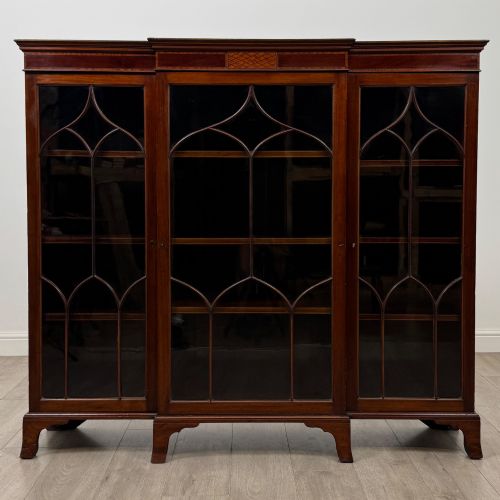
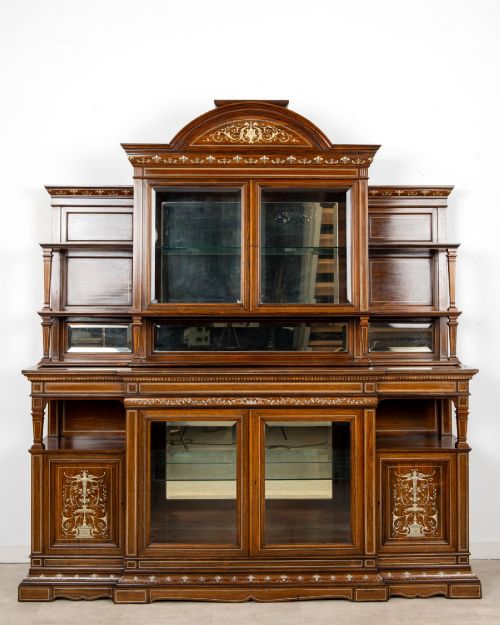
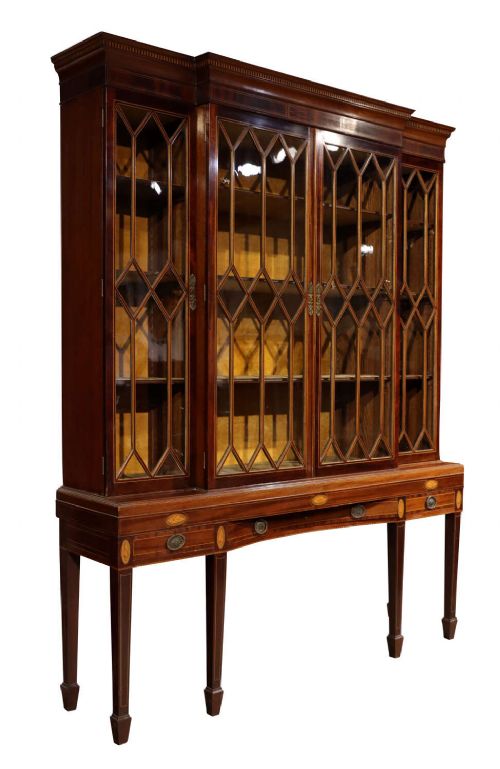
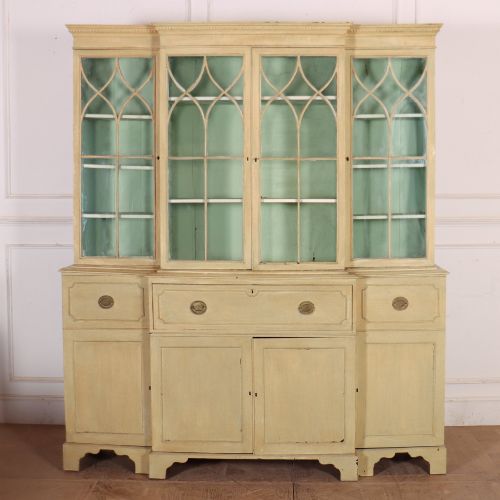

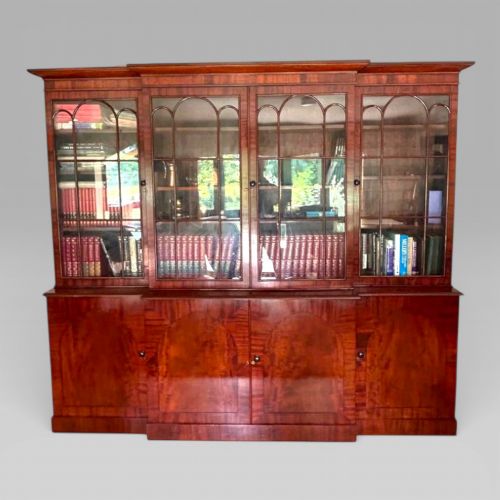
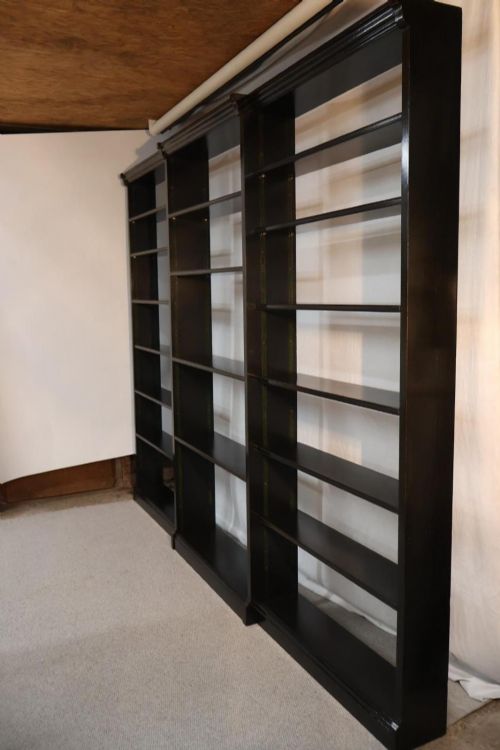


Nineteenth Century Breakfront Bookcase
These nineteenth century breakfront bookcase pieces are substantial statement furniture built to anchor a serious library, offering architectural presence and generous shelved storage.
Nineteenth Century Breakfront Bookcase
A nineteenth century breakfront bookcase displays a characteristic recessed central section flanked by projecting outer wings, a form designed to break up long expanses of wall in formal rooms. The pieces available here span the Regency, William IV, and Victorian periods, alongside later revivals.
Makers utilised dense timbers such as mahogany, rosewood, burr walnut, and oak to construct these large library pieces. Many incorporate glazed upper doors for book display, lower solid timber cupboards, and occasionally secretaire drawers fitted for writing.
The styles range from restrained Regency proportions to heavily carved Victorian Gothic Revival and Sheraton Revival inlays. Buyers seeking a nineteenth century breakfront bookcase will find both grand four-door library editions and smaller open shelving formats.
Construction and Materials
Cabinet makers built these large carcasses using solid foundational timbers like oak and mahogany, applying figured veneers such as burr walnut, rosewood, and pollard oak to the primary display surfaces. Cross-banding and delicate string inlays frequently define the perimeters of doors and drawer fronts.
Glazing bars partition the glass upper doors into geometric patterns, while brass hardware secures the heavy doors. Secondary elements include embossed leather inserts on writing surfaces and carved wooden appliques reflecting Gothic, classical, or revival tastes.
Evaluating Quality
Quality rests upon the choice of timber veneer and the precision of the cabinet work, particularly how cleanly the projecting central section joins the outer wings. Finer examples display continuous grain matching across large drawer fronts and doors.
Carved details and applied brass work distinguish workshop-produced pieces from standard commercial output. The weight of the timber and the depth of the carving in styles such as Gothic Revival set superior examples apart.
Jas Shoolbred·Collinson & Lock·Gillows·Holland & Sons·Lamb of Manchester
The Nineteenth Century Breakfront Bookcase Glossary
- Breakfront
- A cabinet design where the central section projects forward from the flanking wings, creating visual depth and architectural rhythm. This format was favoured for large library bookcases throughout the nineteenth century.
- Secretaire
- A desk disguised as a drawer, featuring a drop-front that reveals small compartments and pigeonholes inside. It allows a library bookcase to function as both a writing desk and a storage unit.
- Cross-banded
- A decorative technique where strips of veneer are laid around the borders of a panel so that the grain runs at right angles to the central wood. It frames the primary timber and adds visual contrast.
- Ebonised
- Wood treated with a chemical stain or paint finish to imitate expensive ebony. This dark finish gained popularity during the Victorian period for cabinets and bookcases.
- Rosewood
- A dense, heavily figured tropical timber prized for its deep brown colour and dark grain markings. Regency cabinet makers utilised it extensively for high-status library furniture.
Nineteenth Century Breakfront Bookcase: Frequently Asked Questions
What is a breakfront bookcase?
A breakfront bookcase is a large cabinet featuring a central section that extends further forward than the flanking left and right wings. This architectural form prevents long walls of books from appearing flat and monotonous.
Such pieces typically combine glazed upper display areas for volumes with lower wooden cupboards for concealed storage. They served as the primary furniture anchor in nineteenth century libraries and formal reception rooms.
How do I tell Regency from Victorian?
Regency pieces often display restrained classical lines, architectural pediments, and exotic timbers like rosewood with minimal carving. They date from the early part of the nineteenth century and lean towards proportion and symmetry.
Victorian pieces tend to be heavier, incorporating deeper mouldings, more prominent walnut or oak grain, and Revival styles such as Gothic or Sheraton. The carving is generally more robust and dimensional.
Can the shelves be adjusted?
Many nineteenth century breakfront bookcases feature fixed wooden shelving systems built directly into the structural partitions. Some examples utilise simple peg-and-hole adjustable supports, though this varies by the specific workshop and period.
Buyers intending to store books of unusual heights should check the internal configuration of each cabinet. Fixed shelves reflect the original library function where specific shelf heights were designed for standard folio volumes.
How should I care for timber bookcases?
Maintaining these pieces requires placing them away from direct sunlight and heat sources to prevent the burr veneers from drying and cracking. Consistent indoor humidity protects both the solid woods and the applied finishes.
Occasional dusting with a dry, soft cloth is sufficient for maintenance, avoiding silicone-based polishes that can build up on nineteenth century surfaces. Leather writing inserts benefit from occasional neutral leather conservation balms.