



Neoclassical Style Commode
A neoclassical style commode brings architectural restraint and fine timber to a room, offering both surface display and deep drawer storage.
Neoclassical Style Commode
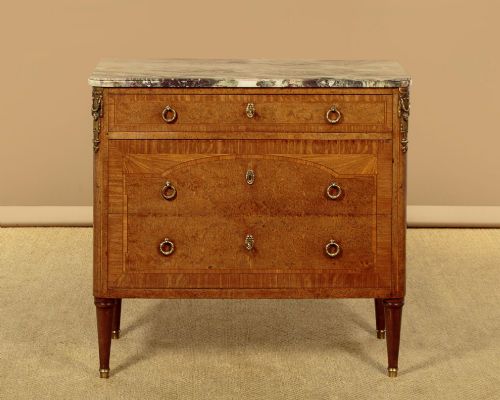
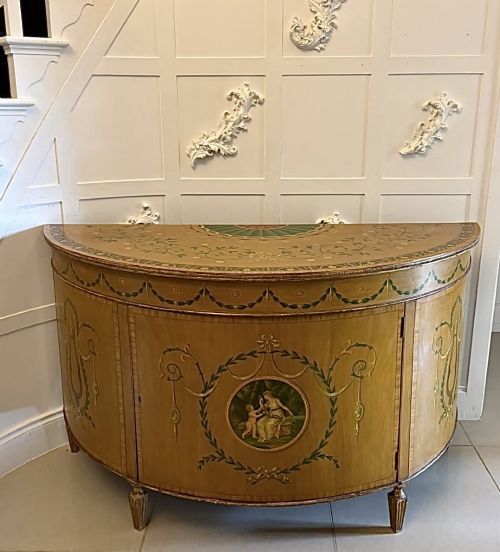
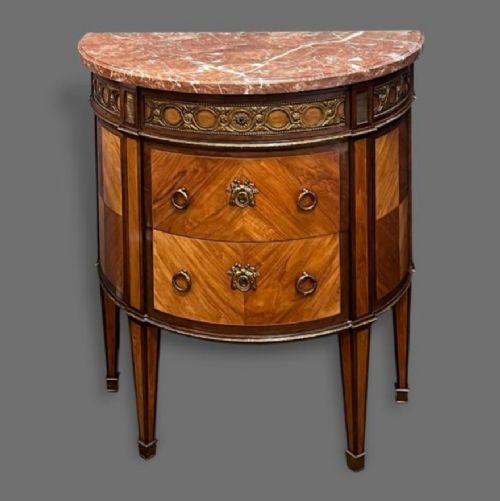
A neoclassical style commode draws on 18th-century design principles of symmetry, straight lines, and classical proportions, spanning origins from Italy, France, Sweden, and England. The pieces take the form of chests of drawers, side cabinets, and demi-lune commodes, often fitted with stone tops.
The versions most commonly met on this page include 19th-century revivals alongside authentic 18th-century examples, incorporating Gustavian painted finishes, French Louis XVI detailing, and English satinwood marquetry.
Makers and workshops range from continental cabinetmakers to later revival firms, utilising regional timbers such as walnut, mahogany, birch, and satinwood.
Materials and Technique
Cabinetmakers constructed carcass frames in timbers like oak, pine, or walnut, applying veneers of mahogany, satinwood, kingwood, and burr elm to the exterior surfaces.
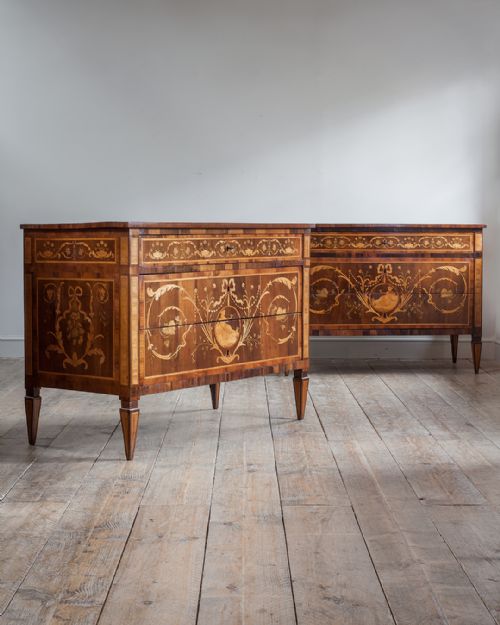
Marquetry and parquetry patterns created geometric or pictorial designs using contrasting wood varieties, while hand-painted finishes appeared on Swedish Gustavian and English satinwood pieces.
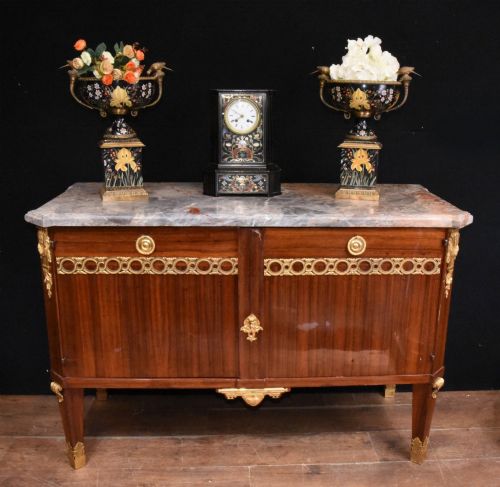
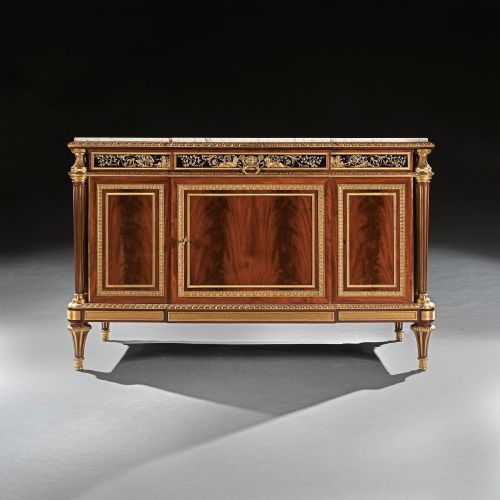
Mounts in cast ormolu and brass framed the drawers and corners, paired with heavy marble tops in white or coloured varieties.
Neoclassical Style Commode Retail Price Guide 2026
Typical asking prices for neoclassical style commode among the pieces listed under this phrase on Sellingantiques today, from the lower quarter to the upper quarter. They describe what is for sale here now, not the wider market.
Pieces span 18th-century originals through 19th-century revival work and early 20th-century exhibition cabinets.
Markers of Quality
The standard of a neoclassical style commode rests in the crispness of its marquetry cutting and the precision with which individual veneer sections align across the drawer fronts.
Metalwork reveals the hand of the maker through the depth of chase work on ormolu mounts and the weight of cast brass handles and escutcheons.
Carcass construction, drawer lining timbers, and the selection of unblemished marble slabs separate standard production from exhibition pieces.
Henry Dasson·Pietro Ferrario·Weisweiler·Riesener·Kaufman
The Neoclassical Style Commode Glossary
- Demi-lune
- Half-moon shaped in plan, describing furniture with a flat back and a curved front. This form appeared frequently on late 18th-century side cabinets.
- Marquetry
- The art of forming decorative patterns by fitting together thin veneers of different coloured woods. It differs from inlay by covering the entire surface of the carcass.
- Ormolu
- Gilded bronze used for decorative mounts and furniture hardware. The technique involves applying a mercury-gold amalgam to cast brass or bronze.
- Gustavian
- The Swedish interpretation of neoclassical design, characterised by light paint finishes and restrained classical carving. It emerged during the reign of Gustav III.
Neoclassical Style Commode: Frequently Asked Questions
What is a neoclassical style commode?
A neoclassical style commode is a decorative storage chest defined by classical symmetry, straight tapering legs, and architectural restraint. These pieces draw inspiration from archaeological discoveries of the 18th century.
They serve as focal points in reception rooms, providing surface space for lamps or decorative objects alongside functional drawer storage.
How do I spot an 18th century commode?
Authentic 18th-century commodes show hand-cut dovetails, timber shrinkage appropriate to age, and traditional hand-planed secondary woods inside the drawers. Construction methods predate modern machine tooling.
Decoration often relies on genuine fire-gilt ormolu and natural pigment paints rather than synthetic finishes.
Where should I place a demi-lune commode?
A demi-lune commode fits well against flat walls in hallways, entrance lobbies, or beneath mirrors in drawing rooms. Its curved front softens linear room layouts.
The shallow depth makes it practical for narrow spaces where rectangular cabinets would obstruct circulation.
What is the difference between Empire and Gustavian?
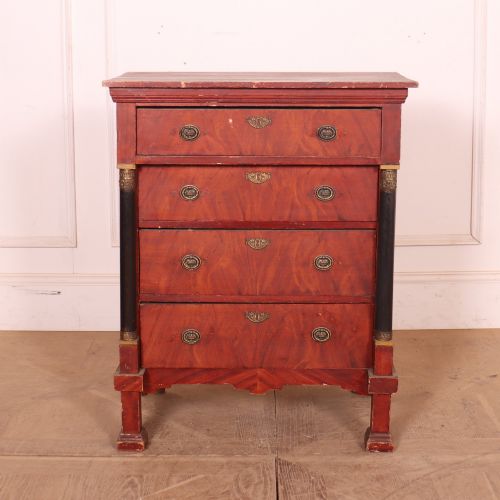
Empire style commodes reflect the heavy, monumental tastes of Napoleonic France, utilising dark mahogany, prominent columns, and martial ormolu mounts. Gustavian pieces embody a lighter Swedish interpretation.
Gustavian commodes favour pale painted surfaces, soft greys, and muted carving over dark polished tropical timbers.