
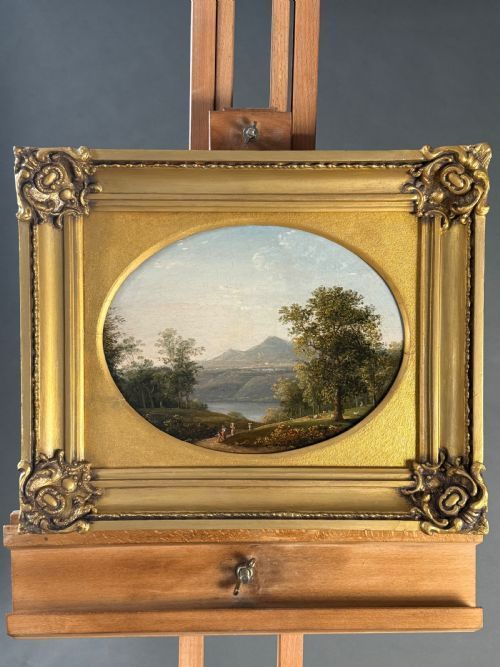


Neoclassical Landscape Painting
Neoclassical landscape painting works best when it brings classical ruins and mythic figures together within balanced, harmonious compositions.
Neoclassical Landscape Painting
Neoclassical landscape painting captures the ordered serenity of classical antiquity through structured views of architecture, ancient ruins, and idealized natural settings.
The evidence on this page spans the 18th century and the 19th century, incorporating Georgian, Regency, and French Empire styles alongside Grand Tour watercolours.
Buyers will encounter oil paintings, watercolours, and related decorative arts such as painted mirrors and porcelain vessels that share this distinct visual vocabulary.
Materials and technique
Artists and makers utilised paint, oil on canvas, and watercolour on paper, applying pigments to render atmospheric skies and distant architectural forms.
Decorative frames and associated objects incorporate wood, gesso, gilt, and gold leaf, often finished with hand painting and parcel gilding.
Porcelain pieces employ enamel decoration and hand-painted scenes to translate classical landscape motifs onto three-dimensional forms like vases and ice pails.
Listings span the 18th century, Georgian, Regency, and 19th century periods, utilising oil, watercolour, porcelain, and gilt wood.
Assessing quality
Quality rests in the precision of the brushwork and the confidence with which figures and architectural elements are integrated into the composition.
The handling of light and atmospheric depth distinguishes superior works, where distant horizons draw the eye naturally through the pictorial space.
In painted woodwork and gilt mirrors, the crispness of the carved detail and the application of gold leaf determine the overall refinement of the piece.
Jacob Philipp Hackert·George Robertson·Jean Baptiste Isabey
The Neoclassical Landscape Painting Glossary
- Grand Tour
- A cultural journey undertaken by wealthy young Europeans to continental sites of antiquity. It generated a demand for paintings and watercolours recording classical ruins.
- Parcel Gilt
- A surface finish where only specific portions of an object are highlighted with gold leaf. This technique accentuates carved details on wooden frames and mirrors.
- Trumeau Mirror
- A wall mirror featuring an upper painted or carved panel integrated into the frame. These pieces often incorporate neoclassical landscape scenes above the glass.
- Gesso
- A plaster-like mixture applied to wood surfaces as a base for gilding and painting. Its smooth buildup allows for sharp, crisp moulding details.
Neoclassical Landscape Painting: Frequently Asked Questions
What is a neoclassical landscape painting?
It is a work of art that depicts idealized natural scenery, often populated by figures from mythology or framed by classical ruins. These pieces reflect the eighteenth and nineteenth century fascination with antiquity.
The listings here show how these subjects extend beyond canvas into watercolours and painted porcelain, uniting diverse decorative objects under a shared classical aesthetic.
How do I date these works?
Dating relies on stylistic markers, materials, and the recorded periods of the pieces, which range from the Georgian era through the Regency and French Empire styles to the late nineteenth century.
Examining the application of paint, the composition of the gesso, and the framing techniques provides further clues to a piece's exact era of origin.
Where were these pieces displayed?
Historically, such artworks and decorated mirrors hung in the principal reception rooms of country houses and town residences. They served to display the owner's classical education and refined taste.
Today, they function well in traditional interiors, positioned above mantelpieces or integrated into wood-panelled drawing rooms.
What subjects appear in these scenes?
Common subjects include ancient Roman and Greek ruins, idealized Italianate vistas, and figures drawn from classical mythology. Artists frequently placed these elements within balanced, theatrical compositions.
Works associated with the Grand Tour specifically record actual locations such as Pompeii, blending topographical accuracy with neoclassical idealism.