
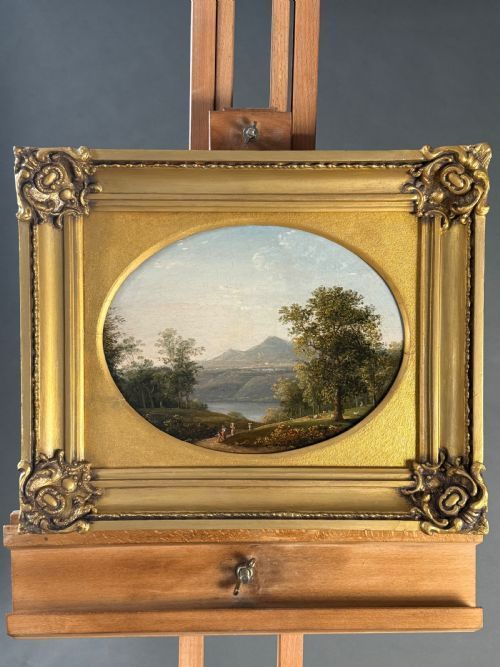
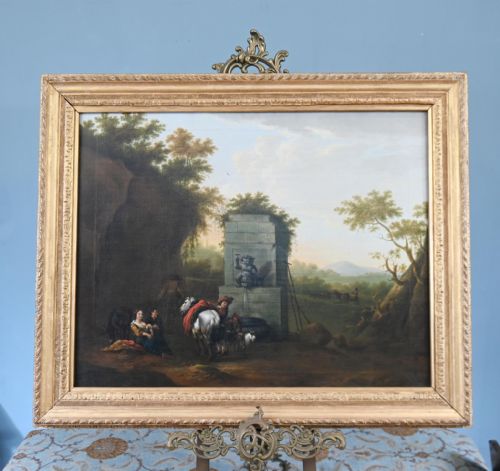

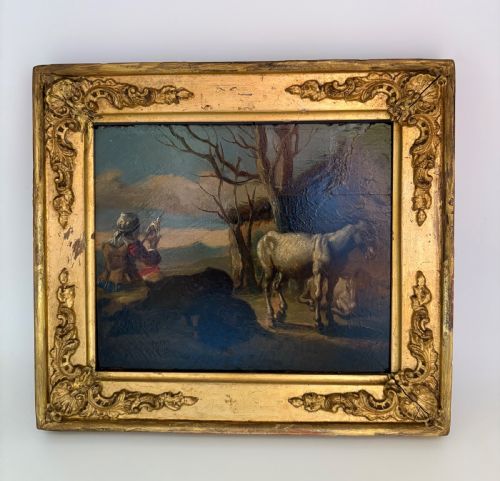
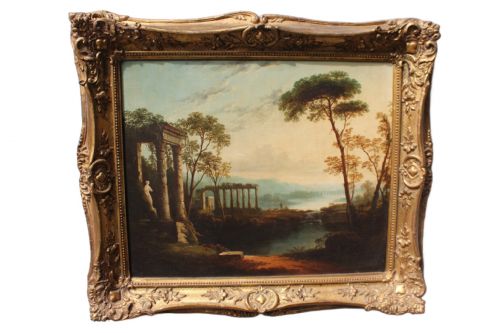

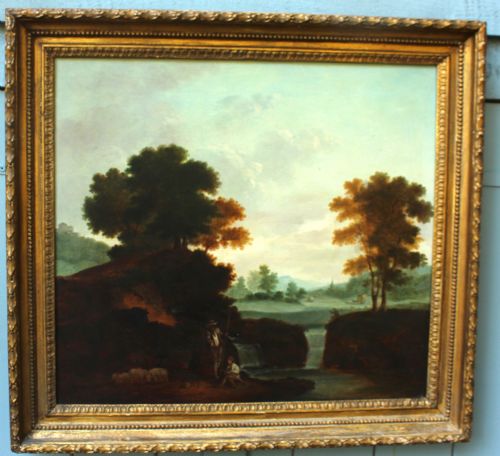
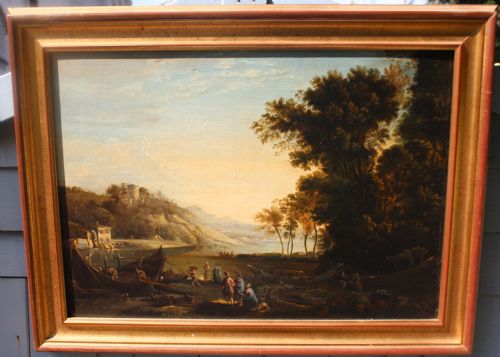


Italianate Landscape Oil Painting
An italianate landscape oil painting brings warm Mediterranean light and classical ruins into a room, capturing an idealised view of southern Europe that collectors prize.
Italianate Landscape Oil Painting
An italianate landscape oil painting presents idealised pastoral scenes, classical ruins, and warm Mediterranean light rooted in seventeenth and eighteenth-century traditions. These works draw inspiration from classical antiquity and the Grand Tour, often featuring distant villas, shepherds, and ancient architecture.
The pieces on this page span from the seventeenth century through to the nineteenth century, including works associated with the Dutch Golden Age, Neoclassical ideals, and the Scottish School. Buyers encounter both oak panel paintings and larger canvases framed in period giltwood.
Compositions range from intimate cabinet paintings to expansive views, executed by followers of renowned masters or produced within specific European artistic circles. The subject matter typically balances natural river settings with architectural remnants such as temples and classical bridges.
Materials and construction
These works utilise traditional oil paint applied to prepared canvas or solid wood panels, allowing artists to build luminous glazes and delicate atmospheric effects. Painters layered pigments to capture the characteristic golden light and atmospheric haze of the southern European countryside.
Surviving works are frequently housed in their original or period-appropriate giltwood and gold leaf frames, which complement the warm tones of the pigment. The physical support often shows the natural grain of oak panels or the dense weave of historic canvas.
The inventory records examples linked to the Dutch Golden Age, the Grand Tour, and the Scottish School.
Distinguishing finer works
The distinction between ordinary and superior works lies in the dexterity of the brushwork and the management of atmospheric perspective. Masterful handling renders distant hills with a soft, hazy blue, whilst foreground figures and architectural masonry retain crisp anatomical and structural definition.
Compositional balance and the integration of light also separate works, as superior artists construct convincing spatial depth through alternating zones of shadow and illumination. The condition of the original paint surface and the integrity of the giltwood frame further influence the overall standing of a piece.
JACOB PHILIPP HACKERT·Cornelis Van Poelenburgh·Philipp Peter Roos·Claude Lorrain·Richard Wilson·Thomas Jones·Peter de Wint·Franz Joachim Beich·Louis Bélanger
The Italianate Landscape Oil Painting Glossary
- Grand Tour
- A cultural journey through Europe undertaken by young upper-class men in the eighteenth and nineteenth centuries to collect art and antiquities. Many paintings from this era were acquired specifically to commemorate these travels.
- Giltwood
- Timber that has been coated with a thin layer of gold leaf or gold paint. Frames executed in this manner provide a reflective boundary that enhances the luminosity of the oil painting within.
- Classical Pastoral
- An artistic genre depicting an idealized, harmonious rural life usually set against ancient ruins and rolling hills. These scenes emphasise peace and rustic simplicity rather than gritty agrarian reality.
- Panel
- A rigid support for a painting, commonly made of oak in earlier centuries. Artists painted directly onto the prepared wood surface before the widespread adoption of stretched canvas.
Italianate Landscape Oil Painting: Frequently Asked Questions
What defines an italianate landscape oil painting?
These works depict idealised southern European views populated by classical architecture, pastoral figures, and ancient ruins bathed in warm light.
They reflect European artistic fascination with antiquity and the Mediterranean countryside across several centuries.
How do I care for an antique oil painting?
Keep the canvas or panel away from direct sunlight and dramatic fluctuations in household temperature and humidity.
Dust the surface gently with a soft, dry brush and avoid using liquid cleaners on either the paint or the giltwood frame.
How can I tell the period of a canvas?
Examine the preparation of the canvas weave, the composition of the wood panel if applicable, and the construction methods of the frame.
Stylistic cues and the handling of the oil paint also offer clear indicators of whether a work originates from the seventeenth, eighteenth, or nineteenth century.
Where should I hang these paintings?
Select a wall with stable ambient conditions away from heat sources and moisture to protect the historic materials.
Their warm palettes and detailed architectural subjects suit traditional drawing rooms, studies, or libraries where the lighting can be controlled.