


Neoclassical Hall Light
A neoclassical hall light brings architectural clarity to an entrance, combining glass and metal to illuminate a threshold with proportion.
Neoclassical Hall Light
A neoclassical hall light is a hanging fixture designed for an entranceway, drawing on classical architectural motifs and symmetrical forms. When you search for a neoclassical hall light, you encounter lanterns and pendant lights spanning the nineteenth and early twentieth centuries.
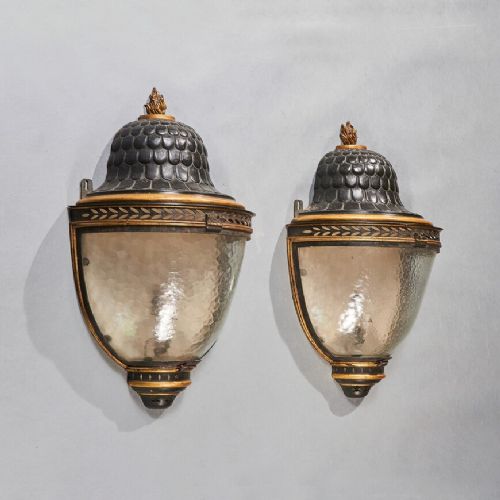
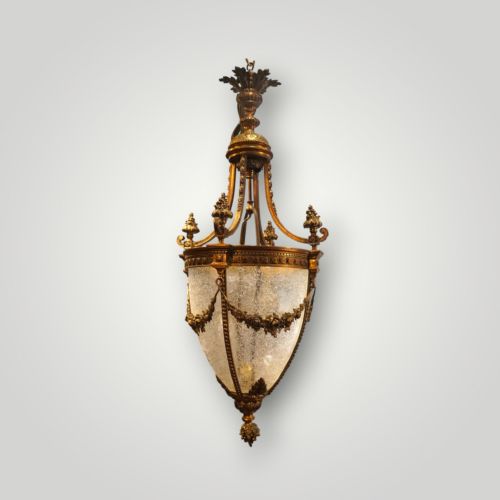
The pieces on this page appear in forms such as wall lanterns, hanging lanterns, and ceiling lights, reflecting both French Empire and broader European design traditions. Materials range from brass and gilt bronze to glass, tole peinte, and parcel gilt metal.
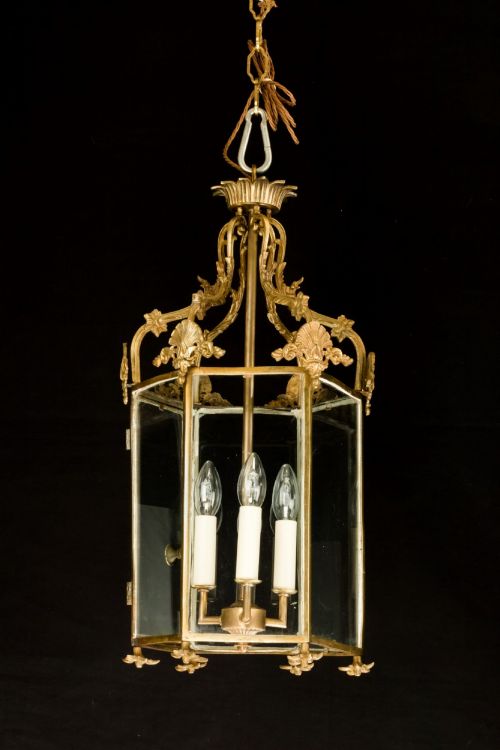
Origins include French and Italian workshops, alongside English Edwardian examples, demonstrating how diverse makers interpreted classical restraint. These fixtures range from simple hexagonal brass frames to multi-light gilt bronze and convex glass creations.
Materials and construction
Makers utilised cast and chased metals such as brass, gilt bronze, and ormolu to form the structural frames and decorative mounts of each lantern. Glass panels, occasionally curved or convex, were fitted into these metal armatures to enclose the light source.
Surface treatments included parcel gilding, tole peinte painting, and patination on bronze and brass components. Workshops also incorporated secondary materials like marble and oak in related console tables, though the hanging fixtures themselves rely primarily on metal and glass construction.
Several lanterns take direct inspiration from the opulent illumination found within the Palace of Versailles.
Judging quality and execution
Quality in these lanterns rests upon the crispness of the metal casting and the depth of the gilding or patination. Finer examples display precise chasing on ormolu mounts and well-proportioned frames that echo classical architectural orders without clutter.
The integration of glass panels also distinguishes finer pieces, particularly where convex glass or intricate framing requires skilled assembly. Heavier bronze and brass structures demonstrate substantial metalwork compared to lighter, simpler commercial variants.
The Neoclassical Hall Light Glossary
- Ormolu
- Gilded bronze used for decorative mounts and architectural details. The technique involves applying a mercury and gold amalgam to bronze before firing.
- Tole Peinte
- Painted sheet metal, often used in decorative lanterns and light fixtures. This material allows for rich colour application on surfaces.
- Parcel Gilt
- Partially gilded metal or wood where specific raised details receive gold leaf. This creates contrast against a dark or patinated base.
- Convex Lantern
- A hanging light fitted with curved, outward-projecting glass panels. This shape disperses light more widely across an entrance hall.
Neoclassical Hall Light: Frequently Asked Questions
What defines a neoclassical hall light?
A neoclassical hall light draws inspiration from classical Greek and Roman architecture, featuring symmetrical geometry, urn motifs, and restrained ornamentation.
These fixtures use brass, bronze, and glass to create balanced illumination suited for grand or modest entranceways.
Where should a hall lantern hang?
These lanterns are traditionally hung in entrance halls, vestibules, or corridors where ceiling height permits vertical suspension.
Proper placement ensures the fixture acts as a focal point while providing adequate illumination for a threshold space.
How do French Empire lights differ?
French Empire hall lights often incorporate bolder military and classical motifs, reflecting early nineteenth-century design tastes under Napoleon.
They frequently employ heavy gilt bronze and multifaceted glass configurations compared to later Edwardian interpretations.
How do I care for antique brass?
Antique brass and bronze require gentle dusting with a soft cloth to preserve their historical patination and surface finishes.
Avoid abrasive polishes that strip away the aged character accumulated on nineteenth and early twentieth-century metalwork.