
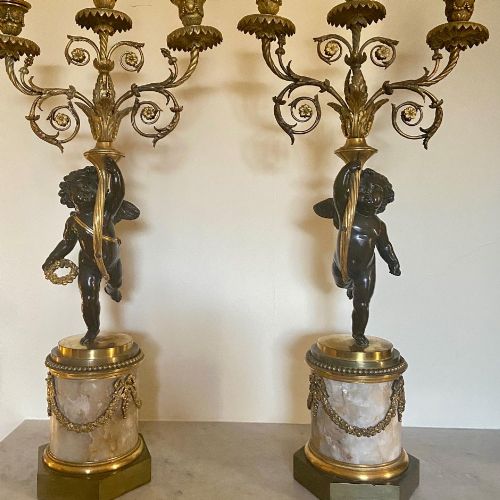


Neoclassical Cherub Candle Holder
These neoclassical cherub candle holders combine figural bronze putti with marble bases, bringing classical French and Italian design into domestic lighting.
Neoclassical Cherub Candle Holder
When you search for neoclassical cherub candle holder, you encounter figural lighting pieces that typically feature cast bronze putti paired with marble bases or mounted with ormolu. The selection centres on candelabra and candlesticks originating from the eighteenth and nineteenth centuries, including Grand Tour pieces and later Louis XVI revival designs.
The figures themselves appear as winged putti, cherubs, or bronze and ormolu statuettes supporting twin lights or central sockets. Most examples take the form of symmetrical pairs designed for mantlepieces or desk placement, drawing heavily on French Empire and Victorian interpretations of classical antiquity.
Makers and models referenced in this inventory include pieces associated with Claude Clodion and François Redmond, alongside unmarked Italian Grand Tour works. The materials span patinated bronze, gilt bronze, white marble, and occasional inclusions of fluorspar and enamel.
How they were made
Plinths and bases were turned or slab-cut from white marble, sometimes incorporating decorative bronze collars or gilt mounts secured with internal iron or brass threaded rods. Candle nozzles and drip pans were cast separately and fitted into the arms of the candelabra.
Listings feature items dated across the eighteenth and nineteenth centuries, including the Regency and Victorian periods, constructed from bronze, marble, and ormolu.
What varies in quality
Quality rests primarily on the crispness of the bronze casting and the depth of the manual chasing in the putti figures. Superior examples exhibit finely rendered hair, distinct feather articulation on the wings, and clean transitions in the metal rather than smoothed-over details.
The integration between the bronze figures and the marble bases indicates the standard of manufacture. Well-made pieces feature tightly fitted mounts and solid stone plinths without excessive filler, whereas lesser items show loose joints or crude casting seams.
Claude Clodion
The Neoclassical Cherub Candle Holder Glossary
- Ormolu
- Gilded bronze produced by applying a mercury-gold amalgam to a cast bronze base and heating it to vaporise the mercury. This technique creates a durable, warm golden surface found on many French candlesticks.
- Putto
- A plump, often winged male child figure derived from classical art and frequently termed a cherub in nineteenth-century descriptions. These figures form the central sculptural element of the candle holders.
- Grand Tour
- A traditional trip through Europe undertaken by upper-class young men during the eighteenth and nineteenth centuries, resulting in the acquisition of souvenirs like Italian marble and bronze figures.
- Candelabra
- A branched candlestick holding multiple lights from a single base. The examples here typically support two or three arms branching from a central putto figure.
- Fluorspar
- A halide mineral prized for its variegated purple and blue banding, occasionally utilised in decorative bases alongside marble and bronze.
Neoclassical Cherub Candle Holder: Frequently Asked Questions
How do I date a bronze cherub candle holder?
Dating relies on examining the casting technique, the style of the base, and the type of patination or gilding applied to the bronze. Nineteenth-century revival pieces often imitate eighteenth-century Louis XVI models, requiring close inspection of tool marks and assembly methods.
Material choices like white marble combined with ormolu are typical of the Grand Tour period and the French Restoration, while spelter substitutes point towards later nineteenth-century manufacturing.
Are these candle holders purely decorative?
While many pieces function practically for holding taper candles, their substantial bronze and marble construction means they were primarily designed as ornamental garnitures for tables and mantlepieces.
Using them with modern candles requires care to avoid wax spilt onto antique bronze surfaces or fragile enamel components.
How should I clean antique bronze and marble?
Maintenance requires only a soft, dry cloth to remove dust from the bronze patination and marble surfaces. Water and chemical cleaning agents can strip delicate gilt ormolu or stain porous stone bases.
Handling should be done by the solid base rather than the projecting wings of the putti to prevent structural strain on the soldered joints.