


Neoclassical Card Table
These neoclassical card table pieces are folding tables for games and tea, bringing eighteenth-century symmetry and inlaid timber to a room.
Neoclassical Card Table
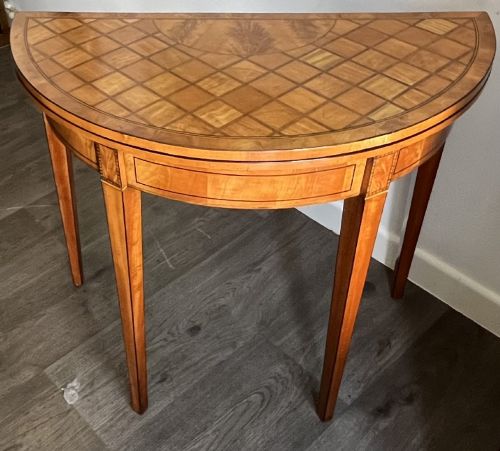
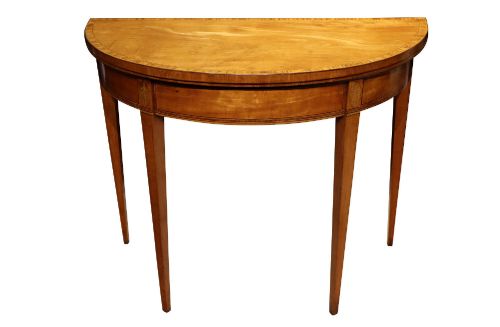
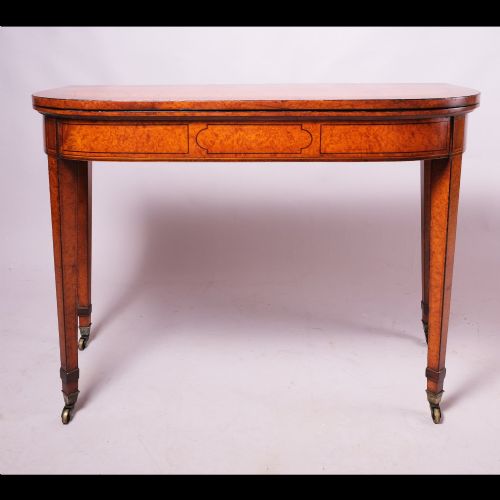
A neoclassical card table serves as a folding surface for gaming and tea, appearing frequently in demi-lune, D-shape, and rectangular forms. You will most often meet George III examples from the eighteenth century, alongside later revival pieces from the nineteenth and early twentieth centuries.
The construction typically relies on a fold-over top supported by hinged rear legs, revealing a baize-lined interior designed for cards. Makers shaped these pieces in mahogany and satinwood, frequently finishing the surfaces with intricate crossbanding and marquetry.
Originating primarily within Georgian and Louis XVI styles, these tables transition easily from utilitarian gaming surfaces to decorative side tables. Their restrained geometry and classical proportions define the aesthetic of the period.
Materials and construction
Cabinet makers utilised dense primary timbers like mahogany, rosewood, and walnut to build the foundational frame and legs. Finer veneers such as satinwood, kingwood, and amboyna were then applied to the top and apron, accented with contrasting boxwood and ebony stringing.
Surface decoration frequently involved marquetry and painted details, embedding natural motifs directly into the wooden panels. Brass mounts, galleries, and hinges provided both structural support and metallic contrast to the polished timber.
Mahogany and satinwood dominate the timber selections across the recorded pieces, frequently paired with boxwood and ebony stringing.
The markers of quality
The refinement of the timber selection dictates the distinction at the upper end of the market, where figured veneers and tight crossbanding show exceptional grain matching. Hand-cut inlay and delicate marquetry display a precision that mechanical or later substitutes lack.
Structural integrity rests on the smoothness of the folding mechanism and the rigidity of the leg support when open. The crispness of carved details, such as fluted legs or paterae blocks, separates master workshops from standard production.
Maple and Co
The Neoclassical Card Table Glossary
- Demi-lune
- A half-moon shape used for table tops and frames. This curve allows the table to sit flush against a wall when folded.
- Crossbanding
- A strip of veneer applied around the border of a table top with the grain running perpendicular to the centre. It creates a neat visual frame for the main timber.
- Marquetry
- The art of forming decorative patterns by fitting together small pieces of different coloured veneers. Craftsmen use various woods to picture floral or geometric designs.
- Bouillotte table
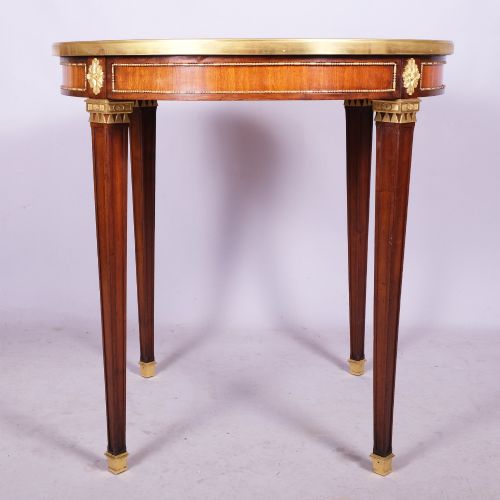
- A small round card table with a raised gallery edge designed for a French card game. These typically feature marble tops and brass railings.
- Stringing
- Thin lines of contrasting wood inlaid into the surface to create linear borders. This technique highlights the geometric edges of neoclassical furniture.
Neoclassical Card Table: Frequently Asked Questions
How do I use a card table daily?
These tables function well as console or side tables against a wall when the top is folded closed. Simply unfold the leaf and swing the supporting leg out when you need a surface for cards or writing.
Keep the timber away from direct sunlight and strong heat sources to protect the delicate veneers and polish. A soft, dry cloth is sufficient for routine dusting.
How do I tell an eighteenth-century table from a revival piece?
Examine the secondary woods on the interior framing and drawer linings, as older pieces use native timbers appropriate to their period. Tool marks and hand-cut joinery also offer clear clues regarding the age of the construction.
Revival pieces from the nineteenth and twentieth centuries often display machine-sawn elements and standardised hardware fittings. The finish and wear patterns on the underside usually corroborate the stated era.
Why do some tables have marble tops?
Marble tops appear primarily on bouillotte tables to provide a durable, heat-resistant surface for evening card games played around candlelight. The stone adds weight and stability to smaller circular frames.
This material choice reflects French Louis XVI influences present in certain neoclassical designs.