

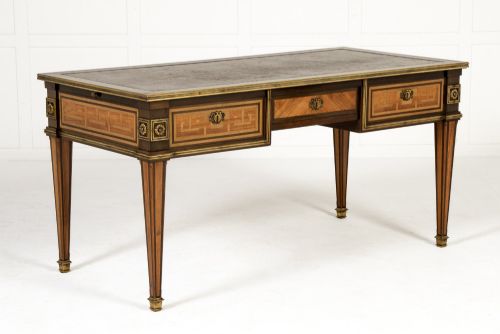


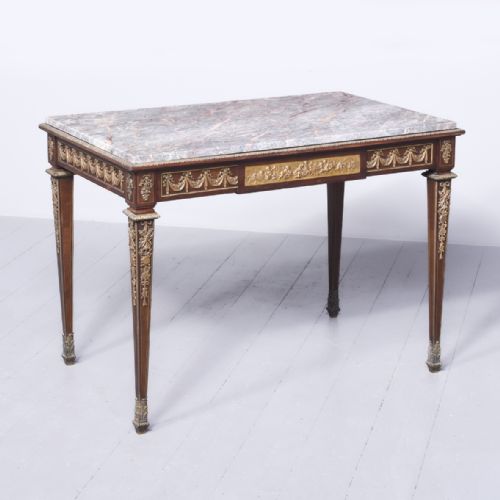


Neoclassical Bureau Plat
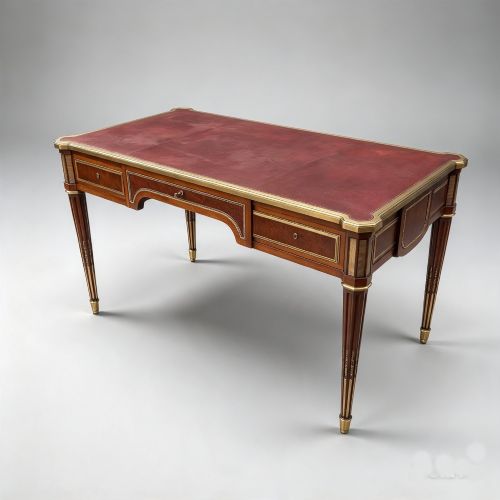
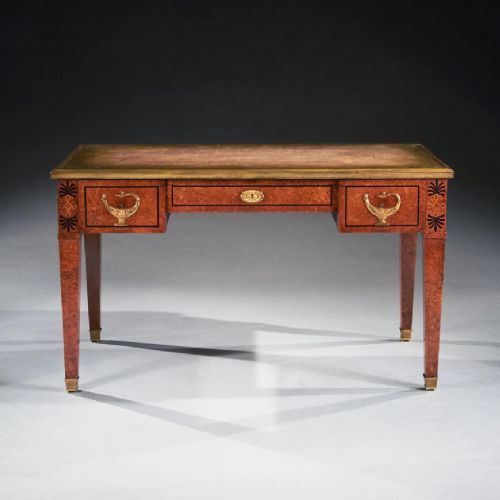
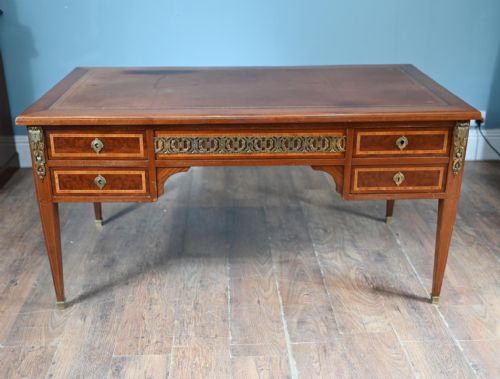
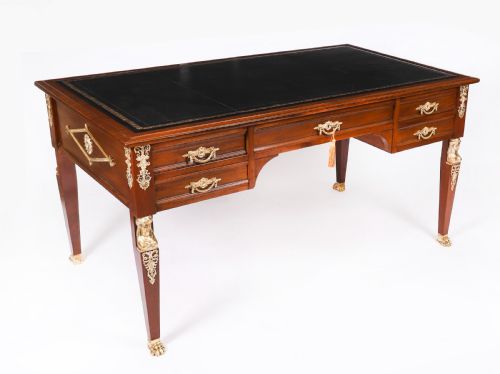
These neoclassical bureau plat writing tables bring architectural dignity and fine French bronze mounts straight into a study.
Neoclassical Bureau Plat
A neoclassical bureau plat is a freestanding writing table designed to sit proudly in the centre of a room rather than against a wall. The pieces listed here span the nineteenth century, Edwardian era, and Victorian period, drawing heavily on French Empire, Louis XVI, and Directoire design vocabularies.
Most examples you will encounter take the form of refined writing tables and desks equipped with gilt bronze or ormolu mounts. Makers often turned to classical French aesthetic traditions, pairing restrained structural forms with decorative metalwork.
Originating largely from French workshops or English makers influenced by continental tastes, these tables combine broad writing surfaces with freestanding capability. They remain working desks of grand proportions suited to formal interiors.
Materials and construction
Cabinetmakers utilised dense hardwoods including mahogany, walnut, kingwood, and amboyna veneer to build the carcasses of these tables. Selected timbers were often polished to a high finish or ebonized to contrast sharply against metallic mounts.
Gilt bronze, ormolu, and brass provide the characteristic hardware, cast and chased into classical motifs before being applied to corners, drawers, and legs. Leather inserts frequently form the writing surface, providing a tactile counterpoint to the polished wood frames.
Neoclassical Bureau Plat Retail Price Guide 2026
Typical asking prices for neoclassical bureau plat among the pieces listed under this phrase on Sellingantiques today, from the lower quarter to the upper quarter. They describe what is for sale here now, not the wider market.
Several models incorporate secret compartments disguised within the frieze, reminding us that nineteenth-century correspondents guarded their letters fiercely.
Distinguishing quality
Quality rests heavily on the crispness of the cast bronze mounts and the depth of the timber figuring. Finer pieces demonstrate precise chasing in the ormolu and sophisticated choice of veneers such as amboyna or kingwood.
Construction details distinguish standard production from exceptional work, particularly the integration of freestanding finished backs and the weight of the materials. Tables associated with notable makers or specific stylistic revivals command attention through superior proportion and heavier metalwork.
Henry Dasson
The Neoclassical Bureau Plat Glossary
- Bureau plat
- A flat-topped freestanding writing table, typically featuring drawers across the frieze. This form developed in France and remains defined by its finished appearance on all four sides.
- Ormolu
- Gilded bronze used extensively for decorative mounts on furniture. The technique involves applying finely ground gold amalgam to a bronze base before heating.
- Amboyna veneer
- A highly decorative timber prized for its rich, speckled grain pattern. Cabinetmakers used this exotic wood to cover primary structural carcases on high-status tables.
- Directoire style
- A transitional French design period bridging Louis XVI and Empire aesthetics. It favours cleaner geometric lines and sparse, classically inspired ornamentation.
- Frieze
- The horizontal band running directly beneath the top edge of a desk. On these tables, this section frequently houses one or more pull-out drawers.
Neoclassical Bureau Plat: Frequently Asked Questions
Can a bureau plat float in a room?
Yes, these tables are specifically designed as freestanding pieces finished on all sides so they do not need to touch a wall.
This makes them ideal for placing in the middle of a study or library where the back and sides remain fully visible.
What is the difference between Empire and Louis XVI styles?
Louis XVI style leans towards lighter, rectangular proportions with restrained classical motifs and fluted legs. Empire style introduces heavier, more monumental forms inspired by Roman and Greek antiquity, often featuring bolder ormolu mounts.
Both appear frequently among nineteenth-century interpretations of the bureau plat.
How do I care for the leather top?
Leather writing surfaces require gentle cleaning with a slightly damp cloth followed by a neutral leather cream to prevent drying. Avoid harsh chemical polishes that can strip the colour or damage the surrounding wood.
Careful maintenance preserves the smooth texture needed for writing.
Are these desks suitable for daily computer work?
While originally built for handwritten correspondence, many nineteenth-century and Edwardian examples offer ample surface space for modern laptops. Their sturdy timber construction handles everyday administrative tasks comfortably.
However, clearance beneath the frieze drawers should be checked to ensure adequate legroom.