

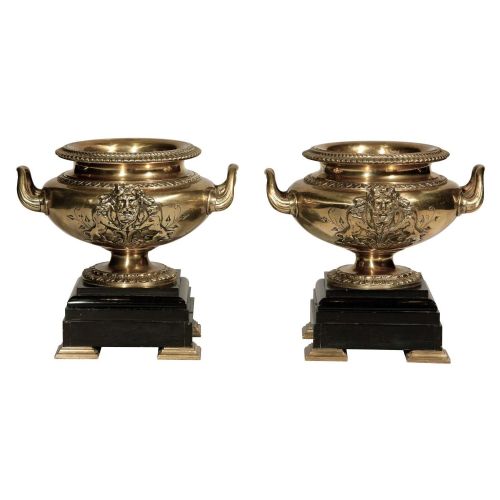


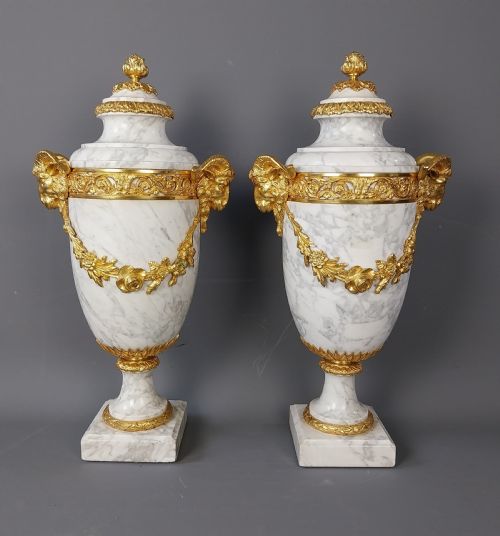


Neoclassical Bronze Cassolettes
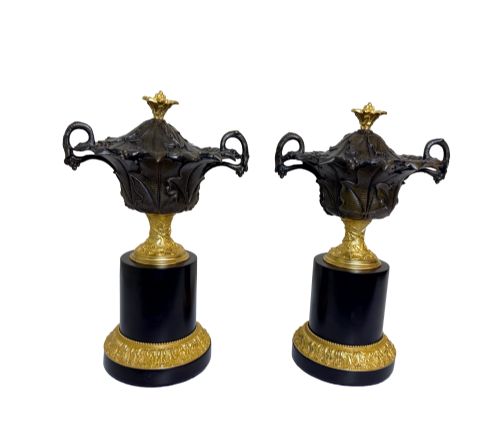
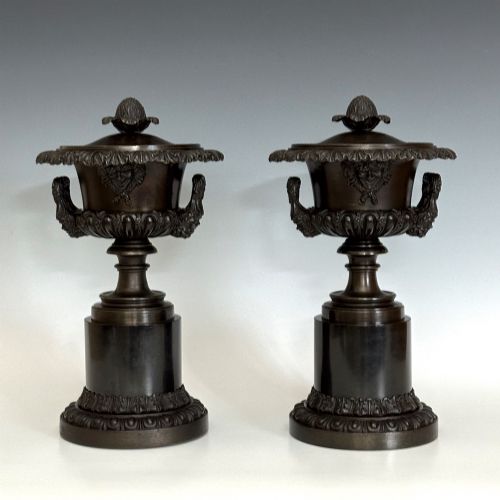
Neoclassical bronze cassolettes are reversible lidded urns that transition between display vases and incense burners, prized for bringing monumental architectural form into domestic interiors.
Neoclassical Bronze Cassolettes
When you search for neoclassical bronze cassolettes, you encounter lidded decorative vessels designed to serve a dual purpose through reversible lids that reveal either an urn top or a burner bowl. The pieces met on this page span the nineteenth century, including specific dates such as eighteen twenty, eighteen sixty, eighteen seventy, eighteen ninety, and nineteen hundred, alongside Regency and Victorian periods.
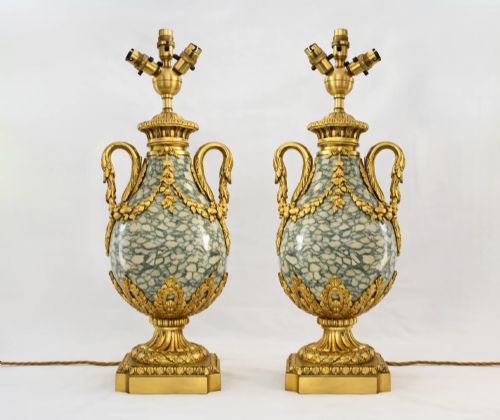
The forms appear chiefly as pairs of decorative urns, ornamental urns, cassolettes, and cassolettes and incense burners, alongside mounted table lamps. Stylistically, the inventory aligns with neoclassical, French Empire, French neoclassical, Louis XVI, Louis XVI style, neoclassical revival, Louis XVI revival, and Regency designs.
Origins represented in the selection point towards French and Italian workshops, including Grand Tour items and English Regency productions. Buyers encounter these objects mounted upon plinths, pedestals, and bases formed from various stones.
How they were made
The construction of these pieces relies on the combination of cast metals and carved stone, principally utilising bronze, gilt bronze, ormolu, patinated bronze, and brass. Metal components undergo casting and chasing to produce crisp decorative mounts, handles, and foliage.
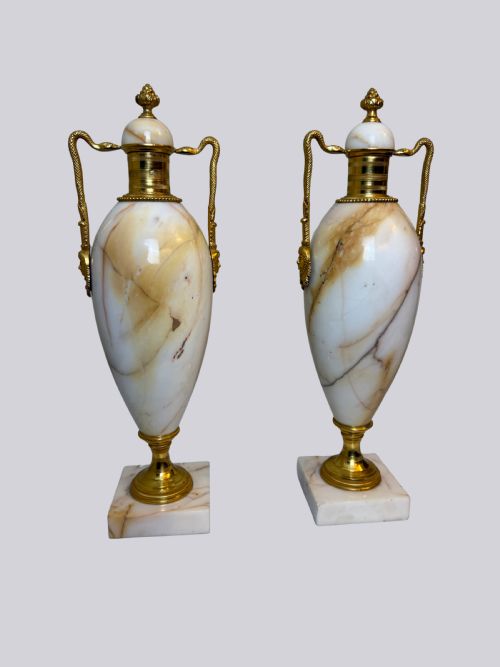
Stones provide stable plinths and bodies, incorporating marble, black marble, white onyx, green marble, quartz marble, and rouge marble. These mineral elements are turned on lathes and polished to contrast with the metallic lustre of the bronze and ormolu mounts.
Materials documented across the listings include gilt bronze, white onyx, green marble, black marble, rouge marble, and brass.
What varies in quality
Quality in these pieces rests upon the crispness of the metal casting and the depth of the subsequent chasing. Superior examples display sharp relief in the foliate mounts and well-defined classical motifs, whereas lesser items show softened details from worn moulds.
The selection of the stone body dictates visual weight and refinement, with densely figured marbles and unblemished onyx elevating the piece. Integration between the bronze mounts and the stone housing determines structural cohesion, separating standard decorative objects from masterworks.
The Neoclassical Bronze Cassolettes Glossary
- Cassolette
- A decorative vessel with a reversible lid functioning as an urn or an incense burner. This duality defines the primary utility of the form.
- Ormolu
- Gilt bronze created by applying a mercury and gold amalgam to cast bronze before firing. The technique produces a rich golden surface finish.
- Patinated bronze
- Bronze treated with chemical solutions to alter the surface colour and tone. This process darkens the metal to achieve aged or antiqued finishes.
- Grand Tour
- Souvenirs and classical antiquities acquired by travellers journeying through Europe. These pieces reflect classical antiquity and Renaissance ideals.
- Empire period
- A design style spanning the early nineteenth century characterised by classical Roman motifs. It draws inspiration from ancient Greece and Egypt.
Neoclassical Bronze Cassolettes: Frequently Asked Questions
What is a cassolette?
A cassolette is a lidded vessel designed to function as an ornamental urn or an incense burner. The lid typically reverses to reveal a perforated burner or a solid finial.
These pieces served functional and decorative roles in nineteenth-century interiors, often arranged on mantelpieces or console tables in matched pairs.
How do you use a cassolette?
They are primarily displayed as decorative objects on marble bases or pedestals. Turning the lid allows the piece to shift visually between a closed urn and an open burner.
In period settings they held aromatics or stood purely as sculptural elements reflecting classical architecture and design.
Are these pieces French or English?
The inventory includes French Empire, Louis XVI style, and Italian Grand Tour productions alongside English Regency examples. French workshops produced a significant portion of the gilt bronze and marble combinations.
Stylistic markers such as mount design and marble selection help identify the likely regional origin of each individual pair.
How do I date a nineteenth-century cassolette?
Dating relies on stylistic indicators from the Regency, Victorian, or Louis XVI revival periods. Specific dates like eighteen seventy or eighteen ninety appear in workshop records and design conventions.
Material combinations, such as specific coloured marbles paired with patinated bronze, also correspond to distinct manufacturing decades.