




Neoclassical Bench Sofa
A neoclassical bench sofa brings classical symmetry, clean lines and refined proportions to an interior, offering an elegant seating option rooted in ancient design.
Neoclassical Bench Sofa
A neoclassical bench sofa bridges the gap between formal seating and architectural restraint, drawing on ancient Greek and Roman motifs. When exploring a neoclassical bench sofa, buyers encounter forms that range from restrained Swedish Gustavian frames to ornate French Empire revivals. These pieces function as settees, daybeds, and hall seats that prioritise linear grace.
The selection includes pieces spanning from the eighteenth century through the Edwardian era and the early twentieth century. Continental workshops dominate the offerings, particularly French, Italian, and Swedish makers working within revived classical idioms. Such seating suits reception rooms and hallways where silhouette and proportion matter as much as comfort.
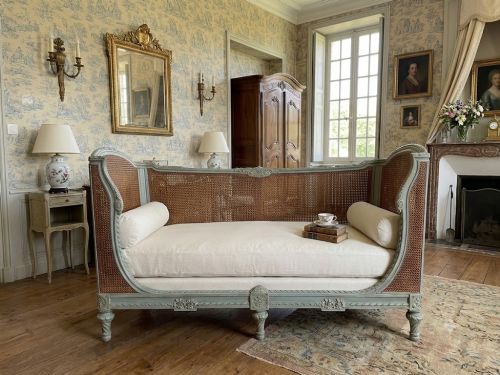
Makers adapted these classical forms across generations, resulting in variations like triple-back settees and caned daybeds. The underlying structure typically relies on timber frames configured to display balanced armrests and straight or subtly tapered legs. Every example reflects the enduring appeal of classical symmetry adapted for domestic life.
Distinctions in quality and execution
The degree of hand-carving and the crispness of architectural details set finer examples apart from simpler production. Superior pieces exhibit well-proportioned frames where mouldings, fluted legs, and crest rails align with classical proportions. The integration of mounts, whether giltwood or ormolu, reveals the precision of the maker.
Condition of the primary materials also defines the tier of a piece, especially the preservation of original paint finishes, gilding, and tight canework. The choice of timber, from figured mahogany to fine satinwood inlay, indicates the original ambition of the commission. Better examples retain their structural integrity without relying on heavy modern reinforcement.
Listings feature pieces spanning from the eighteenth century to the early twentieth century, incorporating mahogany, beech, paint, cane, and giltwood.
The Neoclassical Bench Sofa Glossary
- Gustavian
- The Swedish interpretation of neoclassical design, characterised by pale painted finishes, restrained carving, and functional elegance. This style emerged during the late eighteenth century under King Gustav III.
- Caned
- Woven rattan or split cane utilised for seat bases and back panels to provide a resilient, lightweight surface. This technique appears frequently on eighteenth and nineteenth-century seating.
- Ormolu
- Gilded bronze mounts applied to furniture frames to accent classical motifs such as leaves, urns, and scrolling foliage. French Empire pieces frequently employ this decorative metalwork.
- Satinwood
- A lustrous hardwood native to Ceylon and India, prized for its golden yellow colour and fine grain. Cabinetmakers used it extensively for veneers and decorative inlay.
- Bergère
- An enclosed upholstered armchair or sofa featuring solid upholstered sides integrated into the armrests. These pieces provide a more enclosed seating experience than open-frame settees.
Neoclassical Bench Sofa: Frequently Asked Questions
Where should I place a neoclassical bench sofa?
These sofas suit spaces that benefit from linear elegance, such as long hallways, grand landings, or formal drawing rooms. Their shallow depths often make them practical for placement against walls where bulkier seating would overwhelm the floor plan.
Because many examples feature decorative backs or detailed woodwork, they also function effectively when floated within a room or positioned beneath large windows.
How do I identify a Gustavian piece?
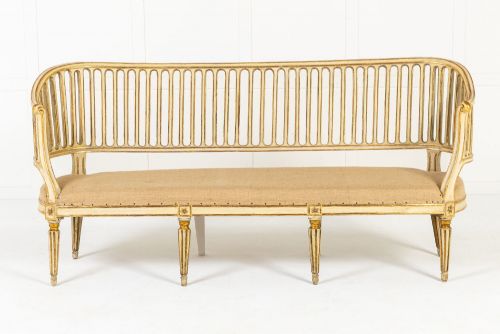
Gustavian pieces typically display a pale, muted painted finish, often in cream, grey, or soft white. The carving remains restrained, favouring subtle fluting, rosettes, and clean geometric lines over heavy ornamentation.
Originating in Sweden, these designs reflect a Scandinavian adaptation of French neoclassical and Louis XVI styles, prioritising light and simplicity.
What is the difference between a settee and a daybed?
A settee functions primarily as a multi-seat bench designed for upright sitting, featuring a structured backrest and standard arm placement. Examples include double and triple-back configurations.
A daybed, such as a canapé corbeille, incorporates extended proportions or raised ends intended for reclining, blending the function of a chair with that of a small bed.
How should I care for painted and gilt furniture?
Painted and gilt surfaces require gentle maintenance using a dry, soft microfibre cloth to remove dust. Avoid chemical sprays, abrasive cleaners, or excess moisture, which can lift delicate paint layers or damage gold leaf.
Keeping these pieces out of direct sunlight prevents the painted wood and giltwood from fading or drying out over time.