


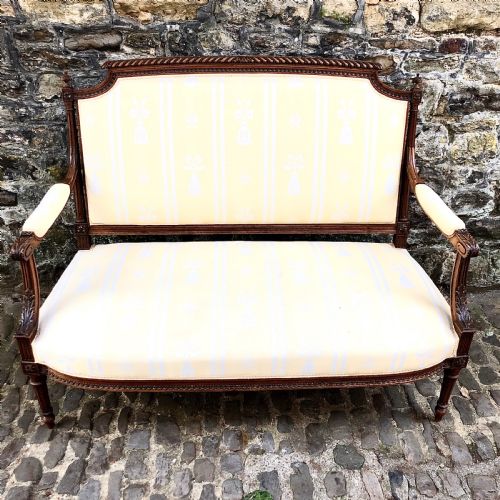
Empire Style Sofa
An empire style sofa brings the commanding presence of neoclassical design into a room, defined by architectural lines and classical mounts.
Empire Style Sofa
An empire style sofa draws upon the grand classical vocabulary of the early nineteenth century, blending severe architectural lines with rich timber and metal ornamentation. Pieces appearing on this page span the nineteenth century and later revivals, crossing French, Swedish, and Biedermeier interpretations alongside Regency connections.
The dominant forms are settees and larger salon sofas, often accompanied by related seating or occasional furniture such as console tables and sofa tables. Timber choices run from rich mahogany and walnut to lighter birch figures, sometimes accented with ebonised details or striking giltwood surfaces.
Materials and construction
Makers relied on substantial timber frames of mahogany, walnut, and birch, frequently applied as veneers over secondary woods to display rich grain patterns. Structural integrity relied on traditional joinery, supporting generous upholstered areas destined for silk or varied decorative fabrics.
Cast bronze or brass ormolu mounts provide the characteristic classical flash, fixed to the timber with screws or pins to frame the structural corners and arm terminals.
Empire Style Sofa Retail Price Guide 2026
Typical asking prices for empire style sofa among the pieces listed under this phrase on Sellingantiques today, from the lower quarter to the upper quarter. They describe what is for sale here now, not the wider market.
The furniture spans French Empire, Biedermeier, Swedish Empire, and Regency Revival styles.
Assessing craftsmanship and finish
The distinction between tiers rests upon the crispness of the carving and the quality of the timber selection, particularly in figured birch or richly polished mahogany. Finer examples display carefully cast and chased ormolu mounts that integrate seamlessly with the wood framing, whereas simpler versions rely on plain timber or basic brass details.
Proportion and the handling of classical motifs dictate the aesthetic success of the piece, separating grand salon suites from provincial interpretations.
The Empire Style Sofa Glossary
- Ormolu
- Gilded bronze mounts applied to furniture, adding bright metallic contrast to dark timber surfaces. This technique defined the decorative program of the classical age.
- Biedermeier
- A Central European style prioritising clean lines, domestic comfort, and striking domestic wood veneers over heavy ornamentation. It represents a restrained interpretation of the broader empire aesthetic.
- Settee
- A medium-length upholstered seat with arms and a back, built to accommodate multiple sitters comfortably in a drawing room or salon. The term frequently overlaps with sofa in period descriptions.
- Giltwood
- Timber carved and coated with gold leaf, creating an opulent reflective surface. Swedish and French makers utilised this finish to highlight structural motifs.
Empire Style Sofa: Frequently Asked Questions
What defines an empire style sofa?
These seating pieces draw inspiration from classical antiquity, featuring rectilinear frames, architectural profiles, and rich timber surfaces.
Ormolu mounts and classical scrollwork complete the distinct appearance established during the early nineteenth century and later revivals.
How do I place one in a modern room?
An empire style sofa works well as a focal point in a large living space, paired with minimalist furnishings to highlight its silhouette.
Keep surrounding items simple to let the strong timber grain and metal mounts stand out without visual clutter.
Are Biedermeier and French empire sofas different?
Biedermeier versions focus on domestic warmth and pale veneers like birch, avoiding excessive metal mounts in favour of clean woodwork.
French pieces lean towards greater formality, incorporating deep mahogany and gleaming ormolu for a grander presentation.
What fabrics suit these historic settees?
Traditional upholstery choices include heavy silks, damasks, and textured wovens that match the substantial weight of the wooden frame.
Plain neutral fabrics also work effectively to tone down the visual impact of heavily carved or mounted woodwork.