



Needlepoint Upholstered Side Chairs
These needlepoint upholstered side chairs bring warmth and tactile pattern to a room, offering sturdy seating with historic hand-stitched character.
Needlepoint Upholstered Side Chairs
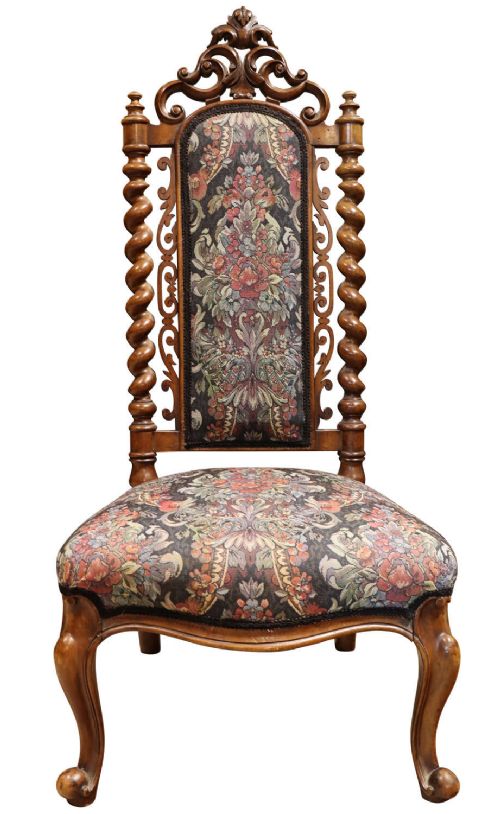
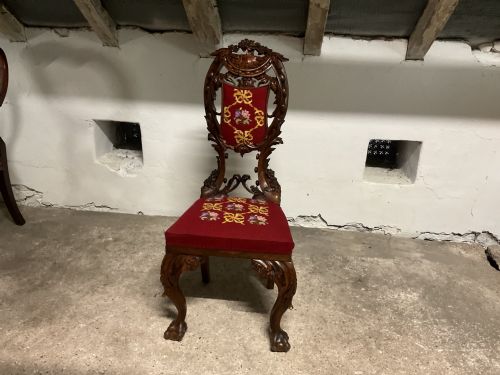
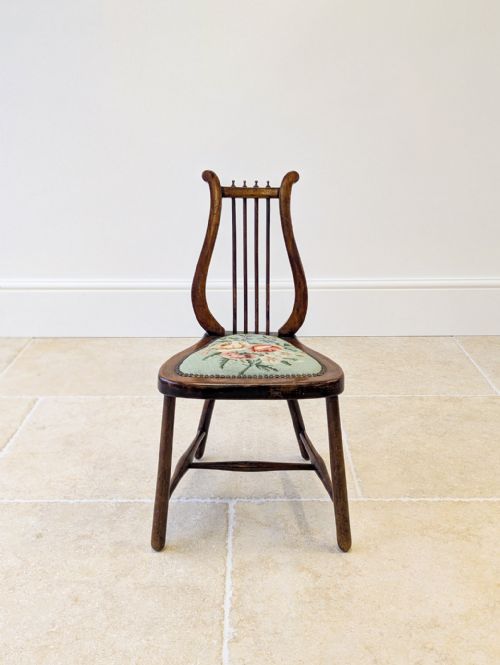
Needlepoint upholstered side chairs span periods from the Regency era through the Victorian and Edwardian decades, encompassing dining chairs, hall chairs, and low nursing seats. You will frequently encounter Victorian walnut and rosewood frames alongside Edwardian mahogany examples.
The form functions primarily as auxiliary seating, easily pulled up to a desk, placed in a hallway, or grouped around a dining table. Makers of the nineteenth and early twentieth centuries applied wool work and tapestry fabric to these wooden frames to create decorative domestic seating.
Materials and construction
Frames rely on dense hardwoods such as mahogany, walnut, rosewood, and beech, shaped through turning, carving, and ebonising. Cabinetmakers built these structures to endure daily use while supporting ornate decorative schemes.
Upholstery involves wool work and tapestry fabric, often hand-stitched in needlepoint. These textiles are fixed directly over padding to wooden seat frames, sometimes secured with brass detailing.
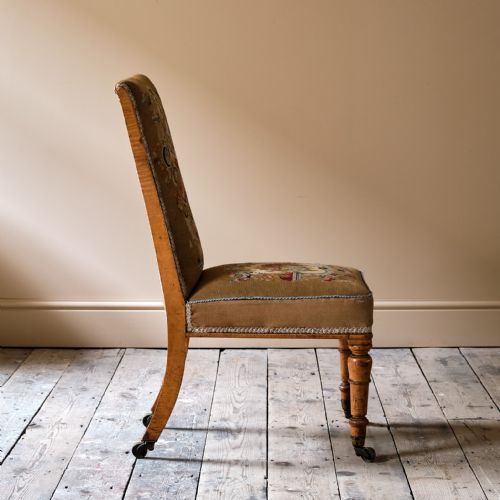
Listings feature woods including rosewood, mahogany, walnut, and birds-eye maple, spanning periods from the Regency era through the Edwardian decade.
Markers of distinction
Quality rests in the crispness of the timber carving and the density of the wood grain, with rich rosewood and figured walnut elevating a frame above standard beech or mahogany. The rigidity of the structural joints and the precision of the turnings further distinguish finer workshop output.
The needlepoint upholstery itself varies from coarse commercial stitching to fine, tight hand-stitching with intricate wool work designs. Matching sets demonstrate higher initial investment than single pieces or assembled groupings.
Charles Tozer·Waring & Gillow·Gillows
The Needlepoint Upholstered Side Chairs Glossary
- Needlepoint
- A type of canvas work embroidery stitched by hand using wool or yarn. It provides durable and colourful decorative covering for chair seats.
- Side chair
- A light, movable chair without arms designed for dining or occasional use around a room. These pieces sit easily against walls or beside tables.
- Nursing chair
- A low-seated chair traditionally designed for comfort by a hearth or nursery. They often feature upholstered backs and needlepoint seats.
- Hall chair
- A rigid wooden seat intended for entrance halls, frequently featuring carved backs and solid wooden or upholstered seats. They emphasise architectural presence over cushioned comfort.
- Tapestry fabric
- A heavy woven or stitched textile displaying pictorial or geometric patterns. It appears frequently on nineteenth-century seating.
- Ebonisation
- A chemical or paint treatment applied to cheaper woods like beech to imitate expensive ebony. This dark finish gained popularity during the Victorian period.
Needlepoint Upholstered Side Chairs: Frequently Asked Questions
How do I date these chairs?
Dating relies on timber choices, leg forms, and the style of the carving. Regency and early nineteenth-century pieces tend to show restrained classical lines, whereas Victorian examples often feature heavy walnut or rosewood frames with elaborate ornament.
Edwardian items frequently display lighter mahogany or beech structures with simpler Edwardian turnings. Comparing the construction methods inside the seat frame clarifies the era of manufacture.
Were these chairs used at dining tables?
Many examples function as dining seating, particularly when found in matching sets of four, six, or ten. Robust mahogany and rosewood frames suited daily dining routines in nineteenth-century homes.
Other lighter forms served as occasional, bedroom, or hall seating rather than primary dining chairs. The presence of arms or low seats usually indicates a secondary domestic purpose.
How should I care for needlepoint seats?
Needlepoint upholstery requires gentle vacuuming with a low-suction attachment through a mesh screen to remove dust without catching the wool threads. Avoid direct sunlight to prevent the coloured wool work from fading over time.
Professional textile cleaning is recommended for stubborn marks. Conditioning the underlying mahogany or walnut frames with appropriate wax maintains the timber finish.