


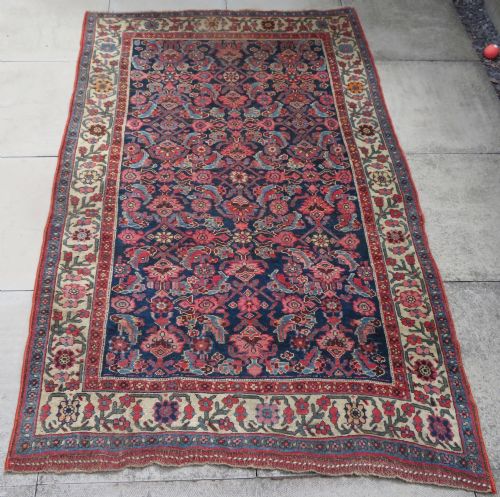
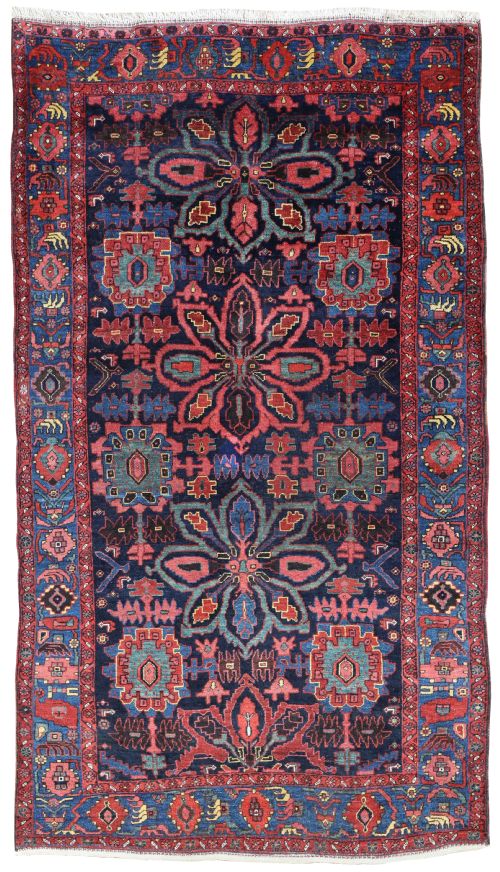


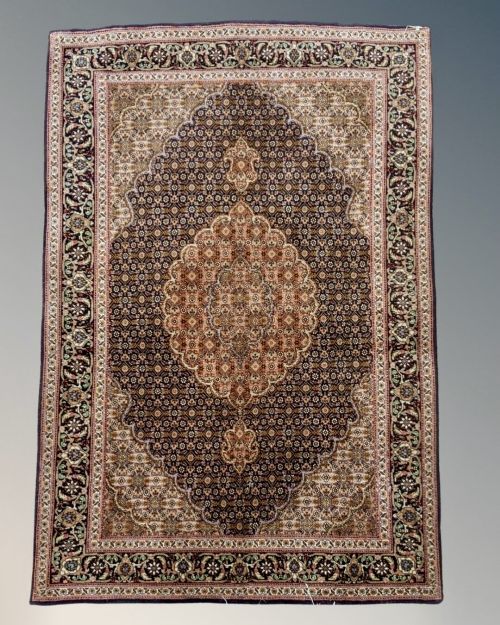

Navy Blue Bidjar Carpet
These navy blue bidjar carpet pieces are heavy Persian floor coverings prized for their dense foundation and enduring tribal designs.
Navy Blue Bidjar Carpet
When you search for a navy blue bidjar carpet, you are looking at substantial Persian floor coverings originating from Kurdish weaving centres. These rugs and carpets encompass various formats, ranging from smaller tribal village rugs and Kelleh runners to large oversized carpets.
The pieces listed on this page date from the nineteenth century up through the early decades of the twentieth century. They reflect traditional Persian craftsmanship, particularly the distinctive output associated with the Kurdish tribes of Bijar.
How they were made
Makers constructed these carpets using wool and cotton materials, employing tight knotting techniques that produced a famously heavy and rigid fabric structure. This dense foundation allowed the rugs to withstand decades of heavy use without losing their structural integrity.
Weavers utilised traditional Persian designs rooted in tribal village traditions, working with natural dye palettes dominated by deep navy blue tones alongside contrasting secondary colours.
Navy Blue Bidjar Carpet Retail Price Guide 2026
Typical asking prices for navy blue bidjar carpet among the pieces listed under this phrase on Sellingantiques today, from the lower quarter to the upper quarter. They describe what is for sale here now, not the wider market.
The listings span from eighteen-eighty through nineteen-thirty, utilising wool and cotton across Persian tribal and traditional styles.
What varies in quality
Quality in these carpets rests primarily on the density of the weave and the finesse of the pattern execution. Finer examples display crisper drawing within the traditional Persian motifs and greater precision in the handling of the wool pile.
The overall scale also influences the character of the piece, with larger oversized carpets and specific formats like Kelleh runners requiring a higher degree of sustained weaving skill across a broader surface.
The Navy Blue Bidjar Carpet Glossary
- Bidjar
- A town and region in western Iran renowned for producing exceptionally heavy, durable rugs woven by Kurdish artisans. These pieces are often called the iron rugs of Persia due to their dense construction.
- Kelleh
- A long, rectangular format of Persian carpet, traditionally narrower than a standard room-sized carpet but wider than a runner. It serves well in corridors or along the edge of a large room.
- Garrus
- A specific design sub-type associated with the Bijar region, frequently featuring large-scale Herati patterns or bold floral trellis motifs. Garrus carpets are noted for their robust structural weight.
- Kurdish
- Pertaining to the ethnic group inhabiting parts of western Iran who produced many of the traditional village and tribal rugs in this region. Their weaving is distinguished by geometric strength and saturated colour.
Navy Blue Bidjar Carpet: Frequently Asked Questions
Where were these carpets made?
These carpets were woven in the town and surrounding villages of Bijar in western Persia by Kurdish tribal weavers.
The makers drew upon centuries of local weaving traditions to produce some of the most durable textiles in the region.
How do I care for an old carpet?
Place the carpet in a low-traffic area or use a quality underlay to reduce friction and prevent movement on hard floors.
Vacuum gently without using a rotating brush bar to protect the wool pile from unnecessary wear.
What is an iron rug?
Iron rug is a common descriptor for Bidjar carpets because their dense weave and heavy foundation make them remarkably rigid.
This tight packing of the knots stems from a specific technique involving a metal tool used to beat the wet wefts down firmly.
How old are these pieces?
The examples on this page span from the nineteenth century through the early twentieth century, specifically covering decades between eighteen-eighty and nineteen-thirty.
Each piece reflects the prevailing tribal and traditional styles of its specific period of origin.