
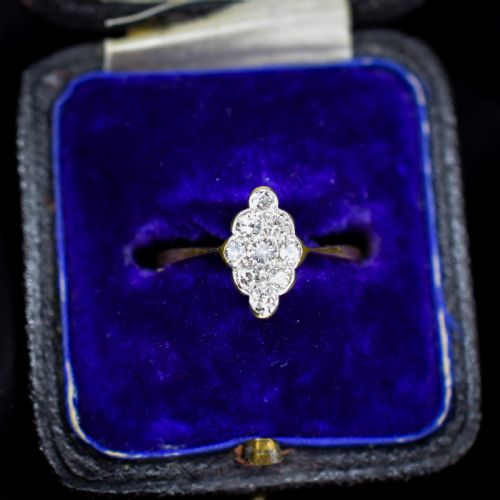
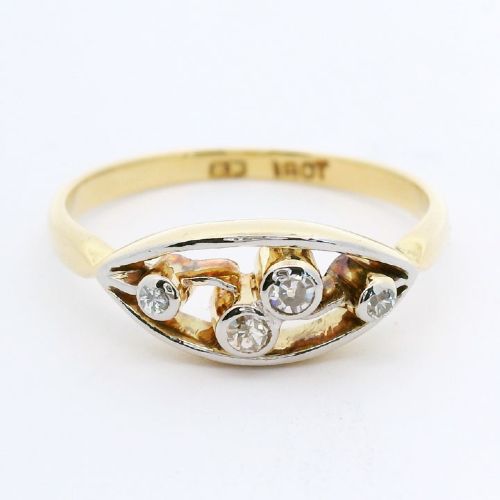
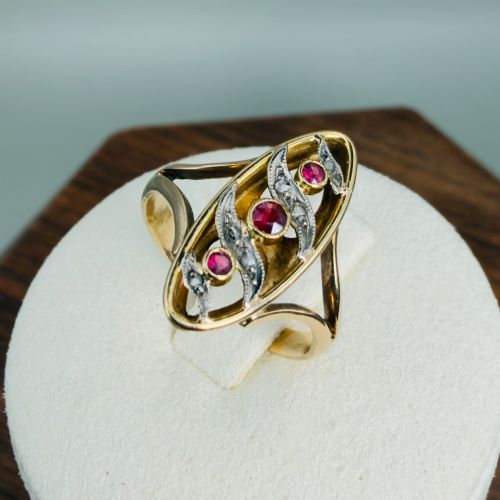
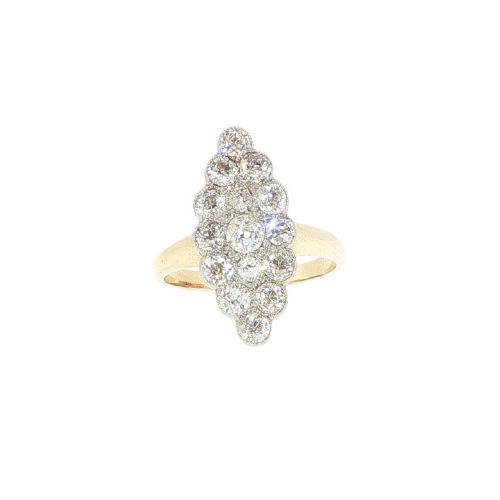

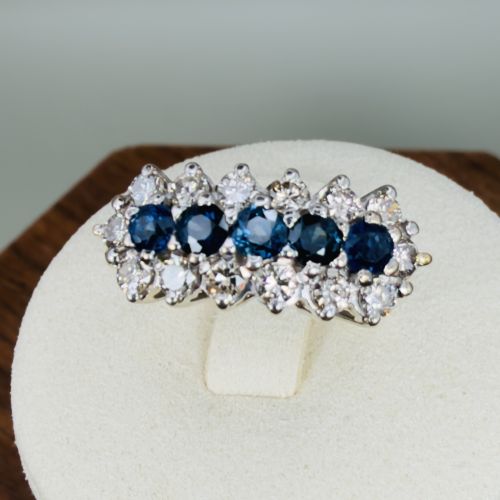
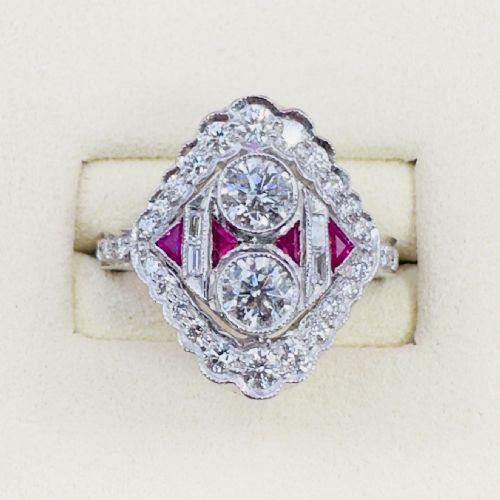
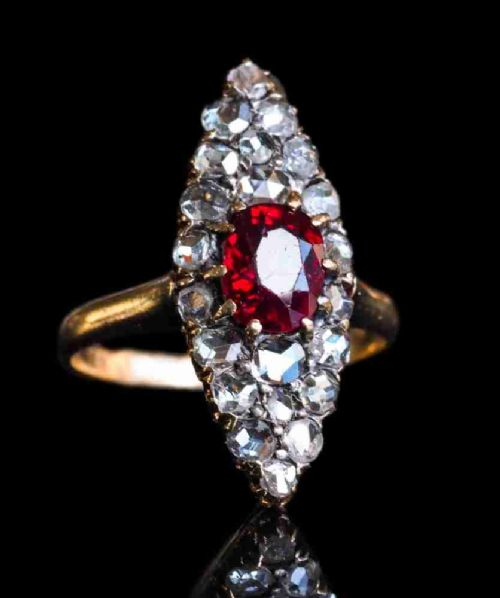


Navette Diamond Ring
A navette diamond ring draws the eye with its elongated boat shape, designed to sit gracefully along the finger.
How They Were Made
Goldsmiths utilised 18ct gold and platinum, often combining yellow gold shanks with platinum-topped settings to keep diamond sparkle bright against a white metal background. Silver also appears on early Victorian pieces alongside gold backs.
Stone-cutting methods evolved from rose cuts and old mine cuts in the nineteenth century to old transitional cuts and step cuts by the Art Deco period, secured with claw or bezel settings.
What Varies in Quality
The harmony of the navette silhouette depends on the symmetry of the pointed ends and the uniformity of the cluster work. Master jewellers balanced stone sizes precisely so that central diamonds or rubies sat seamlessly within the outer border.
Hand-finishing details, such as delicate millegrain edges and pierced gallery work, elevate finer Edwardian and Art Deco examples above standard production pieces.
Listings include pieces set in platinum, yellow gold, white gold and silver, spanning Victorian, Edwardian, Art Deco and mid-century periods.
The Navette Diamond Ring Glossary
- Navette
- French for little boat, describing the pointed, elongated oval shape of the ring face.
- Marquise
- An alternative term for the boat-shaped or navette silhouette used across Victorian and Art Deco periods.
- Old cut
- A hand-faceted diamond cut common in Victorian and Edwardian jewellery, featuring a small table and high crown.
- Millegrain
- A decorative technique creating a fine border of tiny raised metal beads along the edges of a setting.
- Cluster
- An arrangement where a central gemstone is surrounded by a group of smaller stones.
Navette Diamond Ring: Frequently Asked Questions
How do I wear a navette diamond ring?
The elongated boat shape sits lengthwise along the finger, creating a striking profile that lengthens the hand.
Because of their distinct length, these rings often stand alone on the hand without needing wedding or eternity bands stacked beside them.
What periods do these rings come from?
The selection spans the Victorian, Edwardian, Art Deco and mid-century eras, with pieces dating from the mid-nineteenth century through to the 1960s.
Victorian examples often pair yellow gold with pearls or rubies, while Edwardian and Art Deco versions favour platinum settings and geometric diamond clusters.
What gemstones accompany the diamonds?
Rubies, sapphires, emeralds and natural pearls frequently share the cluster settings alongside the central diamonds.
Coloured gemstones provide strong contrast against the white metal and diamond borders, a popular design choice throughout the late nineteenth and early twentieth centuries.
Are these rings handmade?
Victorian, Edwardian and Art Deco pieces were constructed by hand using period cutting styles like old mine cuts and rose cuts.
Master jewellers individually shaped the platinum or gold galleries to support the complex multi-stone layouts characteristic of the style.